
Key takeaways
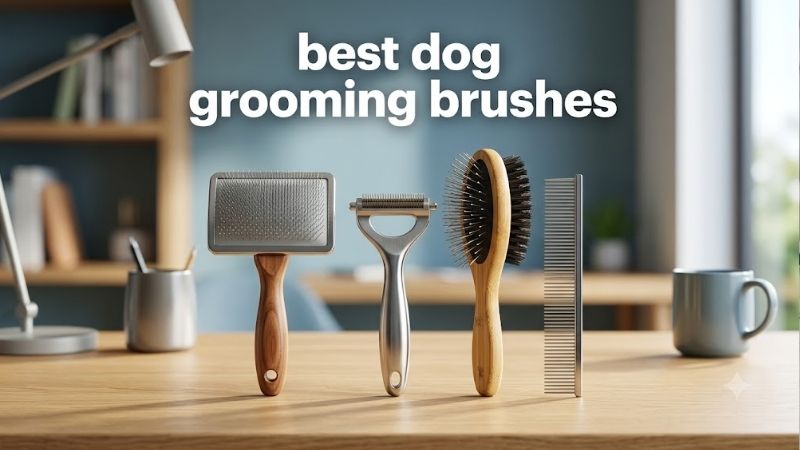
Best dog grooming brushes are not a ranking so much as a set of six different jobs. A slicker, a pin brush, a bristle brush, a rake, a rubber curry and a steel comb each do something the others cannot, and matching them to your dog’s coat matters far more than brand.
Our top picks
 Docrok Pet Grooming Combo
- Product Group: Pet Products
- Binding: Health and Beauty
 SleekEZ Dog Brush for Shedding
- Product Group: Pet Products
- Binding: Apparel
 Swihauk Self Cleaning Slicker Brush
- Product Group: Pet Products
- Binding: Misc.
| Product | Key specs | Amazon rating | |
|---|---|---|---|
| Docrok Pet Grooming Combo | Product Group: Pet Products Binding: Health and Beauty | 4.9★ | Check price |
| SleekEZ Dog Brush for Shedding | Product Group: Pet Products Binding: Apparel | 4.7★ | Check price |
| Swihauk Self Cleaning Slicker Brush | Product Group: Pet Products Binding: Misc. | 4.2★ | Check price |
 Professional 3PCS Self Cleaning Slicker Brush & Professional 3PCS Self Cleaning Slicker Brush & | – | Check price | |
 Maxpower Planet Dog Grooming Rake Maxpower Planet Dog Grooming Rake | Product Group: Pet Products Binding: Misc. | 4.0★ | Check price |
 2PCS Slicker Brush for Dogs & Pet 2PCS Slicker Brush for Dogs & Pet | 【Premium Dog Grooming Kit】Owning a professional dog slicker… 【Professional Slicker Brush for Dogs】Designed for medium-length and… 【High Quality Dog Comb】Made of high quality stainless… | 4.7★ | Check price |
 Dipoo Self Cleaning Shedding Brush Dipoo Self Cleaning Shedding Brush | 4.6★ | Check price | |
 Pat Your Pet Deshedding Dog Brush For Pat Your Pet Deshedding Dog Brush For | Product Group: Pet Products Binding: Health and Beauty | 4.4★ | Check price |
As an Amazon Associate we earn from qualifying purchases at no extra cost to you. Ratings are shown as listed on Amazon.
As an Amazon Associate we earn from qualifying purchases.
🛒 Best Price Today on Amazon
Prime members get fast, free shipping on everything above, plus member-only deals. New members get a 30-day free trial — cancel anytime.
How to Choose Between the Best Dog Grooming Brushes
The best dog grooming brushes for one dog are the wrong tools for another, and most owners own the wrong brush rather than too few. A slicker on a short-coated Labrador does very little, a bristle brush on a matted doodle does nothing at all, and an undercoat rake on a poodle-type coat is pure friction. Identify the coat first, then the tool follows.
Coat Type Decides Everything
Short single coats such as Beagles, Boxers and Staffies need a rubber curry and a bristle brush, and nothing else. There is no undercoat to rake out and no length to tangle, so the job is lifting loose surface hair and distributing skin oils along the shaft. Buying beyond that pair is wasted money, because the best dog grooming brushes for a smooth coat contain nothing designed to reach an undercoat that does not exist.
Double coats such as Huskies, Corgis and German Shepherds need an undercoat rake and a slicker, because the dense soft layer beneath the guard coat is where the shedding happens. Continuously growing coats such as Poodles and Doodles need a slicker and a steel comb, because they mat rather than shed.
Pin Type, Cushion and Coat Damage
Pin flexibility and cushion softness determine whether a brush lifts coat or breaks it. Fine flexible pins mounted in a soft cushion bend when they meet resistance; stiff pins in a hard backing dig into skin and snap hair shafts, which shows up as thinning on a long-coated breed within weeks.
Tip finish matters just as much. Rounded or polished tips glide over skin, while cut wire ends scratch. This is the single biggest difference between a professional slicker and a supermarket one, and it is why the same brush design can cost five pounds or fifty. Among the best dog grooming brushes, tip finish and cushion quality are where the money genuinely goes, and neither is possible to judge from a product photograph.
Self-Cleaning Mechanisms and Real-World Use
A brush you can clear in one press gets used daily; one you have to pick clean by hand tends to sit in a drawer. That practical difference matters more to results than any specification, because frequency is what actually keeps a coat in condition.
Handle comfort follows the same logic. A brush that hurts your hand after five minutes limits every session to five minutes, which on a large double-coated dog during a coat blow is nowhere near enough. Test grip before pin quality if you are choosing between two similar tools.
The Order to Use Them In
Work from coarse to fine. Rake or de-tangle first, then brush with a slicker or pin brush, then check with a steel comb, then finish with a bristle brush if the coat has any length. Reversing that order means brushing over tangles you then have to go back for.
Brush before bathing, never after a mat has got wet. Water tightens a mat considerably, so a dog bathed while tangled comes out with felt rather than coat. The best dog grooming brushes cannot fix a mat that has been through a wash cycle.
Top Picks: 6 Brush Types Every Kit Should Cover
The best dog grooming brushes for any household are the two or three that match its coat, so what follows is one representative of each category, chosen for build quality rather than price. Almost no household needs all six, but every household needs to know which two or three apply to its dog.
| Tool | Type | Suits | Job |
|---|---|---|---|
| Chris Christensen Oval Pin Brush | Pin brush | Long coats | Daily brushing without breakage |
| Hertzko Self-Cleaning Slicker | Slicker | Most coats | Loose hair and light tangles |
| Coastal Safari Undercoat Rake | Rake | Double coats | Undercoat removal |
| KONG ZoomGroom | Rubber curry | Short coats | Bath work, surface hair |
| Coastal Safari Bristle Brush | Bristle | Short and smooth coats | Finishing, oil distribution |
| Andis Steel Pet Comb | Comb | All coats | Checking your work |
Chris Christensen Oval Pin Brush
The daily brush for long-coated breeds where preserving length actually matters. Polished pins set in a flexible cushion move through coat without snapping the shaft, which is the difference between a coat that grows and one that stays permanently at the same length.
It is expensive relative to a supermarket pin brush, and it is the wrong tool for anything short-coated, where it simply skates over the surface. It also lifts rather than strips, so it does nothing meaningful during a double-coated dog’s seasonal shed.
Hertzko Self-Cleaning Slicker Brush
The most broadly useful single brush for most households. Fine angled bristles lift loose hair and surface tangles across almost every coat type, and the retracting pin mechanism means clearing it takes one press rather than two minutes of picking.
The bristles are stiffer than premium slickers, so pressure has to be light on fine-coated or thin-skinned dogs, and scratching is a genuine risk if you lean on it. On a dense double coat it lifts rather than strips, so it supports a rake instead of replacing one.
Coastal Safari Undercoat Rake
The tool that does the actual work on a shedding double coat. Tapered rounded pins reach beneath the guard coat and pull loose undercoat out without any cutting edge, which makes it safe for frequent use in a way blade-edged deshedders are not.
It is slow compared with a blade-edged tool and needs several passes over the same area during a heavy shed. Pins bend if you force the rake through a tangle rather than working it loose, and it is entirely the wrong tool for a poodle-type coat.
KONG ZoomGroom
A soft rubber curry that works wet or dry, and the single best tool for short-coated dogs. Massaged through a shampooed coat it loosens a surprising quantity of hair before the dog is dry, and used dry it lifts surface shed while feeling like being stroked.
It reaches no depth at all, so on a double coat it manages surface hair rather than undercoat. Hair also clings to the rubber and needs peeling off repeatedly during a session, which is messier indoors than a tool with a collection surface.
Coastal Safari Bristle Brush
The finishing brush, and the most overlooked of the six. Natural or firm synthetic bristles distribute skin oils along the hair shaft, which is what produces shine on a smooth coat, and it lifts the fine surface hair that other brushes leave behind.
It removes very little coat and does nothing about tangles or undercoat, so anyone buying it as their only brush will be disappointed. On a thick double coat the bristles cannot penetrate at all, making it useful only on the outer surface.
Andis Steel Pet Comb
Not a brush, and the tool that tells you whether the brushes worked. Fine teeth at one end confirm you have reached the skin rather than tidied the surface; coarse teeth at the other work through light tangles behind the ears and in the armpits.
It is slow and frustrating if used as a primary tool, and steel teeth catch painfully if you drag rather than working in short sections. Its value is diagnostic, which is why it belongs at the end of every session rather than the start.
Frequently Asked Questions
These four cover what owners ask when facing a wall of brushes and no clear idea which of the best dog grooming brushes their dog actually needs.
How Many Brushes Do I Actually Need?
Two or three. A short-coated dog needs a rubber curry and a bristle brush; a double-coated dog needs a rake and a slicker; a continuously coated dog needs a slicker and a steel comb. Every household benefits from the comb regardless of coat type.
Why Does My Brush Not Seem to Do Anything?
Usually because it is the wrong category for the coat. A bristle brush on a thick double coat cannot reach past the guard hairs, and a slicker on a smooth-coated dog has almost nothing to lift. Matching the tool type to the coat solves this more often than buying a better version.
How Often Should I Brush?
Weekly for short coats, several times a week for double coats and daily during a coat blow, and every day or two for continuously growing coats that mat. Short frequent sessions beat long occasional ones for both results and the dog’s willingness to cooperate.
Should I Brush Before or After a Bath?
Before, always. Water tightens existing tangles into felt, so any mat that goes into a bath comes out considerably worse. Brush and comb through to the skin first, bathe, dry fully, then brush again to finish.
See More:
- Best way to get rid of dog hair in car
- Best vacuum for hard floors and dog hair
- Best dog clippers for golden doodle
- Best small dog nail clipper
- Best dog clippers for yorkies
Final Thoughts
The best dog grooming brushes for your dog are the two or three that match its coat type, used in the right order from coarse to fine and finished with a steel comb to check the work. Build quality matters most in the slicker, since that is where cheap pins do real damage, and everything else can be modest without affecting the result.




Write Your Review
No reviews yet. Be the first to share your experience!