
Key takeaways
- Pins that arrive bent, uneven, rusty, or visibly sharp.
- Coated tips that are cracked, missing, or loosely attached straight out of the package.
- No stated head dimensions or indication of whether the pins are short, regular, or extra long.
- A handle-to-head joint that flexes, rattles, or shows gaps.
- Claims that the brush can safely remove severe mats without discomfort.
- Extremely dense pins marketed for every coat type, including short and sensitive coats.
- Brushes that feel heavy for their size; anything over about 8 ounces may become tiring for routine use unless you specifically need a large professional model.
Shoppers often buy a slicker brush by looking only at the head size or whether the tips are coated. That misses the details that determine whether the brush gently lifts loose coat or scratches the skin, bends its pins, and gets abandoned in a drawer. Pin length, gauge, tip finish, pad flexibility, and head shape all matter—and the right combination depends on coat type more than dog size alone.
A small dog with a dense, curly coat may need longer pins than a large short-haired dog. Likewise, a coated-tip brush is not automatically gentler if the pins are too stiff, too tightly packed, or used with excessive pressure. In 2026, the best buying approach is still straightforward: match the pins to the coat, choose construction that will hold up to regular cleaning, and avoid paying premium pricing for cosmetic features that do not improve grooming.
Our top picks


As an Amazon Associate we earn from qualifying purchases at no extra cost to you. Ratings are shown as listed on Amazon.
Decide These 3 Things First
- Coat length and density: For short, smooth coats, look for pins roughly 0.35 to 0.5 inch long. Medium or double coats usually need 0.5- to 0.75-inch pins. Long, thick, curly, or heavily coated breeds often benefit from pins measuring 0.75 to 1 inch, provided the brush is used carefully.
- Whether you need everyday brushing or dematting support: A soft, flexible slicker is ideal for frequent maintenance and finishing work. For lifting shedding undercoat or working through small tangles, choose firmer pins and a slightly denser pin field. A slicker brush should not be your only tool for tight mats; use a detangling comb or seek professional help for mats close to the skin.
- Your dog’s tolerance for brushing: Puppies, senior dogs, thin-coated dogs, and dogs with sensitive skin generally do best with fine, rounded, flexible pins. A dog with a resilient double coat may tolerate a firmer stainless-steel pin brush, but even then, technique matters: use short strokes and avoid pressing the pad into the skin.
Pin Size, Length, and Density
Pin specifications are the first thing to evaluate because they determine how deeply the brush reaches and how much resistance it creates. The term “slicker brush” describes a broad category, so two brushes with the same 4-inch-wide head can perform very differently.
For most household grooming, pin length is more useful than marketing phrases such as “extra long” or “professional grade.” Pins from 0.35 to 0.5 inch are suitable for short coats and light surface brushing. Pins from 0.5 to 0.75 inch are the versatile middle ground for many medium-length and double-coated coats. Brushes with 0.75- to 1-inch pins can reach deeper into thick coats, including poodle mixes, doodles, collies, and long-coated cats, but they require a lighter hand.
Pin density is equally important. Closely spaced pins collect more loose undercoat and can separate fine hair efficiently, but they can snag if used on an unprepared, tangled coat. Wider spacing is more forgiving for casual maintenance, especially on coats that are short, delicate, or prone to discomfort. As a general guide, a compact head may have 500 to 900 pins, while larger rectangular heads can have 1,000 or more. Manufacturers do not always publish counts, so inspect product photos for visibly uniform spacing rather than relying on claims alone.
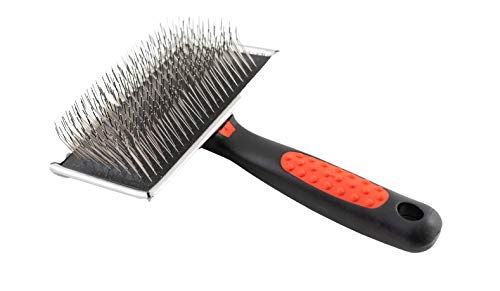
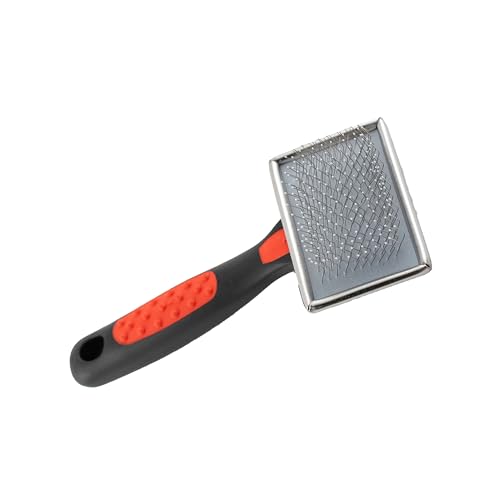
Head dimensions should match the grooming area. A mini brush head around 1.5 by 2 inches is useful around the face, legs, paws, and ears. A regular head in the 2.5-by-3.5-inch range suits many small and medium dogs. Large heads around 3.5 by 5 inches cover broad backs and sides more quickly, though they are less maneuverable in tight areas.
Pin Material and Tip Finish
Stainless steel is the standard pin material worth seeking out. It resists rust better than plain steel, is easy to wipe clean, and generally maintains its shape through routine use. A brush does not need exotic metals to work well; what matters is that pins are straight, consistently set, and securely anchored.
Fine stainless-steel pins are typically the best choice for coat penetration with minimal bulk. Thick pins can be useful in a heavy coat, but excessively thick pins may feel harsh and can pull rather than separate hair. Avoid brushes with visibly uneven pin thickness, sharp-looking ends, or pins that lean in different directions when new.
Coated tips deserve a practical, not automatic, recommendation. Plastic-coated or ball-tipped pins can feel gentler on sensitive skin and are especially useful for light maintenance brushing. However, coating can wear, crack, or fall off over time. Once a coating is damaged, the exposed tip may become rough. Check the brush every few uses and replace it if multiple tips are missing or if the pins feel scratchy against the inside of your wrist.
Uncoated polished pins are common on professional-style slickers. They can be safe when the tips are properly finished and the user applies light pressure. These are often more effective for fluffing and lifting dense coats, but they are not a shortcut for aggressive brushing. If your pet objects to brushing, switch to a softer tool rather than pressing harder.
Pad Construction and Pin Security
The pin pad—the cushioned section holding the pins—has a major effect on comfort and durability. A flexible pad lets pins give slightly as they encounter resistance, reducing the chance of scratching skin or snapping pins. This is a strong choice for routine at-home grooming, puppies, and sensitive pets.
Firmer pads provide more direct control and may work more efficiently through dense undercoat. They are commonly found on brushes intended for professional or frequent use. The trade-off is less forgiveness: a firm pad requires short, controlled strokes and should never be pushed flat against the body.
Look for pins that enter the pad evenly and stand at a consistent angle. A few slightly angled pins are normal on curved-head designs, but loose, sunken, or spinning pins are not. On a new brush, lightly run your fingers across the pin field without pressing down. The pins should flex together and return to position; they should not wobble independently or feel as if they might pull out.
Curved slicker heads can improve contact across rounded areas such as the rib cage and hindquarters. Flat heads are easier to control on legs, tails, and smaller bodies. A curved brush is not inherently better, but it can cover more coat per pass when its curve matches the pet’s body rather than forcing the user to angle the handle awkwardly.
Handle Comfort and Grooming Performance
A slicker brush may weigh only 3 to 8 ounces, but repetitive grooming can strain the hand quickly. Look for a handle at least 4.5 inches long for adult hands, with a non-slip grip area around 1 to 1.5 inches wide. Rubberized inserts can improve grip when hands are damp, while smooth plastic handles are easier to sanitize.
An ergonomic handle should reduce wrist bending rather than simply add bulky padding. Test the shape mentally against the way you groom: if the handle is very short, narrow, or sharply squared off, it may become uncomfortable during a 15- to 30-minute brushing session. This matters most for thick-coated pets that need line brushing, where the coat is worked in small sections from the ends toward the roots.
Brush performance also depends on balance. A very large head on a light, narrow handle can feel top-heavy. Conversely, a heavily padded handle may make a small brush feel clumsy around feet and facial furnishings. For most homes, a regular slicker head paired with a 5- to 6-inch handle is the easiest all-purpose format.
Examples of the category range include compact coated-tip flat slickers for detail work, such as the Paw Brothers Soft Flat Slicker Brush in mini/small sizing, and larger curved models designed for wider coverage. The Millers Forge universal curved slicker represents the basic stainless-pin style, while extra-long-pin professional brushes are better suited to thick coats when used by someone comfortable with grooming technique.
Price Tiers and What You Actually Get
Budget: $8 to $12. Expect a basic plastic handle, stainless pins, and a small to regular head. This tier can be an excellent value for a short-coated pet or occasional grooming. Inspect pin alignment carefully, because lower-priced brushes are more likely to have inconsistent finishing or less durable pads. The under-$10 range is realistic for a simple regular curved slicker.
Mid-range: $13 to $20. This is the sweet spot for most buyers. Brushes in this range often add better grips, more uniform pin fields, curved heads, coated tips, or purpose-specific pin lengths. The example prices of under $20, under $20, and under $20 fall around this practical everyday-grooming range.
Premium: $21 to $35 or more. Higher prices should buy meaningful improvements: stronger pin retention, refined handle ergonomics, specialized extra-long pins, replaceable components, or a manufacturer reputation for professional use. Do not pay extra solely for bright colors, oversized packaging, or vague “spa-quality” language.
For most pet owners, spending $14 to $20 on one correctly selected brush is better than buying a $30 heavy-duty slicker that is too harsh for the pet’s coat. If you have multiple pets with different coat types, two targeted brushes may be more useful than one expensive all-purpose model.
Warranty, Replacement, and Care
Slicker brushes are simple tools, so warranties tend to be limited. A 30-day return window is useful for checking comfort, pin quality, and head size. A 1-year limited warranty is a positive sign, particularly if it covers handle or pad defects, but it should not be the deciding factor for a brush under $20.
More important is whether the brand provides clear care instructions and responsive replacement support. Pins gradually bend with use, especially on dense coats. Replace the brush when roughly 10% of the pins are visibly bent, when the pad cracks, when tips become rough, or when pins loosen. With weekly use and proper cleaning, a well-made slicker often lasts 1 to 3 years.
After each session, remove trapped hair. Wipe the pins with a damp cloth and mild soap as needed, then dry thoroughly with the head facing down so moisture does not sit at the pin bases. Never soak a brush with a cushioned pad for long periods, as trapped water can degrade the backing and adhesive.
Delivery and Assembly
Most slicker brushes arrive fully assembled and require no setup beyond removing a protective sleeve or packaging. Delivery considerations are simple but still worth checking: a brush with a 4- to 6-inch-wide head can arrive in a box larger than expected, while mini brushes often ship in padded mailers.
Inspect the brush immediately after delivery. Check for bent pins caused by transit, cracks around the handle joint, and any detached tip coatings. Keep the packaging until you have tested the brush on a small section of coat. A new brush should glide through clean, detangled hair with light resistance—not catch, squeak, or leave the skin pink.
Spec Checklist
| Spec | Budget | Mid | Premium |
|---|---|---|---|
| Typical price | $8–$12 | $13–$20 | $21–$35+ |
| Pin material | Basic stainless steel | Uniform stainless steel; optional coated tips | Refined stainless pins with specialized length or finish |
| Pin length | 0.35–0.6 in. | 0.5–0.75 in. | 0.75–1 in. for specialty coat needs |
| Head size | 1.5 × 2 to 2.5 × 3.5 in. | 2.5 × 3.5 to 3.5 × 5 in. | Specialty mini, large, or curved profiles |
| Pad | Basic flexible rubber or cushion | Consistent flexible or firm pad | Durable, purpose-tuned pad construction |
| Handle | Plastic, 4–5 in. | Textured ergonomic grip, 5–6 in. | Enhanced ergonomic or professional-style grip |
| Best for | Occasional maintenance | Regular home grooming | Dense, long, or specialty coats |
Red Flags
- Pins that arrive bent, uneven, rusty, or visibly sharp.
- Coated tips that are cracked, missing, or loosely attached straight out of the package.
- No stated head dimensions or indication of whether the pins are short, regular, or extra long.
- A handle-to-head joint that flexes, rattles, or shows gaps.
- Claims that the brush can safely remove severe mats without discomfort.
- Extremely dense pins marketed for every coat type, including short and sensitive coats.
- Brushes that feel heavy for their size; anything over about 8 ounces may become tiring for routine use unless you specifically need a large professional model.
FAQ
Are coated slicker brush pins better than uncoated pins?
Not universally. Coated pins can be gentler for sensitive pets and light maintenance brushing, but the coating can wear away. Well-finished uncoated stainless pins are often preferred for thicker coats because they move through hair efficiently. Choose based on coat density, skin sensitivity, and your grooming technique.
How long should slicker brush pins be?
Choose approximately 0.35 to 0.5 inch for short coats, 0.5 to 0.75 inch for many medium and double coats, and 0.75 to 1 inch for dense or long coats. Longer pins are not automatically better; they can be too intense for thin coats or sensitive skin.
Can a slicker brush damage a dog’s skin?
Yes, if used with too much pressure, on matted hair, or with damaged pins. Use light, short strokes and brush a small area at a time. Stop if the skin becomes pink, the pet flinches, or the brush catches repeatedly. Do not use a slicker over irritated skin, sores, or heavy mats.
When should I replace a slicker brush?
Replace it when pins are bent across a noticeable portion of the head, tips feel rough, the cushion cracks, or pins loosen from the pad. For a brush used once or twice weekly, replacement is commonly needed every 1 to 3 years, depending on coat density and care.


Write Your Review
No reviews yet. Be the first to share your experience!