
Key takeaways
- Choosing the widest rake available: XL heads save time on the back but are clumsy around the legs, neck, and tail.
- Choosing teeth that are too short: Teeth under 0.5 inch may remove surface fur without reaching a thick Husky undercoat.
- Choosing teeth that are too long: Teeth over 1.5 inches can feel harsh and may snag instead of gliding through loose hair.
- Confusing a rake with a slicker brush: A rake is designed to reach undercoat; it is not automatically suitable for detangling every mat.
- Ignoring tooth spacing: Very tight spacing can clog quickly in a dense coat, while wide spacing may miss fine undercoat.
- Using pressure to compensate for the wrong size: If the rake does not glide, stop and change the tool or technique rather than pressing harder.
The Short Answer
For most adult Huskies, choose an undercoat rake with a 4- to 5-inch head (10 to 13 cm), teeth or pins measuring 0.75 to 1.25 inches long (1.9 to 3.2 cm), and a handle measuring about 5 to 7 inches (13 to 18 cm). A double-row rake can remove loose undercoat efficiently, while a single-row rake is often easier to control around the legs, neck, and tail.
The best size depends on your Husky’s coat density, body size, and the area you are grooming. A wide rake covers the back and sides quickly, but a smaller head is safer and more practical for narrow areas. Avoid choosing an extra-long or very aggressive rake simply because your dog sheds heavily. The teeth should reach through the loose undercoat without scraping the skin or tugging firmly on healthy, attached hair.
Our top picks
 Maxpower Planet Dog Grooming Rake
- Product Group: Pet Products
- Binding: Misc.
 DOGI Deshedding Brush
- Product Group: Pet Products
- Binding: Health and Beauty
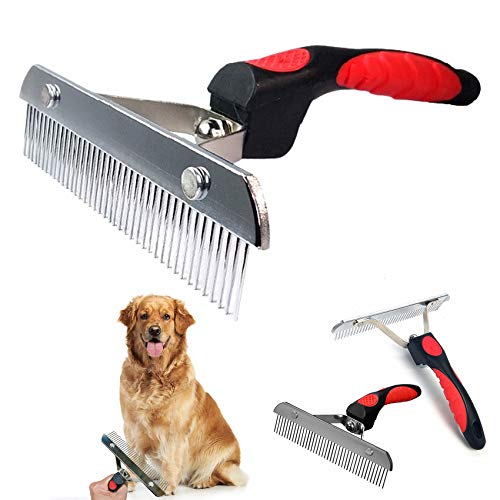 Dog Brushes for Grooming Large Dogs
- Product Group: Pet Products
- Binding: Health and Beauty
| Product | Key specs | Amazon rating | |
|---|---|---|---|
| Maxpower Planet Dog Grooming Rake | Product Group: Pet Products Binding: Misc. | 4.0★ | Check price |
| DOGI Deshedding Brush | Product Group: Pet Products Binding: Health and Beauty | 4.0★ | Check price |
| Dog Brushes for Grooming Large Dogs | Product Group: Pet Products Binding: Health and Beauty | 4.7★ | Check price |
 XL+ Undercoat Rake for Dogs & Cats XL+ Undercoat Rake for Dogs & Cats | – | Check price |
As an Amazon Associate we earn from qualifying purchases at no extra cost to you. Ratings are shown as listed on Amazon.
As a general buying range, expect to pay about $9 to $18 for a basic undercoat rake and approximately $25 to $35 for an extra-large or more substantial model. Examples in this category include the Maxpower Planet rake at about $15, the DOGI double-row brush at about $10, a large-dog steel comb around $15, and an XL+ rake near under $40. Prices can vary by seller and size.
Standard Sizes
Undercoat rakes are usually sized by their working head rather than by the overall tool length. Measure the metal section that contacts the coat, including the distance covered by the teeth. For a full-grown Siberian Husky, a medium or large rake is usually the most versatile choice.
| Rake size | Head width | Pin or tooth length | Overall length | Best use |
|---|---|---|---|---|
| Small | 2.5 to 3.5 in (6.4 to 8.9 cm) | 0.5 to 0.75 in (1.3 to 1.9 cm) | 7 to 9 in (17.8 to 22.9 cm) | Face, legs, paws, puppies, and small dogs |
| Medium | 3.5 to 4.5 in (8.9 to 11.4 cm) | 0.75 to 1 in (1.9 to 2.5 cm) | 8 to 11 in (20.3 to 27.9 cm) | Most adult Huskies and routine grooming |
| Large | 4.5 to 5.5 in (11.4 to 14 cm) | 1 to 1.25 in (2.5 to 3.2 cm) | 9 to 12 in (22.9 to 30.5 cm) | Broad backs, flanks, and heavy seasonal shedding |
| XL | 5.5 to 6.5 in (14 to 16.5 cm) | 1.25 to 1.5 in (3.2 to 3.8 cm) | 10 to 14 in (25.4 to 35.6 cm) | Very large dogs or experienced groomers |
For a typical adult Husky, start with a medium or large rake. A head around 4.5 inches wide and 1 inch deep offers a useful balance between coverage and control. Pin spacing also matters. Closely spaced teeth collect fine, loose undercoat, while wider spacing is less likely to clog with thick fur and may move more comfortably through a dense coat.
Look for rounded or polished tooth tips, a nonslip handle, and a head that does not flex excessively. A tool weighing roughly 3 to 8 ounces (85 to 227 grams) is generally comfortable for home grooming. Heavier metal tools may feel durable but can cause hand fatigue during a long deshedding session.
How to Measure Your Space
Although an undercoat rake is not a furniture item, “space” matters in two ways: the dog’s body area and the room where grooming will take place. Use these steps to choose a practical size.
- Measure the widest coat area. Place a tape measure across your Husky’s back, from one side of the coat to the other. Most adult Huskies have enough room for a 4- to 5-inch head, but a narrower dog may be more comfortable with a 3.5- to 4-inch rake.
- Check the coat depth. Lift the guard hairs and estimate the distance from the outer coat to the skin. The teeth should reach the loose undercoat, not press forcefully against the skin. For many Huskies, teeth around 0.75 to 1.25 inches are sufficient.
- Measure narrow areas separately. The neck, legs, belly, and base of the tail need more control than the back. If the main rake feels too wide, use a second 2.5- to 3.5-inch tool for these areas.
- Allow room for your grip. Measure from the center of your palm to the end of your fingers. Select a handle that allows a relaxed grip, generally 5 to 7 inches long. An oversized handle can make short strokes awkward.
- Plan the grooming area. Leave at least 2 feet (61 cm) of working space on each side of the dog. A 4-by-6-foot (1.2-by-1.8-meter) washable mat is large enough for many home sessions and helps collect loose hair.
- Test the stroke. On a small section of the shoulder, draw the rake in the direction of hair growth with light pressure. If it catches, scratches, or pulls healthy topcoat, choose shorter teeth, wider spacing, or a smaller head.
By Room or Use Case
For routine bathroom or laundry-room grooming
A medium rake with a 3.5- to 4.5-inch head is easy to maneuver in a compact room. Choose a rubberized handle and a tool under about 8 ounces if you expect to groom for 15 to 30 minutes. Keep the rake dry between uses, especially when it has stainless steel pins joined to a metal head.
For a mudroom or covered porch
A large 4.5- to 5.5-inch rake is useful when you have more room to stand beside the dog and sweep long sections of the back and sides. This size reduces the number of passes across a large coat. It is particularly practical during seasonal shedding, when loose fur may come out in substantial amounts.
For a small apartment or indoor living area
Choose a medium rake with rounded teeth rather than an XL model. A compact 3.5- to 4.5-inch head offers better control around furniture and doorways. Groom over a washable mat or sheet, and avoid tools with very long teeth if your Husky is restless; shorter, controlled strokes are easier to manage in a tight space.
For sensitive areas
Use a small 2.5- to 3.5-inch rake around the chest, hindquarters, legs, and tail. These areas have curves and thinner skin, so a narrow head and shorter 0.5- to 0.75-inch teeth provide better precision. Do not use a rake over irritated skin, scabs, hot spots, or visible mats that resist gentle removal.
For a puppy or smaller Husky-type dog
A small or medium rake is preferable until the dog’s adult coat develops. The tool should be light enough for short sessions and narrow enough to avoid dragging across the puppy’s body. Introduce the rake gradually, using a few gentle strokes followed by a break or reward.
Common Sizing Mistakes
- Choosing the widest rake available: XL heads save time on the back but are clumsy around the legs, neck, and tail.
- Choosing teeth that are too short: Teeth under 0.5 inch may remove surface fur without reaching a thick Husky undercoat.
- Choosing teeth that are too long: Teeth over 1.5 inches can feel harsh and may snag instead of gliding through loose hair.
- Confusing a rake with a slicker brush: A rake is designed to reach undercoat; it is not automatically suitable for detangling every mat.
- Ignoring tooth spacing: Very tight spacing can clog quickly in a dense coat, while wide spacing may miss fine undercoat.
- Using pressure to compensate for the wrong size: If the rake does not glide, stop and change the tool or technique rather than pressing harder.
FAQ
Is a 4-inch undercoat rake big enough for a Husky?
Yes. A 4-inch head is large enough for routine grooming on most adult Huskies and is easier to control than an extra-wide model. If your dog is especially large or has a very dense coat, a 4.5- to 5.5-inch rake may cover the back more efficiently.
How long should Husky undercoat rake teeth be?
Start with teeth measuring about 0.75 to 1.25 inches long. That range commonly reaches a Husky’s loose undercoat without requiring heavy pressure. Shorter teeth can work on puppies and sensitive areas, while longer teeth should be used cautiously and only if they glide comfortably.
Should I buy a single-row or double-row rake?
A double-row rake can collect more loose fur per pass, which is useful during seasonal shedding. A single-row rake often provides more control and may be easier to clean. Whichever style you choose, rounded tips and gentle handling matter more than the number of rows.
Can I use an XL rake on every part of my Husky?
It is better to reserve an XL rake for broad areas such as the back and sides. Use a smaller tool around the face, legs, belly, neck, and tail. This two-size approach gives you efficient coverage without sacrificing control in sensitive or curved areas.




Write Your Review
No reviews yet. Be the first to share your experience!