
Key takeaways
Best long hair dog brush is a question with five answers, because pin brushes, slickers, combs, rakes and bristle brushes each do a different job on a long coat. This roundup explains what each type actually does, then compares one worthwhile example from every one of the categories.
Our top picks
 Maxpower Planet Dog Grooming Rake
- Product Group: Pet Products
- Binding: Misc.
 Swihauk Self Cleaning Slicker Brush
- Product Group: Pet Products
- Binding: Misc.
| Product | Key specs | Amazon rating | |
|---|---|---|---|
| Maxpower Planet Dog Grooming Rake | Product Group: Pet Products Binding: Misc. | 4.0★ | Check price |
 Professional 3PCS Self Cleaning Slicker Brush & Professional 3PCS Self Cleaning Slicker Brush & | – | Check price | |
| Swihauk Self Cleaning Slicker Brush | Product Group: Pet Products Binding: Misc. | 4.2★ | Check price |
 Paw Brothers Professional Grade Extra Long Slicker Paw Brothers Professional Grade Extra Long Slicker | – | Check price | |
 Docrok Pet Grooming Combo Docrok Pet Grooming Combo | Product Group: Pet Products Binding: Health and Beauty | 4.9★ | Check price |
 BioSilk for Pets Eco Friendly Detangling Pin BioSilk for Pets Eco Friendly Detangling Pin | – | Check price | |
 2PCS Slicker Brush for Dogs & Pet 2PCS Slicker Brush for Dogs & Pet | 【Premium Dog Grooming Kit】Owning a professional dog slicker… 【Professional Slicker Brush for Dogs】Designed for medium-length and… 【High Quality Dog Comb】Made of high quality stainless… | 4.7★ | Check price |
 Dog Brush for Long Haired Dogs Dog Brush for Long Haired Dogs | – | Check price |
As an Amazon Associate we earn from qualifying purchases at no extra cost to you. Ratings are shown as listed on Amazon.
As an Amazon Associate we earn from qualifying purchases.
🛒 Best Price Today on Amazon
Prime members get fast, free shipping on everything above, plus member-only deals. New members get a 30-day free trial — cancel anytime.
What the Best Long Hair Dog Brush Does Depends on the Type
Brushes are sold as if they were interchangeable, and on a long coat they emphatically are not. Each type moves hair in a different way, and buying a second brush of the same category is the most common reason owners end up with a drawer of tools and a still-matted dog.
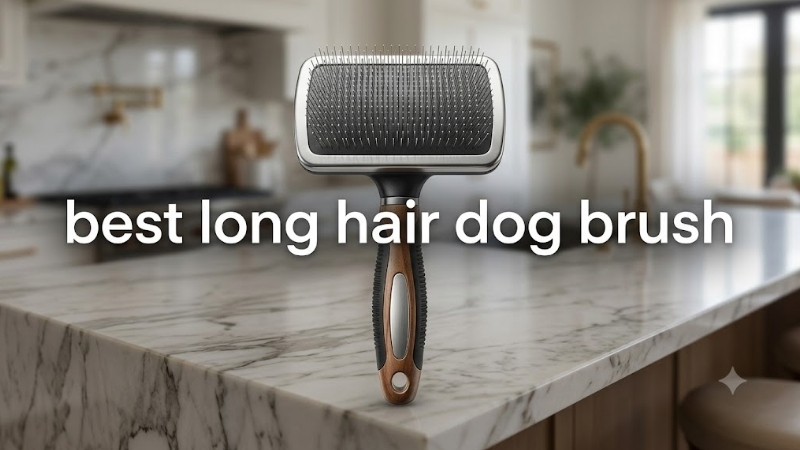
Pin Brushes and What They Are For
A pin brush has widely spaced pins, often ball-tipped, set into a cushioned pad. It lifts and separates long hair without stripping it, which keeps the coat looking full, and it is the gentlest option for a dog that dislikes the scratchy sensation of a slicker on its skin.
What it will not do is clear undercoat or open a genuine tangle. Pins pass over both, so a pin brush works as the finishing step after something more assertive has done the removal, and it is what groomers reach for immediately before any scissoring begins on a long coat.
Pin quality varies enormously at similar prices. Hand-set pads with polished pins glide, while cheap moulded pads have rough pin ends that catch and snap fine hair, so running a hand over the pins before buying is a genuinely useful two-second check to make in a shop.
Long-Pin Slickers and Fine Tangles
If you own only one tool then the best long hair dog brush is almost always a slicker, since it is the single type that both removes loose hair and opens tangles before they consolidate into mats. Nothing else on this list covers both jobs.
Slickers use fine angled pins packed closely together, and on a long coat the pin length is the specification that matters. Pins around 20 to 27 millimetres reach the base of a coat carried long, while short pads simply skim the top and leave the layer near the skin untouched.
They clear fine tangles and loose hair efficiently, which makes them the workhorse of any long-coat routine. Pressure has to stay light, though, because pins pressed into skin cause the irritated pink patches known as slicker burn on the pasterns and the belly particularly.
Combs, Rakes and Dematting Blades
A steel greyhound comb with coarse and fine spacing is the checking tool, and it is the one that tells you whether the brushing worked. It also handles the fine hair behind the ears and under the eyes that a brush of any kind struggles to reach cleanly on a coat of this length.
Undercoat rakes clear packed wool from long double coats, while dematting blades cut through mats a slicker cannot open. The rake is a routine tool during coat changes; the dematting blade is an occasional one, since it removes coat rather than untangling it and thins an outline fast.
Bristle Brushes and Finishing
Nobody buys a bristle brush as the best long hair dog brush and nobody should, but it is the type most often missing from a drawer that already contains three variations of the same slicker, and it costs very little to complete the set.
Natural bristle brushes distribute skin oils along the hair shaft and smooth the outer coat, which is where the shine on a well-kept long coat actually comes from. They remove almost no loose hair, so they finish a session rather than forming any part of the removal work.
Boar bristle suits fine and silky coats best, while stiffer synthetic bristle handles coarser hair. On a heavily coated double-coated breed the bristles rarely reach past the outer layer, which makes this the least essential of the five types for those particular dogs at least.
Top Picks: One Worthwhile Example of Each Type
The best long hair dog brush for a household is usually three of these five rather than one. The list below gives a solid example from each category, and every entry names the job it does alongside a genuine limitation, so the roles stay clear rather than quietly overlapping.
| Brush | Type | Job it does | Limitation |
|---|---|---|---|
| Bass Brushes A19 Pin Brush | Pin brush | Lifting and finishing | No detangling power |
| Hertzko Self-Cleaning Slicker | Slicker | Fine tangles, loose hair | Pins shorter than ideal |
| Andis Steel Pet Comb | Greyhound comb | Checking and detail work | Removes very little hair |
| Mars Coat King Rake | Stripping rake | Thinning packed undercoat | Aggressive if overused |
| Bass Bamboo Boar Bristle | Bristle brush | Shine and oil distribution | Removes no loose hair |
Bass Brushes A19 Pin Brush
Bass makes properly set pin brushes at a sensible price, and the A19 is the one most owners of long single coats settle on. The pins are polished and evenly spaced, the bamboo handle balances well in the hand, and the cushioned pad flexes rather than pressing pins into skin.
It lifts and separates beautifully and detangles almost nothing, which is exactly what a pin brush should do. Anyone buying it hoping to clear mats will be disappointed, so it belongs at the end of a session after a slicker and a comb have already done the actual removal work.
Hertzko Self-Cleaning Slicker Brush
For everyday use this is the best long hair dog brush for most households on price alone, provided the coat is medium rather than genuinely long, and provided the pins still reach the base when you part the hair and check the section afterwards.
The retracting pad is genuinely useful on a long coat, because the volume of hair a slicker collects clogs an ordinary pad within a few sections. Press the button and the collected hair lifts away in one piece, which keeps a longer session moving rather than constantly interrupted.
Pin length is the compromise. The mechanism limits how long the pins can be, so on a coat carried genuinely long it works the outer layer while a dedicated long-pin slicker reaches the base. For medium length and for feathering it remains an excellent everyday choice regardless.
Andis Steel Pet Comb
A 7.5 inch steel comb with a coarse half and a fine half covers both checking and detail work. Coarse teeth confirm a brushed section is clear to the skin, while the fine end handles the muzzle, the area under the eyes and the sensitive skin behind the ears very cleanly.
Solid steel matters because a flexible comb flexes over a dense patch and hands you a false pass. It removes very little hair by itself, which is the correct behaviour for an audit tool, and a comb this length is unwieldy on a small breed’s face in day to day practice.
Mars Coat King Stripping Rake
For long double coats packed with undercoat, this thins the coat rather than merely raking it, and the result on a heavily coated dog is dramatic. Blade counts vary, and choosing a wider spacing for a longer coat matters more than the brand does for the finish you end up with.
It cuts, which is the entire point and also the risk. Overuse thins the outline visibly and takes months to grow back, so short passes with light pressure are essential, and it should never be used on a single-coated breed, nor anywhere near feathering on any dog at all.
Bass Bamboo Boar Bristle Brush
The finishing step that most owners skip, this distributes skin oils along the hair shaft and smooths the outer coat. On a fine silky coat the difference in shine after a minute of bristle work is genuinely visible, which is why show groomers keep one in the bag permanently.
It removes no loose hair at all and reaches nothing below the surface, so on a heavy double coat it achieves very little. Treat it as a cosmetic finish for long single coats rather than as a tool that contributes anything to the removal side of a grooming session at all.
Frequently Asked Questions
Four questions come up constantly once owners start choosing by type rather than by brand. The best long hair dog brush is usually whichever type is missing from the drawer rather than a better version of one already sitting there, which is what the four answers below are really about.
Which brush should I buy first?
A long-pin slicker and a steel comb, in that order, because between them they handle removal and checking. Everything else refines the result rather than producing it, so a pin brush or a bristle brush is a sensible second purchase rather than a first one for most people.
Do I need a pin brush and a slicker?
On a long single coat, yes, since they do opposite jobs. The slicker clears tangles and loose hair while the pin brush lifts and finishes without stripping, and using only the slicker on a coat you are growing out causes more breakage than the great majority of owners realise.
Is a self-cleaning slicker worth the extra cost?
On a long coat it saves real time, since an ordinary pad clogs within a few sections and clearing it by hand interrupts the session repeatedly. The trade-off is shorter pins, so owners of very long coats often keep both types rather than trying to choose between them.
How do I stop fine hair breaking?
Mist each section lightly with a leave-in conditioner before brushing, keep pressure light, and line brush from the skin outward rather than sweeping across the top. Dry brushing a long fine coat causes far more breakage than any particular choice of brush type does on its own.
See More:
- Dog grooming shears best
- Best dog clippers for poodles
- Best dog clippers for doodles
- Best dog brush for poodle
- Best dog brush for great pyrenees
Final Thoughts
The best long hair dog brush is whichever type does the job you are missing: a long-pin slicker for tangles, a steel comb to check the work, a pin brush to lift and finish, a rake for packed undercoat and a bristle brush for shine. Three of the five covers almost every long coat.




Write Your Review
No reviews yet. Be the first to share your experience!