
Key takeaways
Best brush for moulting cat coats has to clear a lot of dead fur without a struggle, because a cat that dislikes the tool simply leaves. Cat skin is thinner than a dog’s, so the right choice balances how much hair it removes against how gentle it feels.
Our top picks
 Aumuca Cat Brush for Shedding
- Hair Type: All
- Item Dimensions L x W x H: 4.05"L x 1.54"W x 9.64"H
- Bristle Material: Stainless Steel


 Docrok Pet Grooming Combo
- Product Group: Pet Products
- Binding: Health and Beauty

As an Amazon Associate we earn from qualifying purchases at no extra cost to you. Ratings are shown as listed on Amazon.
As an Amazon Associate we earn from qualifying purchases.
🛒 Best Price Today on Amazon
Prime members get fast, free shipping on everything above, plus member-only deals. New members get a 30-day free trial — cancel anytime.
How to Choose the Best Brush for Moulting Cat Coats
Cats groom themselves constantly, which is exactly why the best brush for moulting cat coats earns its place indoors. Every hair a cat removes with its tongue goes somewhere, and the choice of brush decides whether that fur ends up in your bin or in a hairball on the carpet.
Why Moulting Matters More With Cats
Shedding follows daylight, so most cats moult heaviest in spring and again through autumn, roughly September into November. Indoor cats living under artificial light shed more steadily all year, which is why owners often feel their cat never really stops dropping fur.
Hairballs are the practical consequence. A cat swallows the loose fur it grooms away, and the more dead coat sitting on the cat, the more ends up in the stomach, so regular brushing genuinely reduces how often you find one on the rug at six in the morning.
Long-haired cats carry the extra risk of matting. Persians, Maine Coons and ragdolls develop tangles behind the ears, in the armpits and along the back legs, and those tighten quickly once they form, which makes weekly attention far easier than monthly rescue work.
Short Hair Versus Long Hair Tools
Short-haired cats need surface tools more than deep ones. A rubber brush, a fine-toothed comb or a small deshedding tool lifts the loose coat sitting on top, and there is no dense undercoat to reach through in the way there is with a double-coated dog.
Long-haired cats need a comb in the kit, not just a brush. Only steel teeth reliably find tangles forming close to the skin, and a slicker used alone will skim the top of a mat while leaving the tight core sitting against the skin untouched.
Deshedding tools come in cat-specific sizes for good reason. A dog tool has a wider head and a more aggressive edge than a cat’s skin tolerates, so buying the version made for cats matters more here than it does with almost any other grooming purchase.
Cats That Dislike Being Brushed
Most cats tolerate grooming better than owners expect, provided the sessions stay short. Two or three minutes along the back and shoulders, ending before the cat asks to leave, builds far more tolerance than a ten-minute session that finishes with a scratch.
Rubber brushes and grooming gloves work well for the reluctant ones. The sensation is closer to stroking than brushing, which lets you remove a useful amount of fur from a cat that will not sit still for anything with metal pins anywhere near it.
Self-groomers are the last resort that genuinely helps. A wall or corner-mounted arch lets the cat rub against soft bristles on its own terms, which collects a surprising quantity of loose fur from cats that refuse to be handled at all.
Pressure, Sensitive Areas and Safety
Cat skin is thin and tears more easily than dog skin. Fine wire slicker pins and deshedding edges both need a light touch, and the belly, armpits and area around the tail base are sensitive enough that many cats will only tolerate a comb there.
Mats sitting tight against the skin are a job for a professional. Scissors near a mat are the most common cause of accidental cat injuries at home, so a groomer or vet with clippers is the safe answer, and sudden over-grooming or bald patches warrants a veterinary check.
Watch the cat’s signals rather than the clock. A tail flick, flattened ears or skin twitching along the back all mean the session should end, and respecting that is what makes the best brush for moulting cat routines sustainable through a long autumn.
Top Picks: Best Brush for Moulting Cat Households
Every option in this best brush for moulting cat lineup suits short or long coats, and cats that enjoy grooming as well as those that tolerate about ninety seconds of it. Most households want a deshedding tool and a comb, plus a rubber option for the days your cat is not in the mood.
| Tool | Type | Best for | Coat |
|---|---|---|---|
| FURminator for Cats, Short Hair | Deshedding edge | Heavy moulting | Short |
| Hertzko Self-Cleaning Slicker | Slicker | Everyday use | Both |
| Safari Cat Shedding Comb | Steel comb | Finding tangles | Long |
| KONG Cat ZoomGroom | Rubber brush | Reluctant cats | Short |
| Catit Senses 2.0 Self Groomer | Self-groomer | Cats that refuse handling | Both |
FURminator deShedding Tool for Cats, Short Hair
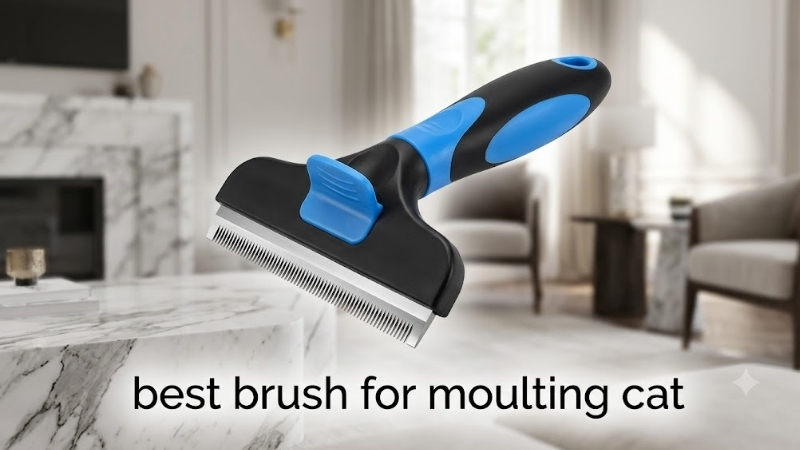
During a heavy moult this clears more fur than anything else on the list. The cat-specific stainless edge reaches loose undercoat without the width of a dog tool, and the ejector button clears collected hair so a short session keeps moving rather than stopping constantly.
It is very easy to overuse on a cat. Keep it to once or twice weekly during moulting season, use light strokes with the lie of the coat, and stop as soon as the yield drops, because further passes take healthy guard hairs and irritate thin skin quickly.
Hertzko Self-Cleaning Slicker Brush
For everyday maintenance between deshedding sessions, a slicker covers most situations. Fine angled pins collect loose surface hair and dander from both coat lengths, and the retraction button pushes the collected fur off the pad so you are not picking it out by hand.
Fine wire pins scratch if you press down, and cats notice that immediately. Hold it lightly, avoid the belly and armpits unless your cat is unusually relaxed, and check the skin afterwards on any cat prone to over-grooming a particular area.
Safari Cat Shedding Comb
A comb is the only tool that honestly tells you whether tangles are forming. Steel teeth pass through the coat and catch anything starting to knot behind the ears or in the armpits, which is exactly where long-haired cats develop mats before owners notice them.
It removes less loose hair per stroke than a deshedding tool, so it works alongside one rather than instead of it entirely. Teeth also catch painfully on established mats, so work those loose gently or hand the job to a groomer entirely.
KONG Cat ZoomGroom
Cats that object to metal often accept rubber without complaint. The soft nubs lift loose surface hair while feeling like a firm stroke, which makes it the practical choice for nervous cats, kittens learning the routine, and elderly cats with sensitive skin.
It will not remove much from a dense or long coat, so treat it as the gentle option rather than your main tool during a heavy moult. Collected hair also mats onto the rubber surface, which means pulling it clear by hand every few strokes.
Catit Senses 2.0 Self Groomer
Some cats simply will not be brushed, and this is the workaround. Mounted on a wall or corner, it lets the cat rub against soft bristles whenever it chooses, collecting loose fur passively and often becoming a favourite spot within a week or two.
Hair removal is modest compared with a proper grooming session, and it needs cleaning regularly or the cat simply stops using it. It also does nothing about mats, so long-haired cats still need combing regardless of how much they enjoy the arch.
Frequently Asked Questions
Cat owners ask the same questions each moulting season, usually about frequency, whether brushing genuinely reduces hairballs, and what to do about a cat that treats the sight of a brush as an act of war against its person.
How often should I brush a moulting cat?
Two or three times a week suits most short-haired cats, rising to daily through the weeks of a heavy moult. Long-haired cats benefit from daily combing all year, since tangles form far faster than the moult itself changes with the seasons.
Does brushing reduce hairballs?
It helps considerably in most households. Fur you remove with a brush is fur the cat cannot swallow while grooming itself, so regular sessions through moulting season usually mean fewer hairballs, though frequent vomiting or repeated hairballs is worth mentioning to your vet.
What if my cat hates being brushed?
Start with very short sessions and a rubber tool, brushing only along the back and stopping before the cat wants to leave. The best brush for moulting cat resistance is often a grooming glove or a self-groomer rather than anything with pins.
Should I cut out a mat myself?
No, and this is worth taking seriously. Scissors near a mat sitting against thin cat skin cause serious injuries every year, and the mat is usually tighter to the skin than it looks. A groomer or vet with clippers removes it safely in a couple of minutes.
See More:
- Best robot vacuum dog hair
- Best robot vacuum cleaner for dog hair
- Best robotic vacuum cleaner for dog hair
- Best dog deshedding shampoo
Final Thoughts
The best brush for moulting cat coats is the one your cat will actually sit through, which usually means a deshedding tool used sparingly, a comb for tangles, and a rubber option for difficult days. Keep sessions short, use light pressure, and increase frequency as autumn arrives.




Write Your Review
No reviews yet. Be the first to share your experience!