
Key takeaways
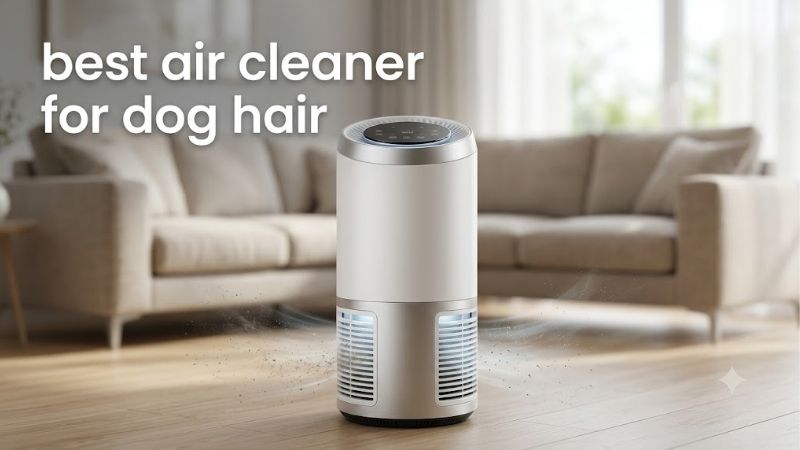
Best air cleaner for dog hair is a search driven by a mechanical problem rather than a health one. Visible fur drifts through the air and clogs intakes, and a unit designed around fine particles will choke on it within weeks. The pre-filter, not the HEPA layer, is what handles hair. Coverage and carbon volume settle the rest.
Our top picks


As an Amazon Associate we earn from qualifying purchases at no extra cost to you. Ratings are shown as listed on Amazon.
As an Amazon Associate we earn from qualifying purchases.
🛒 Best Price Today on Amazon
Prime members get fast, free shipping on everything above, plus member-only deals. New members get a 30-day free trial — cancel anytime.
How to Choose the Best Air Cleaner for Dog Hair
Airborne fur is a coarse-particle problem, which changes what matters. The best air cleaner for dog hair is judged on how easily its first filtration stage sheds hair and how quickly you can clean it, because a blocked pre-filter drags down everything behind it.
Pre-Filter Design and Access
Washable pre-filters are the single most important feature in this category. They catch visible fur before it reaches the expensive HEPA layer, and rinsing one takes two minutes. Coway’s Airmega 150 lets you remove the pre-filter without opening the device at all, which is unusually convenient.
Intake shape matters more than the spec sheets suggest. Units with a flat rear grille tend to mat with fur across the whole face, while wraparound or U-shaped intakes distribute it and stay usable longer between cleanings. That difference shows up within a month in a heavy-shedding home.
Plan the maintenance interval realistically. In a household with a double-coated dog, a pre-filter needs vacuuming or rinsing roughly every two weeks; short-haired single-pet homes can stretch to four. Never reinstall a filter while it is still damp, since moisture in the HEPA layer causes problems.
Coverage, Placement, and Air Changes
Coverage claims are usually quoted at two air changes per hour, which is too slow to matter with a shedding dog. Look for the figure at four or five changes instead: the Coway Airmega 150 manages five changes in roughly 234 square feet, and the Levoit Core 300-P covers 222 square feet at 4.8 changes.
Placement beats specification. A unit in the room where your dog actually sleeps will do more than a larger machine in a hallway, because fur becomes airborne where the dog moves and settles. Keep it off the floor if you can, and away from walls that block the intake.
Doors matter too. A purifier rated for a given area assumes an enclosed space, so leaving the door open effectively doubles the volume it is trying to clean. In an open-plan home, treat the whole floor as one room when you are working out the coverage you need.
Odour Control and Carbon Volume
HEPA captures particles but does nothing for smell, and in a dog household smell is half the complaint. That job belongs to activated carbon, and the amount of it varies enormously. Thin carbon pre-filters lose effectiveness within weeks, while substantial carbon layers last far longer.
Winix pairs a True HEPA filter with a washable carbon layer, which is a practical combination because the washable element extends the life of everything behind it. Levoit’s larger units carry a wraparound filter with a substantial carbon load aimed specifically at persistent household odour.
Be realistic about what carbon can fix. It absorbs odour molecules already in the air, but it will not keep up with a source that is still producing them, whether that is bedding that needs washing or a litter tray that needs emptying. Deal with the source first, then filter.
Seasonal Demand and Running Costs
Demand for air cleaners in pet households peaks twice. September and October bring the autumn coat change, and that is also when windows start closing for the season, so airborne fur that used to disperse begins to circulate instead.
The second driver is increasingly weather. Extreme heat events and wildfire smoke keep homes sealed for days at a time, and that turns a manageable amount of pet dander into a noticeable one. Units sell out during those periods, so buying ahead of the season is the practical move.
Run the numbers on filters before you buy. Replacement costs over two to three years often exceed the price of the unit itself, and models with washable pre-filters cut that bill substantially by protecting the expensive layers. Prime Big Deal Days in October is when this category discounts hardest.
Top Picks: Best Air Cleaner for Dog Hair
These six are chosen for how they handle visible fur rather than for laboratory particle scores alone. Any of them is a reasonable answer to the best air cleaner for dog hair question, and each entry names a genuine drawback.
| Model | Pre-Filter | Best For |
|---|---|---|
| Coway Airmega AP-1512HH Mighty | Washable, 4-stage system | Best overall |
| Winix 5500-2 | Washable carbon layer | Fur plus odour |
| Levoit Vital 200S-P | Washable, pet mode | Open-plan living |
| Coway Airmega 150 | Removable without opening unit | Easiest maintenance |
| Blueair Blue Pure 211i Max | Fabric pre-filter | Large rooms, multiple pets |
| Oneisall Pet Air Purifier | Dual-sided fur intake | Heavy visible shedding |
Coway Airmega AP-1512HH Mighty
The long-standing default in this category, and still the most sensible all-round choice. A four-stage system with a washable pre-filter handles visible fur without you replacing anything, and the Eco mode drops the fan when the air is clean rather than running flat out all day.
The air quality sensors need cleaning roughly every two months or Auto mode gradually becomes less accurate, and that is easy to forget. It is also a plain-looking unit, which matters more than it should in a living room.
Winix 5500-2
The best pairing of fur capture and odour control at a mid-range price. True HEPA handles airborne allergens while the washable AOC carbon filter traps larger particles and smell, and washing rather than replacing that layer keeps long-term running costs down.
The PlasmaWave stage divides opinion and can be switched off if you would rather not use it. Coverage suits a single room rather than an open-plan floor, so a large lounge-diner will need either two units or a step up in size.
Levoit Vital 200S-P
The pet-specific variant with a mode that alternates fan speeds to keep capturing dander continuously rather than running at one setting. Published CADR figures are 289 for pollen, 254 for dust and 250 for smoke, which is genuinely strong for its price bracket.
The smart app adds a setup step some owners would rather skip, and the headline coverage figure is quoted at a low air-change rate, so treat the real working area as considerably smaller. The washable pre-filter is the feature that justifies the pet designation.
Coway Airmega 150
The easiest unit here to maintain, with a pre-filter you can remove and wash without opening the device. In a shedding household that turns a fiddly job into a thirty-second one, which is the difference between doing it fortnightly and never doing it.
Its PM1 CADR of 156 cfm gives five air changes per hour in around 234 square feet, so it is a bedroom or study unit rather than a whole-floor one. Carbon volume is modest compared with larger models, so heavy odour needs something bigger.
Blueair Blue Pure 211i Max
The choice for large rooms and multi-pet homes, with the airflow to cover an open-plan space that would defeat a compact unit. The fabric pre-filter sleeve catches visible fur on the outside of the machine, where you can see it and pull it off to wash.
The fabric sleeve is a consumable in practice, since it eventually stains and loses its shape. The unit is also physically large, and it is loud enough at the top speed that most owners run it a setting lower than they intended to.
Oneisall Pet Air Purifier
Built around the specific problem of visible fur rather than fine particles, with dual-sided intake filtration designed to catch hair before it reaches the inner layers. Owners of long-haired breeds regularly single it out for exactly this reason.
It is a smaller brand with less independent testing behind it than Coway or Levoit, so the particle performance figures are harder to verify. Treat it as a fur-capture specialist alongside a better-documented unit rather than as your only machine.
Frequently Asked Questions
These are the questions owners ask most often when weighing up the best air cleaner for dog hair against simply cleaning more often.
Will an air cleaner actually catch floating dog hair?
It catches the fur that becomes airborne, which is a meaningful share in a home with a shedding dog, but it cannot lift hair that has already settled on the floor or furniture. Think of it as reducing what circulates rather than replacing vacuuming.
How often should I clean the pre-filter?
Every two weeks in a heavy-shedding household, every four in a short-haired single-pet home. Vacuum the surface first, then rinse in cold water and let it dry fully for around 24 hours. Putting a damp filter back in the unit is the most common maintenance mistake.
Does an air cleaner help with dog smell?
Only if it has meaningful activated carbon. HEPA filtration does nothing for odour molecules, so a unit sold purely on particle performance will leave the smell untouched. Washable carbon layers are the practical choice because you are not replacing them every few months.
One large unit or two smaller ones?
Two smaller units usually beat one large one in a house with separate rooms, because coverage claims assume a single enclosed space. Put one where the dog sleeps and one in the main living area rather than buying a single machine rated for the whole floor.
See More:
- Best nail grinder for big dogs
- Best nail grinder for large dogs
- Best vacuum for dog hair on rugs
- Best Roomba for dog hair
- Best dog hair broom
Final Thoughts
The best air cleaner for dog hair is the one whose pre-filter you will genuinely keep clean, because everything else in the machine depends on that first stage staying open. Prioritise washable and easily accessible pre-filters, add real carbon volume if smell is part of the problem, and place the unit where your dog actually spends its day.




Write Your Review
No reviews yet. Be the first to share your experience!