
Key takeaways
- No published wattage, no stated voltage, or vague claims that cannot be compared with other dryers.
- Only one very hot setting and no cool-air or no-heat option.
- A hose that is under 4 feet long for drying medium or large dogs.
- No removable filter or no instructions for cleaning hair from the intake.
- Loose nozzle attachments that can fly off when airflow is turned up.
- A unit advertised as “silent.” All motorized dryers make noise; credible listings describe settings and measured conditions.
- Thin power cords, a loose plug, cracked housing, or a strong electrical smell during the first test run.
- Warranty language that does not identify the warranty period, covered components, or support contact method.
Most grooming-dryer disappointments start with buyers focusing on the wrong number. A big wattage figure can look impressive but tell you little about how effectively a dryer moves water out of a dense double coat. Likewise, the quietest model is not always the least stressful if its airflow is weak enough to keep a dog on the table for an extra 30 minutes.
When evaluating grooming dryer airflow, look beyond “high velocity” marketing. The useful questions are: How adjustable is the air stream? Is the hose long enough to work around a moving dog? Does the dryer include nozzle options for different coat types? Can it move enough air without producing unsafe heat or an intolerable noise level? In 2026, the best buying decision is usually the dryer that matches your dog’s coat, grooming frequency, and available workspace—not simply the one with the highest claimed power.
Our top picks
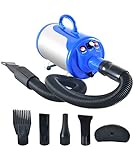
 SHELANDY Groomer Partner Pet Hair Force Dryer
- Wattage: 2386 watts
- Power Source: Corded Electric
- Number of Speeds: 7


As an Amazon Associate we earn from qualifying purchases at no extra cost to you. Ratings are shown as listed on Amazon.
Decide These 3 Things First
- Your dog’s coat type and size. A 10-pound short-haired dog may only need a compact dryer with controlled airflow, while a 70-pound Husky, Golden Retriever, Standard Poodle, or doodle can benefit from a more powerful forced-air unit. Thick undercoats demand airflow volume and velocity more than high heat.
- How often you will use it. For occasional post-bath drying, a $50 to $90 dryer may be sufficient. If you bathe multiple pets, groom weekly, or work with large coated breeds, spend more for a sturdier motor, longer hose, better controls, and a warranty that supports regular use.
- Your tolerance for sound and setup. Many force dryers operate around 70 to 85 decibels near the unit, comparable to a vacuum cleaner or louder. Quiet-oriented models may operate closer to the low-to-mid 40-decibel range in certain settings, but always check whether that figure applies at the motor, at the nozzle, or on the lowest speed.
Airflow Size: CFM, Velocity, and Hose Reach
“Airflow size” in a grooming dryer involves three connected measurements: cubic feet per minute (CFM), air velocity, and hose dimensions. CFM reflects the volume of air moved. Velocity reflects how forcefully that air exits the nozzle. Manufacturers do not always publish both figures, and testing methods vary, so use published claims as comparison points rather than absolute guarantees.
For small dogs with short coats, a dryer with adjustable airflow and a lower setting is more important than maximum output. For medium and large dogs with thick coats, look for a force dryer that offers at least two speed settings and a hose measuring roughly 5 to 8 feet long. A 6-foot hose is usually workable for home use; an 8-foot hose gives more freedom when drying a large dog from different angles.
The nozzle also changes the practical airflow. A narrow concentrator nozzle creates a focused stream that can part dense fur and blow out loose undercoat. A wider flat nozzle spreads air over a larger section and is useful for body drying. For facial areas, legs, and nervous pets, a round or reduced-flow nozzle is easier to control. Avoid using a narrow high-velocity nozzle close to skin, eyes, ears, or sensitive areas.
For a home dryer unit, a base roughly 12 to 16 inches long and 7 to 10 inches wide is compact enough to store in a closet or grooming cabinet. Units weighing 6 to 10 pounds are generally easy to move around the house. Heavier dryers, in the 12- to 16-pound range, may feel more stable during operation but are less convenient for portable grooming.
Materials: What Should Be Plastic, Metal, and Heat-Resistant
Most consumer grooming dryers use an ABS plastic housing, which is normal and appropriate when the shell is thick, well-fitted, and heat-resistant. ABS keeps the machine lighter than an all-metal body and does not automatically signal a low-quality dryer. What matters is whether the casing flexes, rattles, or separates around seams when handled.
Pay closer attention to the hose, nozzle, filter cover, switches, and cord strain relief. A flexible ribbed hose should resist kinking and return to shape after being bent. Hoses commonly measure 1.5 to 2 inches in diameter. A hose that feels overly thin or crushes easily can restrict airflow and may split over time.
Nozzles are often molded plastic. That is fine for standard use, but they should lock securely onto the hose rather than slide off under pressure. Metal nozzle components can be durable, although they may become warm during extended drying. If the dryer has a heating function, check that the nozzle material and hose connectors are designed for warm-air use.
A removable rear filter is a valuable feature. Pet hair and dander accumulate quickly, especially in homes with shedding breeds. A washable or easy-to-clean filter helps preserve airflow and reduces motor strain. If replacement filters are proprietary, confirm that they are available before buying.
Construction: Motor Design, Controls, and Everyday Durability
A well-built grooming dryer should feel stable on the floor, with rubber feet that limit vibration and keep the unit from creeping across hard surfaces. The hose connector should twist or click into place without excessive play. Loose connections cause air leaks, reduce effective force, and create irritating rattling.
Look for separate controls for airflow speed and heat whenever possible. A basic dryer may offer one airflow setting and one warm setting. A more versatile unit typically has two airflow speeds plus no-heat, low-heat, and higher-heat options. The no-heat setting is important: high-velocity ambient air can dry a coat efficiently while reducing the risk of overheating skin.
Many home pet dryers fall between 1,200 and 2,400 watts. Higher wattage can support a stronger motor and heating element, but wattage alone is not a direct measure of drying performance. A 2,000-watt dryer with poor hose design or weak speed control may be less useful than a 1,500-watt model with a well-designed nozzle system and consistent airflow.
Check the power cord length as well. A cord around 6 feet may require an extension cord in a garage or utility room. An 8- to 10-foot cord provides more flexibility. If you use an extension cord, choose one rated for the dryer’s electrical load; undersized cords can overheat.
Comfort and Performance: Noise, Heat, and Coat-Specific Control
The best airflow is airflow your pet can tolerate. A powerful dryer that panics your dog will not save time. Start every new dog on the lowest speed, with the dryer positioned several feet away and pointed away from the face. Gradually introduce the sound and sensation before working closer to the coat.
Noise levels deserve special attention for anxious pets. Standard force dryers can be loud, often falling in the general 70- to 85-decibel range depending on speed and distance. A quieter dryer may be easier to introduce to puppies, senior dogs, and sound-sensitive pets, though lower noise can come with lower maximum force. Ear protection may also be worthwhile for the person grooming multiple dogs.
Heat control matters more than a high maximum temperature. Dogs can overheat quickly, particularly in humid rooms, dense coats, and warm climates. Choose a dryer with a true no-heat or cool-air mode, and keep the nozzle moving rather than holding it in one spot. Warm air should feel comfortably warm at the coat—not hot against your hand when held at the same working distance.
For curly, long, or double-coated dogs, focused airflow helps separate hair down to the skin and remove trapped moisture. For smooth-coated breeds, broad airflow on a lower setting is usually enough. A dryer should speed drying without whipping the coat so aggressively that it tangles long hair or makes a nervous dog harder to handle.
Price Tiers: What $50, $90, and $150+ Usually Buy
Budget: $45 to $75. Expect a lightweight plastic-bodied dryer, a basic hose, one or two nozzles, and limited heat or speed adjustment. These can suit occasional grooming for a small or medium dog. At this price, inspect return policies carefully because noise, hose durability, and switch quality can vary.
Mid-range: $76 to $140. This is the practical sweet spot for many households. Expect two speed settings, multiple nozzles, a 6- to 8-foot hose, better filtration, and more usable temperature controls. Models around $90 often make sense for owners of a shedding medium-to-large dog who bathe at home every few weeks.
Premium: $141 to $250 or more. Higher-priced dryers may offer quieter motor operation, more refined airflow adjustment, stronger construction, longer hoses, improved heat management, and better service support. These are most worthwhile for multi-pet households, frequent home groomers, or owners of large dogs with dense coats.
Do not pay extra solely for a heater. For many dogs, high-velocity unheated airflow does most of the drying work. Pay for adjustability, durability, and an airflow system that fits your grooming routine.
Warranty: Read the Fine Print Before You Need It
A one-year limited warranty is common for home grooming dryers. Better coverage may extend to two years, but the details matter. Some warranties cover motor defects but exclude hoses, nozzles, filters, shipping costs, or damage associated with hair buildup and improper cleaning.
Before purchasing, confirm whether warranty service requires shipping the full unit back at your expense. A dryer weighing 8 to 12 pounds can be costly to send. Keep the order confirmation, serial number, and original packaging for at least the first several months. Also check whether customer support provides replacement hoses and nozzles separately; these are the accessories most likely to wear or get misplaced.
Delivery and Assembly: What Arrives in the Box
Most grooming dryers arrive mostly assembled. Typical setup takes 5 to 10 minutes: attach the hose, fit a nozzle, inspect the filter, and test the controls before introducing the dryer to your pet. The boxed weight is often 10 to 18 pounds, depending on the unit and accessories.
When the dryer arrives, inspect the hose connection, cord, plug, nozzle tabs, filter cover, and housing seams before use. Run the machine for a minute in a clear area and check for burning smells, unusually harsh scraping sounds, or intermittent power. A mild “new appliance” odor can occur briefly, but persistent burning odor, smoke, or excessive heat from the casing are reasons to stop using it and contact the seller.
Spec Checklist
| Spec | Budget | Mid | Premium |
|---|---|---|---|
| Typical price | $45-$75 | $76-$140 | $141-$250+ |
| Power range | 1,200-1,800 watts | 1,500-2,200 watts | 1,800-2,400 watts |
| Airflow control | 1-2 speeds | 2 speeds, better adjustment | Multi-setting or finely adjustable |
| Hose length | 4-6 feet | 6-8 feet | 7-10 feet |
| Nozzles included | 1-2 | 2-3 | 3+ specialized attachments |
| Warranty | 90 days-1 year | 1 year | 1-2 years |
Red Flags
- No published wattage, no stated voltage, or vague claims that cannot be compared with other dryers.
- Only one very hot setting and no cool-air or no-heat option.
- A hose that is under 4 feet long for drying medium or large dogs.
- No removable filter or no instructions for cleaning hair from the intake.
- Loose nozzle attachments that can fly off when airflow is turned up.
- A unit advertised as “silent.” All motorized dryers make noise; credible listings describe settings and measured conditions.
- Thin power cords, a loose plug, cracked housing, or a strong electrical smell during the first test run.
- Warranty language that does not identify the warranty period, covered components, or support contact method.
FAQ
What airflow is best for a thick double coat?
Look for a force dryer with at least two speed settings, a concentrated nozzle, and a hose around 6 to 8 feet long. Thick undercoats respond best to focused, high-velocity airflow that parts the fur and pushes water outward. Use little or no heat, and keep the nozzle moving.
Is higher wattage always better in a grooming dryer?
No. Wattage indicates electrical consumption, not a complete picture of airflow performance. A useful dryer combines adequate motor power with good hose design, secure nozzles, adjustable speed, filtration, and safe heat controls. Compare the full feature set rather than buying by wattage alone.
Can I use a human hair dryer on my dog?
It is usually less effective and can be riskier than a pet dryer. Human hair dryers rely more heavily on heat and typically do not produce the focused, high-volume airflow needed to dry a dense coat efficiently. A pet-specific force dryer is generally the safer choice for routine whole-body drying.
How close should the dryer nozzle be to my dog’s coat?
Start several feet away on a low setting, then work closer as your dog becomes comfortable. For most body drying, keep the nozzle moving and avoid holding it directly against the skin. Maintain extra distance around the face, ears, genitals, paws, and any irritated or sensitive skin.



Write Your Review
No reviews yet. Be the first to share your experience!