
Key takeaways
- A weight capacity is listed without explaining whether it applies to a stationary load or a moving pet.
- The tabletop has no nonslip surface, or the mat curls at the edges.
- The clamp opening does not match the tabletop thickness.
- Folding legs have no visible safety locks, pins, or cross-braces.
- The arm twists when you apply moderate hand pressure.
- Rubber feet are tiny, missing, or suited only to smooth indoor floors.
- An electric model lacks overload protection, manual lowering, or clear voltage information.
- The warranty excludes the motor, frame, or major hardware without offering replacement parts.
- Assembly instructions omit torque guidance, fastener diagrams, or a post-assembly safety check.
When shoppers search for “what to look for grooming table stability,” they often focus on the tabletop finish or the number of included nooses. Those details matter, but they do not determine whether a table feels safe when a 70-pound dog shifts suddenly. The most common mistakes are buying a table that is too small, overlooking the base and clamp design, trusting a high weight rating without checking its conditions, and assuming a heavier table is automatically more stable.
A stable grooming table should resist rocking, sliding, twisting, and tipping while you lift a pet, trim nails, brush a coat, or use a dryer. Stability also depends on the animal, floor surface, table height, grooming arm, and how well the equipment is assembled. Use the guide below to compare portable tables, fixed grooming stations, and powered lift models in 2026.
Our top picks
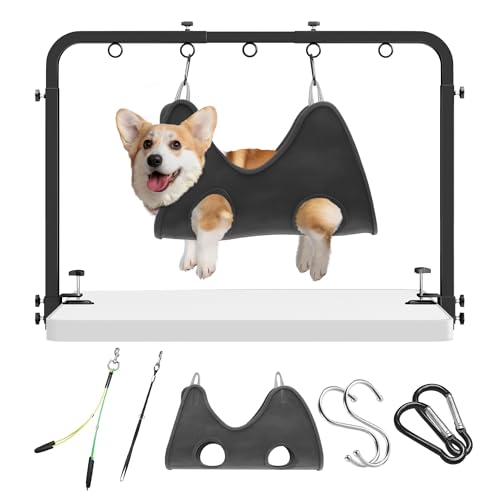


As an Amazon Associate we earn from qualifying purchases at no extra cost to you. Ratings are shown as listed on Amazon.
Decide These 3 Things First
- Your pet’s size and behavior: Measure your pet’s body length from the chest to the base of the tail and note its standing weight. A calm 15-pound dog needs far less table than a restless 75-pound dog.
- Where you will groom: A folding table used on a garage floor has different requirements from a permanent station in a salon. Check available floor space, storage needs, doorway widths, and access to a grounded electrical outlet if you want a powered lift.
- How often you will groom: Occasional nail trimming may justify a compact arm-and-table setup. Weekly full grooms call for a stronger frame, easier cleaning, a more secure arm attachment, and a warranty you can use.
1. Size and Weight Capacity
Start with the tabletop, not the advertised maximum weight. A surface should allow your pet to stand with all four paws comfortably inside the edges. For small dogs and cats, a tabletop around 18 by 30 inches is a practical minimum. Medium dogs generally benefit from 22 by 36 inches, while large dogs may need 24 by 42 inches or more. Measure your pet before shopping; a long-backed breed can outgrow a table that appears wide enough.
Allow at least 2 to 4 inches of usable space around the pet, but do not treat a huge empty surface as a substitute for restraint. An oversized table can give a nervous animal room to turn, back up, or pull against the grooming arm.
Check the capacity in two ways: the listed pet weight and the frame’s ability to handle movement. A 100-pound static capacity is not necessarily appropriate for a 70-pound dog that lunges. For home use, choose a stated capacity at least 25% higher than your pet’s current weight. A table rated for 150 pounds gives more useful margin for a 100-pound dog than one rated exactly at 100 pounds.
2. Material and Surface Grip
Stainless steel is durable, rust-resistant, and easy to sanitize, but the label alone does not guarantee a stable table. Inspect the thickness and support beneath the top. A thin metal sheet over a weak frame can flex more than a thick, well-braced composite top.
Look for a nonslip, waterproof surface with a texture that remains grippy when wet. Rubberized mats, textured vinyl, and sealed waterproof boards are common choices. Avoid deeply ridged surfaces that trap hair and shampoo. The working surface should wipe clean without absorbing moisture around the edges.
For the frame, steel is usually preferable to lightweight aluminum when stability is the priority. Aluminum can be useful for portability, but it needs cross-bracing and a wide stance to prevent side-to-side movement. Rubber feet should be large enough to stay planted—roughly 1 to 2 inches in diameter is a useful benchmark for portable legs—and should not slide easily on tile or sealed concrete.
3. Construction, Base, and Grooming Arm
Construction is where stability is won or lost. Favor legs that lock firmly, crossbars that reduce sway, and a base wider than the tabletop’s centerline. A folding design should have positive locking pins or latches rather than relying only on friction hinges. After setup, push down on each corner and check for movement before placing your pet on the table.
Pay close attention to the grooming arm and clamp. A table-mounted arm is only as stable as the edge it grips. Measure the tabletop thickness and compare it with the clamp’s opening. Some clamps fit edges up to about 2.4 inches, while other models require a much thinner or thicker edge. The clamp should contact a solid structural section, not a hollow decorative lip.
An arm around 36 to 42 inches high suits many small and medium pets, but height alone is not a safety rating. The arm should have a locking knob that remains secure under tension, and the noose should not be the only restraint. A hammock or safety sling can help prevent a small pet from stepping or jumping off, but it must fit correctly and never restrict breathing.
4. Comfort and Performance
A stable table should also make grooming controlled and comfortable. Check the height range if the table is powered or adjustable. A working range of roughly 20 to 40 inches can reduce bending for many owners, while a lower starting height helps with heavier dogs. The table must remain steady at both its lowest and highest positions; some designs feel more secure when lowered.
For electric models, compare motor power, lifting speed, controls, and the stated duty cycle. A motor in the neighborhood of 100 to 300 watts is common for home-oriented powered furniture, but wattage by itself does not prove lifting strength. Look for overload protection, an emergency stop or manual lowering method, and a cord long enough to keep the outlet connection away from splashing water. Never groom with a wet coat or operate electrical controls with wet hands.
Noise matters for anxious animals. A slower, quieter lift may be more useful than maximum speed. For manual tables, confirm that the adjustment pins engage fully and cannot be bumped loose while the pet is standing on the surface.
5. Price Tiers That Make Sense
Budget grooming arms and compact folding tables typically cost about $35 to $80. For example, arm kits in the under-$40 to under $50 range may include a clamp, two nooses, and a hammock, but they may still require a suitable table and careful edge measurement. These are best for light-duty grooming and smaller pets.
Midrange stainless steel folding tables generally fall between $90 and $180. A model priced around $100 may include a tabletop, adjustable arm, noose, and tray. At this level, prioritize frame bracing, clamp security, replacement parts, and the quality of the nonslip top over accessory count.
Powered lift tables commonly cost about $350 to $700 for home and small-business use. A model near under $500 may offer an electric height adjustment, overhead arm, clamps, and two nooses. The extra cost buys easier positioning and less lifting, not automatically better pet restraint. Confirm the base footprint, motor protections, electrical requirements, and shipping terms before paying for a powered design.
6. Warranty and Replacement Support
Look for at least a one-year warranty on the frame, motor, and major hardware. A longer two- or three-year frame warranty is preferable for a frequently used table, but read exclusions carefully. Some warranties cover manufacturing defects but exclude bent arms, damaged surfaces, water exposure, or normal wear.
Ask whether the manufacturer sells replacement clamps, nooses, mats, feet, casters, control switches, and lift motors. A replaceable $15 to $40 mat or $20 to $60 arm component can extend the useful life of a table. Keep the receipt, assembly instructions, and product model number together.
7. Delivery, Assembly, and Storage
Before ordering, check the packaged dimensions and shipping weight, not only the assembled size. A table that is 42 inches long may arrive in a box longer than 48 inches. Measure doors, stairwells, elevators, and the space where you will unpack it.
Allow 30 to 90 minutes for assembly depending on the design. Powered tables may require more time because of the motor, legs, control box, and cable routing. Tighten every fastener after the first use, then recheck folding hinges and arm clamps regularly. For storage, a folded table should remain dry and stand securely without leaning against a wall where it could fall.
Spec Checklist
| Spec | Budget | Mid | Premium |
|---|---|---|---|
| Typical price | $35–$80 | $90–$180 | $350–$700 |
| Useful tabletop size | 18 × 30 inches | 22 × 36 inches | 24 × 42 inches or larger |
| Suitable capacity target | Up to 40 pounds | Up to 75 pounds | 75–150 pounds |
| Arm height | 30–36 inches | 36–42 inches | 36–48 inches, adjustable |
| Frame preference | Locked folding legs | Steel frame with cross-bracing | Wide powered base with reinforced lift columns |
| Height adjustment | Usually fixed | Manual or limited adjustment | Electric, approximately 20–40 inches |
| Warranty target | At least 90 days | At least 1 year | 1–3 years, with motor coverage |
Red Flags
- A weight capacity is listed without explaining whether it applies to a stationary load or a moving pet.
- The tabletop has no nonslip surface, or the mat curls at the edges.
- The clamp opening does not match the tabletop thickness.
- Folding legs have no visible safety locks, pins, or cross-braces.
- The arm twists when you apply moderate hand pressure.
- Rubber feet are tiny, missing, or suited only to smooth indoor floors.
- An electric model lacks overload protection, manual lowering, or clear voltage information.
- The warranty excludes the motor, frame, or major hardware without offering replacement parts.
- Assembly instructions omit torque guidance, fastener diagrams, or a post-assembly safety check.
FAQ
How stable should a grooming table feel?
It should remain level and planted when you press down on each corner and apply moderate side pressure to the arm. A small amount of flex may be normal, but visible rocking, sliding, leg movement, or arm rotation is not acceptable. Test the table empty before using it with a pet.
Is a heavier grooming table always safer?
No. Weight can help, but a wide footprint, braced frame, secure feet, and correctly fitted clamp often matter more. A heavy table with narrow legs can still tip or sway. Match the design to your pet’s weight, movement, and the floor surface.
Do I need an electric grooming table?
Not necessarily. An electric table is useful if you groom large dogs, have lifting limitations, or need frequent height changes. For occasional grooming, a fixed or manually adjustable table can be more affordable and simpler to maintain. Choose powered equipment only if it includes suitable safety controls.
What is the most important stability check before grooming?
Confirm that the table is fully assembled, every leg or lift column is locked, the feet sit flat, and the grooming-arm clamp matches the tabletop edge. Then test the restraint system without the pet. Never rely on a noose or arm to compensate for a table that rocks or slides.




Write Your Review
No reviews yet. Be the first to share your experience!