
Key takeaways
What's inside
Best dog brush for goldendoodles is a question with real consequences, because a doodle coat that is not brushed properly mats right down to the skin within a few weeks. The tools matter here, but the technique matters more, and this guide covers both alongside a realistic schedule.
As an Amazon Associate we earn from qualifying purchases.


As an Amazon Associate we earn from qualifying purchases.
🛒 Best Price Today on Amazon
Prime members get fast, free shipping on everything above, plus member-only deals. New members get a 30-day free trial — cancel anytime.
How to Choose the Best Dog Brush for Goldendoodles
Doodle coats do not shed much, which sounds convenient until you realise the loose hair stays trapped in the coat instead of falling out onto the floor. That trapped hair is what forms mats, so brushing is not cosmetic maintenance for this breed, it is the entire coat care plan.
Understanding the Doodle Coat
Goldendoodle coats vary enormously between individual dogs, which is why the best dog brush for goldendoodles differs from one household to another. Wavy fleece coats are the easiest to manage, curly coats mat fastest and need the most work, and straighter coats sit somewhere between, so two dogs from the same litter can need different routines entirely.
The coat changes as the dog matures. Most doodles go through a coat transition between roughly eight and fourteen months, when the puppy coat is replaced and matting increases sharply, which is exactly when many owners suddenly find themselves out of their depth.
Mats form where there is friction rather than where you can see them. Behind the ears, in the armpits, under the collar, between the back legs and around the harness contact points are the areas to check first, and they mat quietly long before the back does.
Slicker, Comb or Dematting Tool
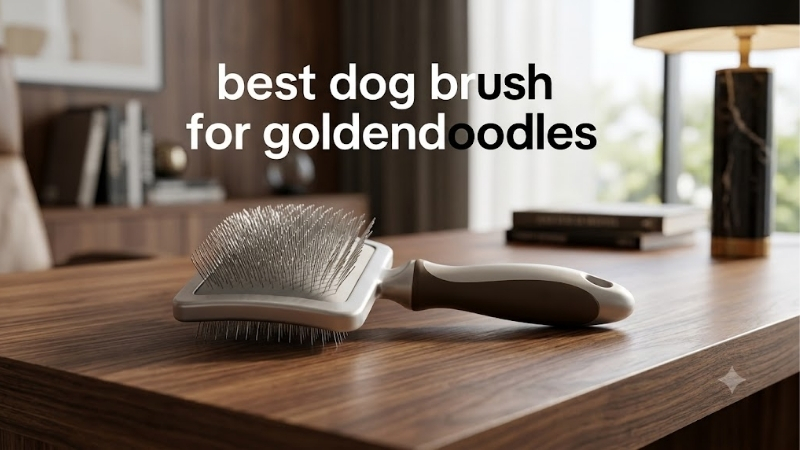
A quality slicker brush does the daily work. Long flexible pins reach through a curly coat to the skin, which is where matting starts, and a cheap slicker with short stiff pins will glide across the surface while leaving the base of the coat untouched.
A steel comb is not optional for this breed. It is the only honest test of whether the coat is genuinely brushed through, since a comb that will not pass from skin to tip in one smooth movement means there is a mat there regardless of how good the coat looks.
Dematting tools are for small, early tangles only. A serious mat sitting against the skin needs a groomer with clippers rather than a blade near a struggling dog, and pulling at tight mats hurts and can tear the skin underneath.
Line Brushing: the Technique That Works
Line brushing is how groomers do it and it changes everything. Part the coat with one hand, brush the exposed layer from the skin outwards, then move the parting up an inch and repeat, working systematically through the dog rather than skimming across the top.
Follow every brushed section with the comb. If the comb passes cleanly, move on, and if it catches, brush that section again before continuing, because a mat you cannot feel today is the one the groomer finds under the collar in three weeks.
Work to a fixed order so nothing gets missed. Starting at the back legs and working forwards, finishing with the head and ears, means the awkward areas get done while both of you still have patience rather than being rushed at the end.
Schedule, Bathing and Professional Grooms
Every second day is realistic for a curly coat and most owners underestimate this. Fifteen minutes of line brushing every other day keeps a doodle mat-free, while weekly sessions are usually enough only for the wavier, lower-maintenance coat types.
Bathing without brushing first makes everything worse. Water tightens existing tangles into solid mats, so brush the dog thoroughly before any bath or swim, and be particularly careful in summer when lake and pool visits are frequent and coats dry slowly.
Harnesses and collars deserve a check every time. Constant friction under a strap is where the best dog brush for goldendoodles gets the least use and mats form fastest, so slide the harness off and comb underneath it before you finish the session.
Top Picks: Best Dog Brush for Goldendoodles at Every Budget
Every tool in this best dog brush for goldendoodles lineup builds part of a kit, and a doodle owner genuinely needs at least a slicker and a comb rather than one brush. The professional options cost more but reach the skin properly, which is what determines whether the routine actually works.
| Tool | Type | Role | Tier |
|---|---|---|---|
| Chris Christensen Big G | Pro slicker | Line brushing | Premium |
| Chris Christensen Buttercomb | Steel comb | Checking the coat | Premium |
| Hertzko Self-Cleaning Slicker | Slicker | Daily maintenance | Budget |
| GoPets Dematting Comb | Dematting tool | Small early tangles | Mid |
| ConairPRO Dog Slicker | Slicker | Starter option | Budget |
Chris Christensen Big G Slicker Brush
Doodle owners who groom seriously nearly all end up here eventually. The long flexible pins reach through a curly coat to the skin where standard slickers stop, the head covers ground quickly on a large dog, and the light frame reduces wrist strain during long sessions.
The price is well above every other brush here, which is difficult to justify for a wavy coat that mats rarely. Long flexible pins also demand a light touch, since pressing hard turns an effective tool into one that scratches the skin underneath.
Chris Christensen Buttercomb
A comb is what tells you the truth about a doodle coat. This one has smooth rounded teeth that pass through curls without snagging, and the combination of wide and narrow spacing on a single comb covers both the body and the finer areas behind the ears.
It is expensive for what looks like a simple piece of metal, and losing one is genuinely irritating at that price. A cheaper steel comb performs the same test adequately, so this is an upgrade for owners grooming often rather than an essential first purchase.
Hertzko Self-Cleaning Slicker Brush
For daily maintenance between deeper sessions, this covers the basics at a fraction of the price. The fine angled pins clear loose hair from the outer coat, and the retraction button pushes collected fur off the pad so the session keeps moving.
The pins are shorter and stiffer than on a professional slicker, so it works on the surface rather than reaching the skin of a thick curly coat. Press harder to compensate and you will scratch the skin, so it complements a proper slicker rather than replacing one.
GoPets Dematting Comb
Small tangles caught early can be split rather than cut out. The curved blades work through a developing knot in a few strokes, which saves the section from becoming a proper mat, and the handle gives enough control to work close to the body safely.
Blades near a moving dog are always a risk, so this is for small tangles rather than established mats. Anything sitting tight against the skin should go to a groomer, and pulling at a serious mat with any tool hurts the dog considerably.
ConairPRO Dog Slicker Brush
Puppy owners unsure how much tool they need can start here without much outlay. It handles a soft puppy coat perfectly well, introduces the dog to being brushed daily, and costs little enough to replace once the adult coat comes through.
It will not cope with a mature curly coat, where the pins are simply too short to reach the skin. Treat it as a first brush for the puppy months rather than the tool that will carry you through the coat transition at around a year old.
Frequently Asked Questions
Doodle owners ask the same questions once the adult coat arrives, usually about how often to brush, why mats keep appearing despite apparently regular sessions, and whether shaving the dog is a reasonable solution to any of it.
How often should I brush a goldendoodle?
Every other day for a curly coat, and at least twice weekly for a wavy one, using line brushing rather than quick surface strokes. The best dog brush for goldendoodles will not help if it is only reaching the top layer of the coat.
Why does my dog still mat when I brush daily?
Almost always because the brushing is not reaching the skin. Surface brushing leaves the base of the coat untouched, and that is exactly where mats form, so switching to line brushing and checking with a comb usually solves it.
Is shaving a matted doodle cruel?
No, and sometimes it is the only humane option. A tightly matted coat pulls at the skin constantly, and removing it with clippers is far kinder than hours of painful dematting, though preventing it with regular brushing is obviously better.
How often do doodles need professional grooming?
Every six to eight weeks for most coats, with consistent home brushing between the appointments. The groom manages length and shape, while your routine at home is what prevents matting, and one cannot substitute for the other.
Final Thoughts
The best dog brush for goldendoodles is a quality slicker paired with a steel comb, used with line brushing rather than surface strokes. Brush before every bath, check with the comb afterwards, and keep a professional groom booked every six to eight weeks.




Write Your Review
No reviews yet. Be the first to share your experience!