
Best dog dematting tool choices are as much about technique as hardware. Every tool in this category is a blade of some description, and skin tents up into a tight mat, which is exactly how home grooming injuries happen. These six work well when used properly, and each entry is clear about the point where you should stop and call a groomer.
Our top picks
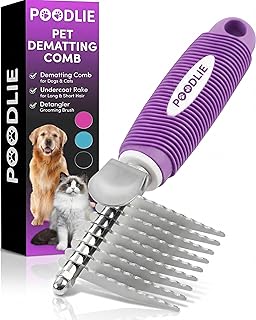
 Docrok Pet Grooming Combo
2-in-1 rake and comb combo covers dematting and deshedding in one set
Soft, protective edges are designed to avoid hurting the pet
Stainless steel teeth and TPR handle add durability and comfort
Geared toward medium and long-haired coats, less so short fur
Combo tools need periodic cleaning to clear trapped hair


 Professional 3PCS Self Cleaning Slicker Brush &
- 【Professional Pet Grooming Kit 】3 Pet grooming tools…
- 【Why Choose Augwind 3PCS ?】 Augwind Pet Grooming…
- 【Dematting and Deshedding Tools】 Augwind Pet Grooming Rake…


As an Amazon Associate we earn from qualifying purchases at no extra cost to you.
As an Amazon Associate we earn from qualifying purchases.
By Laura Simmons
🛒 Best Price Today on Amazon
Prime members get fast, free shipping on everything above, plus member-only deals. New members get a 30-day free trial — cancel anytime.
Start 30-Day Prime Free Trial →See Today’s Amazon DealsHow to Choose the Best Dog Dematting Tool
Mats form where hair is long and friction is constant: behind the ears, in the armpits, along the britches, and around the collar line. The best dog dematting tool for a given dog depends on how tight those mats have become, and on how much coat you can afford to lose while opening them up.
Know What Stage the Mat Is At
A loose tangle that a comb catches on but eventually passes through does not need a blade at all, and reaching for one wastes coat. A dematting tool earns its place on a knot that has begun to felt, where the hairs have locked together but the mat still lifts away from the skin when you slide a finger underneath it.
Beyond that stage the maths changes. A mat sitting flat against the body, or a pelted area where several mats have joined into a sheet, cannot be opened safely at home. That is a job for clippers worked underneath the mat by a groomer or a vet with the dog properly supported.
Understand How the Blades Work
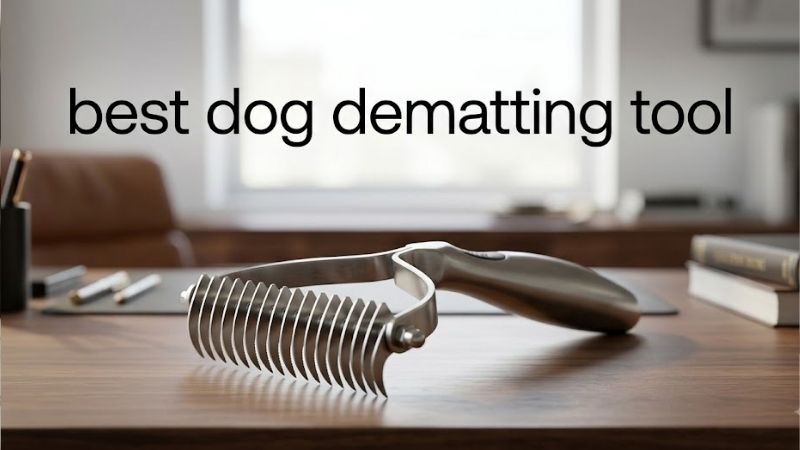
Dematting rakes use curved blades sharpened on the inside edge, so they cut through the mat as you draw them outward rather than pulling the whole knot against the skin. The number of blades sets the aggression: fewer, wider blades cut faster, while more closely spaced blades take smaller bites and preserve more coat.
Rounded outer tips are worth looking for, since they reduce the chance of catching skin if the dog moves suddenly, which is the difference between a tidy result and a trip to the vet. Nothing about a rounded tip makes the cutting edge itself safe, so technique still matters more than the design.
Use a Detangler as a Force Multiplier
A detangling spray works into the mat and reduces friction between the hairs, so the tool has less work to do and the dog feels less pulling. Spraying, waiting a minute, then working the mat is consistently faster than attacking a dry knot with the same tool.
Apply it to a dry coat rather than a wet one, and work the mat before the dog is bathed rather than after. Water tightens an existing mat considerably, which is why a dog that goes into the bath with three small tangles can come out with three solid lumps that were not there an hour earlier.
Work From the Outside In and Support the Skin
Hold the base of the mat between your fingers so any pull goes into your hand rather than the dog’s skin, then work the outer edge with short outward strokes. Splitting a large mat into several smaller sections first makes the whole job faster and considerably less uncomfortable for the dog.
Stop the session before the dog does. Two short attempts on consecutive evenings achieve more than one long one that ends with a dog who now hates being handled, and mats rarely worsen much over a day or two if the dog is not actively scratching at them.
Top Picks: Best Dog Dematting Tool Options
These six cover the whole progression from finding tangles early to opening a genuine mat, plus the detangler that makes all of them work better. The best dog dematting tool for most households turns out to be a double-sided rake backed up by a decent steel comb used regularly.
| Tool | Best For | Type | Key Feature |
|---|---|---|---|
| GoPets Dematting Comb | Everyday tangles | Double-sided rake | Coarse and fine sides |
| Safari Dematting Comb | Precision work | Single-row rake | Serrated curved blades |
| Poodle Pet Dematting Fur Rake | Thick double coats | Wide rake | Covers ground quickly |
| Master Grooming Mat Breaker | Splitting large mats | Mat splitter | Cuts a mat into sections |
| Andis Steel Greyhound Comb | Finding mats early | Steel comb | Fine and coarse ends |
| Cowboy Magic Detangler | Reducing pull | Detangling gel | Works into dry coat |
GoPets Dematting Comb
The best dog dematting tool for a household that wants only one is this. The coarse side opens a tangle and the fine side finishes it, the blades are rounded at the tips, and the padded handle stays comfortable through a session spent working slowly on one area.
It is still a blade tool, so it can catch on a mat pressed flat against the skin and it removes more coat than a comb would. The build is good rather than professional, and the blades eventually dull on a dog needing regular dematting, at which point replacing is cheaper than sharpening.
Safari Dematting Comb
A single row of serrated curved blades gives more control than a double-sided rake, which suits careful work around the ears, armpits, and anywhere the skin is thin. On a small dog it takes smaller bites and leaves a tidier result than a wide rake would manage.
The narrow head means slow going on a large or heavily matted dog, and there is no second side to switch to for finishing. It is also not the tool for a pelted area, where nothing short of clippers will help, and the plastic handle is functional rather than comfortable over long sessions.
Poodle Pet Dematting Fur Rake
Built for volume, with a wide head and long blades that get through the britches and ruff of a thick-coated dog faster than a narrow tool. On a doodle or a heavily coated mixed breed that has been neglected for a few weeks, the time saved is substantial.
Width is also the weakness. It is too much tool for a small dog or for delicate areas, and used with any pressure it removes considerably more coat than you intended. Keep the strokes short, let the blades do the cutting, and switch to something narrower near the face and legs.
Master Grooming Tools Mat Breaker
A splitter rather than a comb, designed to slice a large mat into smaller sections so that a rake or your fingers can then open each piece. On a mat the size of a plum this is genuinely the right first step, and it saves a great deal of pulling further down the line.
It cuts, so it takes coat rather than saving it, and it needs a steady hand and a still dog. This is not the tool to hand to someone dematting for the first time, and it is comfortably the item on this list most likely to nick skin if the dog turns unexpectedly.
Andis Steel Greyhound Comb
Not a dematting tool at all, but the one that prevents you needing one. Running a fine steel comb through the friction areas twice a week finds tangles while they are still soft, and that single habit removes most of the reason to own anything else on this list.
It will not open an established mat, and dragging it into one hurts, which is exactly how dogs learn to avoid grooming. It is also slow across a large dog, so treat it as a checking and finishing tool rather than something you use on the whole coat every session.
Cowboy Magic Detangler and Shine
A concentrated detangling gel that reduces friction inside a mat so the tool slides rather than drags. Worked in and left for a minute, it noticeably shortens the job on longer coats and makes the dog far more willing to stand still for the second half of it.
It is a helper, not a solution, and it does nothing for a mat that is already felted solid. Applied too heavily it leaves the coat feeling slightly greasy until the next bath, so use less than the bottle suggests and concentrate it on the mat rather than the whole dog.
Frequently Asked Questions
These four come up most often from owners buying the best dog dematting tool after finding a knot they cannot brush out. The four answers below cover whether dematting hurts, how to prevent mats forming, why scissors are dangerous, and the point at which the job belongs to a professional.
Does dematting hurt the dog?
It can, which is why technique matters more than the tool. Holding the base of the mat so the pull goes into your hand, working from the outer edge, and keeping sessions short all reduce discomfort considerably. A dog that yelps or turns to bite is telling you the mat is too tight for a home tool.
How do I stop mats forming in the first place?
Comb the friction areas twice a week: behind the ears, the armpits, the britches, and under the collar. Those spots account for the overwhelming majority of mats on every coat type, and a fine steel comb finds a tangle there long before it is visible from across the room.
Can I just cut a mat out with scissors?
No. Skin lifts into a tight mat, and scissor injuries during home grooming are common enough that most vets see them regularly. If a mat will not open with a proper tool and patient finger work, it needs clippers worked underneath it by someone who does that job routinely.
When should I give up and call a groomer?
When mats have joined into a sheet, sit flat against the skin, or cover more than a small area. Pelted coats are removed with clippers in a fraction of the time, and the dog is far more comfortable for it. Persistent matting also warrants a shorter clip until the routine improves.
See More:
- Best dog shampoo for Australian Shepherds
- Best natural dog shampoo
- Best slicker brush for dogs
- Best toothbrush for small dog
- Best cat brush for ragdolls
Final Thoughts
The best dog dematting tool is one you use early, gently, and alongside a steel comb that finds problems before they harden. A double-sided rake covers most households and a detangler makes every tool work better, but nothing here belongs near a mat felted flat against the skin. That one goes to a groomer.



Write Your Review
No reviews yet. Be the first to share your experience!