
Key takeaways
What's inside
Best dog brush for long haired dogs depends on whether that long coat sits over an undercoat or grows as a single layer, because the two need completely different tools. This buying guide separates the coat types, shows where mats actually form, and matches five tools to each situation.
As an Amazon Associate we earn from qualifying purchases.


As an Amazon Associate we earn from qualifying purchases.
🛒 Best Price Today on Amazon
Prime members get fast, free shipping on everything above, plus member-only deals. New members get a 30-day free trial — cancel anytime.
How to Choose the Best Dog Brush for Long Haired Dogs by Coat Type
Long hair is a description rather than a category. A rough collie, a maltese and a golden retriever all carry long coats and none of them want the same brush, so the first job is working out which of the three structures you are dealing with before comparing anything on a shelf.
Long Double Coats: Collies, Retrievers and Newfoundlands
These carry a long weather-resistant outer coat over a dense soft undercoat, and the undercoat is where all the trouble sits. It packs down against the skin, holds moisture after rain, and releases in enormous quantities twice a year during the spring and autumn coat changes.
An undercoat rake is the primary tool here, with rounded teeth that pass through the guard hair and lift loose wool out from underneath without cutting anything. A slicker follows to handle feathering, and a steel comb confirms that each section is genuinely clear to the skin.
Never shave one of these coats for summer. The double layer insulates against heat as much as cold, shaving exposes skin to sunburn, and regrowth is frequently patchy or altered in texture afterwards, so thinning the undercoat with a rake is the only sensible route to comfort.
Long Single Coats: Maltese, Yorkies and Shih Tzus
Single-coated breeds grow hair continuously with nothing underneath, so there is no undercoat to rake out and a deshedding blade will simply cut the coat. A long-pin slicker and a fine steel comb are the correct pairing, used gently and frequently rather than aggressively.
Breakage is the main risk on these coats. Fine hair snaps easily under a dry brush, which is why a light mist of leave-in conditioner before each session prevents more damage than any change of brush achieves, particularly on a coat that is being grown out to full length.
Where Mats Actually Form
Knowing where to look matters as much as which tool you hold, because the best dog brush for long haired dogs is useless if it never reaches the five places that mats reliably start in, and those five are the same on almost every long-coated breed you will meet.
Mats appear in the same places on almost every long-coated dog: behind the ears, in the armpits, in the britches, around the collar line and between the back legs. Those five areas move constantly, generate friction and get missed by anyone brushing only across the back.
Checking them takes a minute and prevents most emergencies. Run a comb through each of the five spots after every walk through long grass or any swim, since debris and moisture together turn a small tangle into a felted mat within a couple of days on a coat this length.
Line Brushing and Session Frequency
Technique turns a tool into a result, and the best dog brush for long haired dogs used badly clears less coat than a cheap one used properly with a parting and a steady hand, which is why groomers spend so long teaching this one habit.
Line brushing is the technique that makes any brush work on length. Part the coat with one hand, brush the exposed line from the skin outward, then move the part up a centimetre and repeat, which reaches the base instead of skimming across the top of the coat surface.
Two or three sessions a week suits most long coats, rising to daily during a coat change or while growing a coat out. Short frequent sessions beat one long weekly struggle, and a dog that has learned the routine is calm will settle far more readily for the next one.
Top Picks: Five Tools Matched to Long Coats
The best dog brush for long haired dogs is rarely one purchase, since the rake, the slicker and the comb each do a job the others cannot. These five cover both coat structures, and each entry names the coat it suits alongside a genuine limitation that is worth knowing first.
| Tool | Type | Coat it suits | Limitation |
|---|---|---|---|
| Safari Undercoat Rake | Rake | Long double coats | Wrong for single coats |
| Chris Christensen Big K Slicker | Long-pin slicker | Both, especially feathering | Premium price |
| Master Grooming Tools Comb | Steel comb | All long coats | Removes little hair itself |
| Chris Christensen Oval Pin Brush | Pin brush | Long single coats | No deshedding ability |
| GoPets Dematting Comb | Dematting blade | Isolated mats only | Removes coat, thins outline |
Safari Undercoat Rake
On a collie, a retriever or a newfoundland this does the bulk of the work during a coat change. Rounded teeth pass through the long guard hair and lift the packed undercoat away in handfuls, and because it separates rather than cuts, the outer coat comes through untouched.
It is entirely wrong for a single-coated breed, where there is nothing underneath to remove and the teeth simply drag through the hair. The double-row versions also pull firmly, so keep pressure light around the belly, the groin and the inside of the hind legs on any dog.
Chris Christensen Big K Slicker Brush
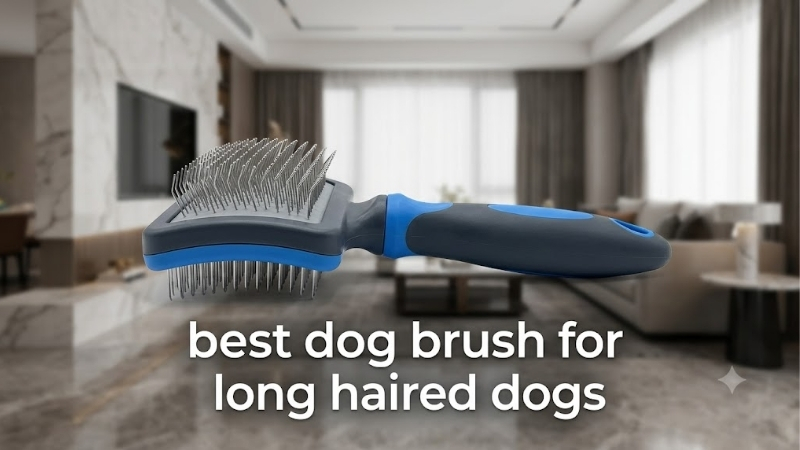
Across both coat structures this is arguably the best dog brush for long haired dogs on the list, because pin length is the one specification that decides whether a slicker reaches the skin at all, and almost nothing else about a slicker matters until it does.
Long pins are what separate a useful slicker from a decorative one on this kind of coat. These reach through the outer layer to the base without you pressing the pad against the skin, and the flexible bed spreads pressure so the tool does the work rather than your forearm.
The price is several times a supermarket slicker, which is the obvious drawback. It is also not a deshedding tool, so anyone expecting it to clear undercoat during a coat blow will be disappointed and should pair it with a rake rather than asking it to do both of the jobs.
Master Grooming Tools Steel Comb
The comb is the audit that makes everything else honest. Run it from the skin outward after brushing a section and it either passes cleanly or catches, which is the only reliable way to know whether you reached the base of a long coat or merely tidied the surface of it.
Rigid steel matters because a flexible comb skips over dense patches and reports a false pass. It removes very little hair by itself, so nobody should expect it to contribute volume, and a long comb is unwieldy around a small breed’s face and muzzle in day to day practice.
Chris Christensen Oval Pin Brush
On long single coats a pin brush finishes the job without stripping. Widely spaced pins lift and separate fine hair, which keeps a maltese or a shih tzu coat looking full rather than thinned, and it is gentler than a slicker on dogs that dislike the sensation of fine pins.
It clears very little from a double coat and nothing at all during a moult, so it belongs in the single-coat kit rather than the retriever one. Used before scissoring it also settles the coat, which is why groomers reach for one at the end of a session rather than at the beginning.
GoPets Dematting Comb
Every long-coated household eventually meets a mat that a slicker cannot open. Serrated blades cut through it from the outer edge inward in short strokes, with the mat held at its base so the skin underneath is never pulled or lifted at all while you are working through it.
It removes coat rather than detangling it, so overuse leaves visible thin patches that take months to grow out. Keep it for isolated mats in the five problem areas, and if a whole region is felted against the skin, a groomer clipping it out is kinder and considerably safer.
Frequently Asked Questions
Four questions come up constantly from owners of long-coated dogs, usually during the first coat change. The best dog brush for long haired dogs depends on the coat structure before anything else, which is why the first two answers below matter more than the tool itself.
How often should a long-coated dog be brushed?
Two or three times a week for most, rising to daily during a coat change or while growing a coat out. Skipping a fortnight is what turns manageable tangles into mats, and once a coat is felted the choice narrows to clipping the coat out rather than brushing it apart.
Can I use a deshedding blade on a long single coat?
No. Breeds such as maltese, yorkies and shih tzus have no undercoat to remove, so the edge simply cuts the hair and leaves a patchy outline that takes months to recover. A long-pin slicker and a steel comb are the correct tools for those coats at every single stage.
Should I brush before or after bathing?
Before, always. Water tightens any tangle that is already present, so a coat bathed while matted comes out worse than it went in. Comb to the skin first, then bathe, then dry with airflow rather than rubbing, then brush again once the coat has completely dried.
What is the fastest way to prevent mats?
Check the five friction areas after every walk and swim, and line brush rather than sweeping across the top of the coat. Those two habits between them prevent the great majority of matting, and neither takes more than a few minutes on an ordinary evening at home.
See More:
- Dog grooming shears best
- Best dog clippers for poodles
- Best dog clippers for doodles
- Best dog brush for poodle
- Best dog brush for great pyrenees
Final Thoughts
The best dog brush for long haired dogs starts with identifying the coat: a rake plus slicker and comb for long double coats, a long-pin slicker with a pin brush and comb for single ones. Line brush two or three times a week, check the five friction areas, and mats stop being an emergency.




Write Your Review
No reviews yet. Be the first to share your experience!