
Key takeaways
What's inside
Best dog brush for poodle coats is really a question about three tools working together: a slicker to open the curl, a pin brush to lift it and a steel comb to prove the work is finished. This guide covers pin length, flexibility and technique, then compares five brushes worth owning at every stage of the coat.
As an Amazon Associate we earn from qualifying purchases.




As an Amazon Associate we earn from qualifying purchases.
🛒 Best Price Today on Amazon
Prime members get fast, free shipping on everything above, plus member-only deals. New members get a 30-day free trial — cancel anytime.
How to Choose the Best Dog Brush for Poodle Coat Types
Poodle hair grows continuously and does not shed out the way a double coat does, so loose hair stays trapped in the curl and felts into mats. That single trait narrows the field quickly, because the brush has to reach the skin through tight curl without scratching what it finds there.
Pin Length and Flexibility
Slicker pins are the first specification to check. Short pads with pins around 12 mm work on a puppy coat or a close trim, but on a coat carried at 25 mm or longer they only skim the surface, leaving the layer next to the skin untouched and quietly felting between grooming appointments.
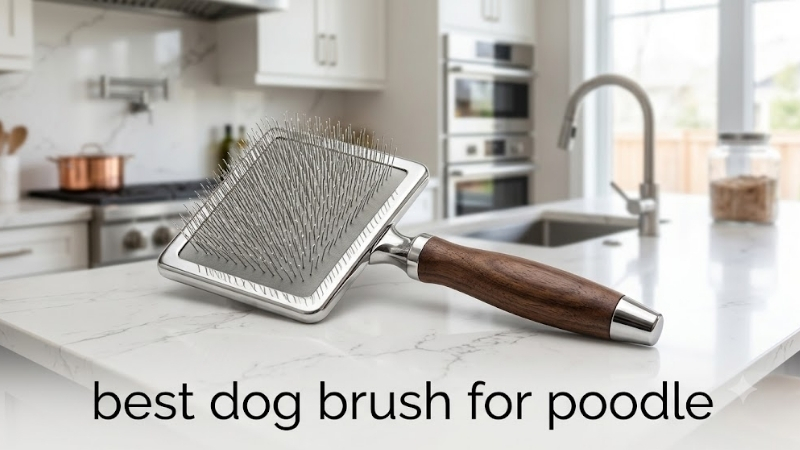
Long-pin slickers with pins near 20 mm to 27 mm are what most owners eventually buy. The pins flex slightly under pressure, which lets them pass through curl and reach the base of the coat without you having to press the pad hard against skin that is thinner than it looks. Flex is what separates a good slicker from a harsh one.
Pin tips matter as well. Fine bent pins grab curl efficiently but can scratch if dragged carelessly, while ball-tipped pins are gentler but slip on tight coat. For most home groomers a fine bent pin used with a light hand beats a ball tip used aggressively, because technique controls damage more than tip shape.
Slicker, Pin Brush or Steel Comb
The slicker does the work of separating hair and lifting out shed coat trapped inside the curl. It is the primary tool between baths, used in small sections rather than long sweeps across the whole dog, and it is what actually prevents mats forming at skin level. The best dog brush for poodle coats is always the slicker first.
A pin brush with longer, widely spaced pins is the finishing tool on a coat carried long, especially on a topknot or ear feathering where a slicker would break hair. It lifts and separates without stripping, which keeps a scandinavian or continental outline looking full rather than thinned out.
Line Brushing and Comb Checking
Line brushing is the technique that makes any brush work on a poodle. Part the coat with one hand, brush the exposed line downward from the skin outward, then move the part up a centimetre and repeat. Worked this way a full leg takes only a few minutes and nothing gets missed. The method matters more than the brand on the handle.
The steel comb is the audit. After brushing a section, run a medium-tooth comb from skin outward; free passage means done, a snag means the slicker never reached the base. Frequency also rises sharply in summer, when swimming, humidity and sand pack curl tighter than at any other time of year.
Handle Comfort and Pad Size
Pad size should match the dog rather than your preference. A full-size pad covers a standard poodle quickly but is clumsy on a toy’s face and legs, where a small or slim pad gives the control needed around the eyes, ears and pasterns without pressing pins into thin skin. Two pad sizes cover a mixed household comfortably.
Contoured, rubberised handles reduce wrist strain across the twenty to thirty minutes a thorough line brushing takes. Self-cleaning slickers with a retract button save time on cleanup, though the mechanism adds bulk and the pins are usually shorter than on dedicated long-pin models built for adult coat.
Top Picks: Five Brushes for a Poodle Coat
These five cover the full routine, from the long-pin slicker that does the heavy lifting through to the comb that tells you when to stop. Each entry notes a genuine limitation, because the best dog brush for poodle coats depends on how long the coat is being carried right now. Budget for the comb as carefully as for the brush.
| Brush | Type | Pin detail | Best for |
|---|---|---|---|
| Chris Christensen Big G | Slicker | Long pins, around 27 mm | Coats carried long |
| Chris Christensen Oval Pin Brush | Pin brush | Widely spaced pins | Topknots, ears, finishing |
| Andis Steel Pet Comb | Comb | Coarse and fine ends | Checking work, face detail |
| Hertzko Self-Cleaning Slicker | Slicker | Short retractable pins | Puppy coats, short trims |
| Safari Dematting Rake | Rake | Serrated cutting blades | Isolated mats only |
Chris Christensen Big G Slicker
This is the brush poodle people talk about, and the long pin bed is the reason. At roughly 27 mm the pins pass through a coat carried at scandinavian or continental length and reach the skin, which is exactly where mats begin and exactly where shorter slickers never manage to arrive.
The pad flexes as you work so pressure spreads across many pins instead of concentrating on a few. The obvious drawback is price, several times a supermarket slicker, and the long pins are wrong for a puppy in a short trim where they simply pass through without contacting any hair.
Chris Christensen Oval Pin Brush
A pin brush is the finishing tool, and this one is built for coats where volume needs keeping rather than stripping. Widely spaced pins lift and separate the topknot, the ear feathering and any area where a slicker would break hair and leave the finished outline looking thin and patchy.
It is also the gentler daily option for dogs that dislike the sensation of a slicker pad. Used after the slicker rather than instead of it, it settles the coat and removes the fine debris curl traps, which is why groomers finish with a pin brush before any scissoring begins. It also spreads coat oils along the hair shaft.
Andis Steel Pet Comb
Every poodle routine needs a comb, and a 7.5 inch steel comb with a coarse half and a fine half is the standard choice. The coarse teeth check body work and legs, while the fine teeth handle the muzzle, the area beneath the eyes and the skin behind the ears. Rigid steel gives a far more honest reading.
Solid steel matters here because a light comb flexes and skips over dense sections, handing you a false pass. A rigid comb either goes through to the skin or it does not. The trade-off is that a long comb is unwieldy on a toy poodle, so choose the length to suit your dog. Half-fine and half-coarse remains the most useful pattern.
Hertzko Self-Cleaning Slicker
The self-cleaning pad is genuinely useful on a puppy or a poodle kept in a short trim. Press the button and the pins retract, releasing collected hair in one motion, which turns cleanup from a fiddly job with a comb into a two-second step between one section and the next. On a busy morning that saving genuinely adds up.
Its limitation is pin length. The pins are short compared with a dedicated long-pin slicker, so on a coat carried long it works only the outer layer and leaves the base untouched. Treat it as the puppy-stage and short-trim brush, then upgrade properly once the coat grows out. The best dog brush for poodle coats changes as the dog matures.
Safari Dematting Rake
A dematting tool belongs in the kit but not in the weekly routine. Serrated blades cut through a tight mat that a slicker cannot open, working from the outer edge inward in short strokes with the mat held at its base so the skin underneath is never pulled or lifted. Work slowly and stop the moment the dog objects.
It removes coat rather than detangling it, so overuse thins a poodle’s outline visibly and takes months to grow back. Reach for it on isolated mats behind the ears or in the armpits, and if mats cover a whole area, a clip is the kinder and safer answer for the dog. Coat grows back, whereas damaged skin takes far longer.
Frequently Asked Questions
These four come up constantly from owners moving a poodle puppy into its adult coat, which is the stage where most matting problems start. Choosing the best dog brush for poodle coats is easier once these details are clear. Most matting problems trace back to the wrong pin length rather than to any lack of effort.
How often should a poodle be brushed?
Every other day is realistic for a coat carried long, and twice weekly for a short trim. The coat change between roughly nine and eighteen months is the risky window, when mats form faster than at any other stage and daily line brushing becomes genuinely necessary rather than optional.
Does a poodle need a deshedding tool?
No. Deshedding blades are designed to strip undercoat from double-coated breeds, and a poodle carries a single continuously growing coat instead. Using one cuts the hair, damages the curl pattern and creates a patchy outline. A slicker and a steel comb do everything that is genuinely needed.
Should I brush a poodle wet or dry?
Brush dry, or lightly misted with a leave-in conditioner spray. Brushing a soaking coat tightens existing mats and snaps hair, while brushing a bone-dry coat creates static and breakage. A light mist over each section just before you work it is the compromise most groomers settle on.
What if the comb still catches after brushing?
Go back to that section and line brush it again from the skin outward rather than moving on. A catch means the slicker reached the outer coat but never the base. If the area is genuinely felted against the skin, clip it out instead of trying to brush your way through it. The best dog brush for poodle coats cannot undo a felted mat.
See More:
- Dog grooming shears best
- Best dog clippers for poodles
- Best dog clippers for doodles
- Best dog brush for great pyrenees
Final Thoughts
The best dog brush for poodle coats is not a single product but a working set: a long-pin slicker for the heavy lifting, a pin brush for finishing and volume, and a steel comb to confirm the job is complete. Add line brushing as a fixed habit and a poodle coat stays comfortable, mat free and much easier to trim at home.




Write Your Review
No reviews yet. Be the first to share your experience!