
Key takeaways
- A capacity number appears without saying whether it is static, evenly distributed, or intended for a moving dog.
- The tabletop dimensions are missing, rounded up, or confused with the shipping-box dimensions.
- The listing shows a large capacity but provides no close-up photos of welds, braces, hinges, or arm clamps.
- The surface is smooth, highly reflective, or difficult to disinfect.
- The arm swivels or slides after the clamp is tightened.
- A hydraulic table has no clear information about lowering, locking, pump maintenance, or replacement parts.
- The warranty excludes nearly every structural or mechanical component.
- The table wobbles on a level floor, has sharp edges, or arrives with bent hardware.
- The manufacturer recommends leaving the dog unattended, using excessive restraint, or exceeding the stated capacity.
What's inside
Shopping for a grooming table by weight capacity alone is an easy way to buy the wrong table. A listing may advertise a 220-pound or 350-pound limit, but that number can describe static weight under ideal conditions—not a large, moving dog stepping, twisting, or leaning against one side. Buyers also overlook table dimensions, arm height, hydraulic clearance, and whether the frame stays stable on a hard floor.
The best choice matches the dog’s actual size, behavior, and grooming routine. A calm 35-pound terrier has different needs from a 110-pound dog that shifts constantly. This dog grooming table buying guide weight capacity explains how to compare the numbers, identify useful features, and avoid paying for capacity that does not improve safety.
As an Amazon Associate we earn from qualifying purchases at no extra cost to you. Product prices and availability are accurate as of the date shown and are subject to change.



Decide These 3 Things First
- Measure the dog, not just the scale weight. Record the dog’s weight, nose-to-tail length, standing height, and chest width. Add room for a natural stance and repositioning.
- Decide how often the table will move. A foldable table works well for occasional home grooming, while a hydraulic or electric model makes more sense for frequent grooming or heavier dogs.
- Set a realistic working-capacity target. Choose a table rated for at least 1.5 times the dog’s weight, and closer to two times for nervous, elderly, or highly active dogs. This is a buying cushion, not a guarantee of safety.
Size and Weight Capacity
Table dimensions are often more important than the headline capacity. For small dogs, a surface around 30 by 18 inches can be adequate. Medium dogs generally benefit from approximately 36 by 24 inches, while large dogs may need a 43-by-24-inch or larger surface, depending on body length and grooming position.
Measure the tabletop separately from the arm’s usable grooming area. A dog may technically fit on a 32-inch table but still have its hind legs hanging off during brushing. Leave at least 4 to 6 inches of usable space beyond the dog’s body length when possible.
Capacity should be treated as a ceiling, not a recommended target. For example, a table advertised with a 220-pound static capacity is not automatically the best option for a 150-pound dog. A table rated at 330 or 350 pounds may provide more margin, but only if its legs, hinges, surface, and restraint points are also designed well.
Pay attention to the word static. It typically means the table is supporting a stationary, evenly distributed load. A dog jumping onto the surface or lunging sideways creates dynamic force. Never exceed the manufacturer’s capacity, and do not use the table as a substitute for a properly fitted restraint.
Material and Surface
Most practical grooming tables use a steel frame with a sealed wood composite, aluminum, or metal tabletop. Steel is usually favored for legs and support brackets because it resists bending, but a steel frame does not make every component heavy-duty. Inspect the thickness of the legs, the welds, crossbars, hinge plates, and arm clamps.
The surface should be waterproof or highly water-resistant and easy to disinfect. A textured rubber mat is preferable to smooth painted metal because it improves paw traction while standing. Look for a mat that is bonded or tightly fitted, with no large edges where hair and moisture can collect.
For home use, a tabletop about 30 to 36 inches wide is easier to clean and store than a very large professional platform. A heavier steel model may feel more secure, but it can be difficult to carry upstairs. Check the folded dimensions and shipping weight before choosing a “portable” table.
Construction and Stability
Stability comes from the whole base, not the capacity printed on the box. Wide leg spacing, locking braces, level feet, and a rigid grooming arm all matter. On a folding model, open every hinge and check that the locking mechanism engages fully. The table should not rock when you press down near each corner.
For a dog weighing 70 pounds, a table with a 350-pound rating may still feel unsafe if it has narrow legs and a flexible arm. Conversely, a lower-priced table can be suitable for a small dog when its frame is rigid and its working load is modest.
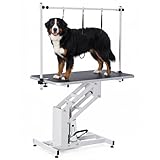
Hydraulic tables add convenience for heavier dogs because the platform can be lowered for loading and raised to a comfortable grooming height. A useful range is roughly 22 to 39 inches, though the exact range varies by model. Confirm that the lowest setting leaves enough clearance for the pump, feet, and the dog’s paws. Hydraulic systems also add weight and moving parts, so they are usually less convenient to carry than folding tables.
Comfort and Grooming Performance
Height adjustment protects the groomer’s back and makes detail work easier. A fixed table around 30 inches high may be fine for a shorter user, but taller groomers often need a platform closer to 36 inches or an adjustable model. Measure from the floor to the dog’s back, then consider your elbow position while brushing or clipping.
The grooming arm should be tall enough for the dog’s neck and body, with a secure clamp that does not slip when the dog moves. Adjustable arms are more useful than a single fixed loop. A no-sit haunch holder can help support a dog that repeatedly tries to sit, but it must be used correctly and should never replace supervision.
Prefer tables with a grooming loop or noose that can be adjusted for the dog’s neck without restricting breathing. Keep the restraint positioned so the dog cannot jump off or become tangled. Never leave a dog unattended on a grooming table, including when the table is rated for far more than the dog weighs.
Price Tiers and What You Get
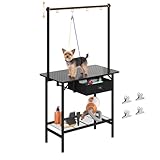
Budget: about $60 to $140. This range typically includes foldable tables for small and medium dogs, often with a 220- to 330-pound advertised static capacity. For example, a 32-by-18-inch table listed at $69.90 may be practical for compact dogs, while a 36-by-24-inch model around $109.90 offers more working room. Expect basic height adjustment, a removable or fixed arm, and limited fine-tuning.
Midrange: about $150 to $300. You may find stronger frames, larger platforms, hydraulic lifting, multiple nooses, and better height ergonomics. Hydraulic examples priced around $269.99 to $285.99 advertise up to 350 pounds and adjustment from approximately 22 to 39 inches. Verify whether the capacity applies to the table in every height position and whether accessories are included.
Premium: about $300 to $800 or more. Higher prices can bring powered lifting, heavier bases, quieter operation, replaceable mats, improved arm hardware, and longer service support. Premium pricing is worthwhile for frequent grooming, large dogs, or users who need to minimize lifting. It is unnecessary for occasional grooming of a small, cooperative dog if a stable budget table meets the measurements.
Warranty and Replacement Support
Look for at least a one-year warranty covering manufacturing defects. A longer two- or three-year warranty can be valuable on hydraulic pumps, motors, switches, and welded frames, but read the exclusions. Wear items such as mats, loops, clips, and casters may have shorter coverage.
Before buying, confirm that replacement mats, grooming arms, nooses, feet, and hydraulic components are available separately. A table that cannot be repaired may cost more over time than a slightly more expensive model with accessible parts. Save the product page, manual, and capacity statement, since warranty service may require proof of the original specifications and purchase.
Delivery and Assembly
Check the package dimensions and shipping weight, particularly for hydraulic tables. A table that weighs 100 pounds or more may require two adults to carry safely. Confirm whether the carrier delivers to the building entrance or a specific room.
Budget 20 to 60 minutes for assembling a basic folding table and potentially one to two hours for a hydraulic model, depending on the base, arm, and pedal installation. After assembly, tighten every bolt, confirm that the arm clamp locks, test the height mechanism without a dog, and place the table on a level, non-slip floor. Do not use a table with missing hardware or a damaged frame.
Spec Checklist
| Spec | Budget | Mid | Premium |
|---|---|---|---|
| Best use | Occasional grooming; small dogs | Regular home grooming; small to medium dogs | Frequent use; medium to large dogs |
| Typical tabletop | 30–32 by 18 inches | 36 by 24 inches | 43 by 24 inches or larger |
| Advertised capacity | 220–330 pounds static | 300–350 pounds static | 350 pounds or more; verify working limits |
| Height | Fixed or limited arm adjustment | About 22–39 inches on hydraulic models | Powered or broad-range hydraulic adjustment |
| Frame | Folding steel | Reinforced steel or hydraulic base | Heavy-duty steel with wide base and serviceable parts |
| Typical price | $60–$140 | $150–$300 | $300–$800+ |
Red Flags
- A capacity number appears without saying whether it is static, evenly distributed, or intended for a moving dog.
- The tabletop dimensions are missing, rounded up, or confused with the shipping-box dimensions.
- The listing shows a large capacity but provides no close-up photos of welds, braces, hinges, or arm clamps.
- The surface is smooth, highly reflective, or difficult to disinfect.
- The arm swivels or slides after the clamp is tightened.
- A hydraulic table has no clear information about lowering, locking, pump maintenance, or replacement parts.
- The warranty excludes nearly every structural or mechanical component.
- The table wobbles on a level floor, has sharp edges, or arrives with bent hardware.
- The manufacturer recommends leaving the dog unattended, using excessive restraint, or exceeding the stated capacity.
FAQ
How much weight capacity should a dog grooming table have?
Choose a rating at least 1.5 times the dog’s body weight, and consider twice the weight for dogs that move, jump, or need assistance standing. Also verify the tabletop size and stability. A high capacity does not compensate for a cramped surface or weak arm.
Is a 220-pound grooming table suitable for a 100-pound dog?
It may be suitable on paper, but only if the manufacturer’s rating applies to the assembled table and the dog fits comfortably. Because 220 pounds is often a static rating, use extra caution with a restless dog. A larger table with a wider base may be the safer choice even when the published capacity is similar.
Are hydraulic grooming tables better than folding tables?
Hydraulic tables are usually better for frequent grooming, taller users, and heavier dogs because they reduce lifting and allow more precise working height. Folding tables are lighter, less expensive, and easier to store. Choose based on use frequency and handling needs rather than capacity alone.
Can I leave my dog on a grooming table while I step away?
No. Stay within arm’s reach and supervise continuously. Use an appropriate grooming loop without tightening it around the neck, keep the table on a level surface, and remove the dog before folding, moving, or adjusting the table.




Write Your Review
No reviews yet. Be the first to share your experience!