
Key takeaways
- A weight-capacity claim with no details about frame material, leg design, or brace construction.
- A tabletop that flexes, rocks, or has lifting edge trim before the dog ever steps on it.
- Thin plastic clamps, loose arm joints, or a grooming arm that rotates under light hand pressure.
- Folding legs without visible locking braces or with feet that slide on tile, vinyl, or hardwood.
- A nonslip mat that has a strong chemical odor, curls at the edges, or cannot be removed for cleaning.
- A table marketed for large dogs that is only 32 inches long or has a narrow, unstable base.
- Electric or hydraulic models without clear instructions, replacement-part availability, or warranty coverage.
Most dog grooming table regrets come from buying for the photo rather than the dog. A compact 32-inch table may look convenient, for example, but it can feel cramped for a 55-pound retriever. A table advertised with a “heavy-duty” arm may still wobble if its clamp, frame, or folding joints are weak. And a low price is less of a bargain if the nonslip mat tears, the grooming loop is flimsy, or the table arrives with difficult-to-align parts.
The right table makes brushing, nail trimming, drying, clipping, and bathing prep safer for both you and your dog. It should hold your dog securely without forcing an awkward posture, remain stable when the dog shifts weight, and fit the space where you will actually use it. In 2026, home users can find capable folding tables for under $100, but choosing well still means looking past the included accessories.
Our top picks
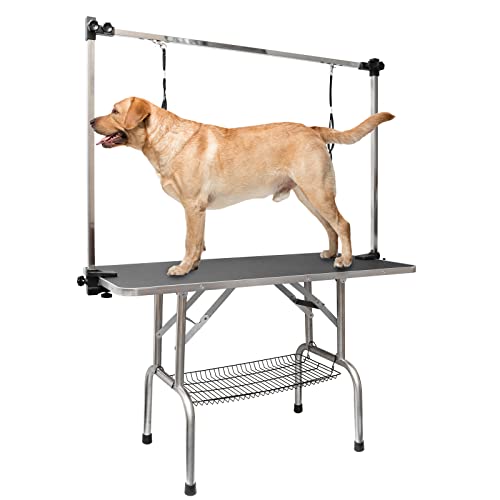 ROOMTEC 46" Dog Grooming Table
- Product Group: Pet Products
- Binding: Target
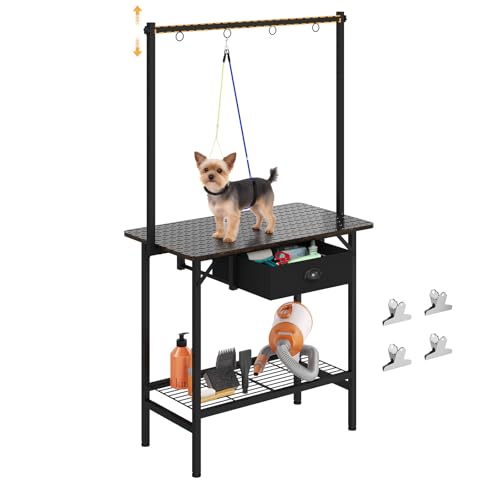

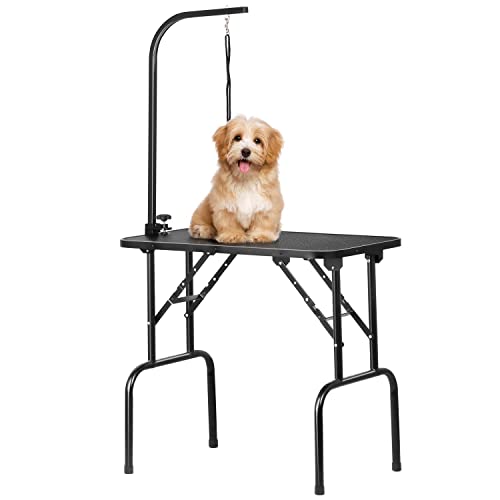
As an Amazon Associate we earn from qualifying purchases at no extra cost to you. Ratings are shown as listed on Amazon.
Decide These 3 Things First
- Measure your dog standing up. Record your dog’s nose-to-tail-base length, shoulder height, and current weight. The table surface should generally be at least 6 to 12 inches longer than your dog’s body length, excluding the tail. A 32-inch table is usually best for toy breeds and many dogs under 25 pounds; 42- to 46-inch tables are more practical for medium breeds.
- Choose a working height. A fixed-height table generally needs a surface around 30 to 36 inches from the floor for most standing grooming tasks. If more than one person will use the table, or if you groom dogs of very different sizes, an adjustable-height model can be worth the added cost and weight.
- Decide whether portability or permanence matters more. Folding tables are ideal for apartments, occasional grooming, and storage between uses. A hydraulic or electric table is better for frequent grooming, senior dogs, or dogs that should not be lifted onto a high surface.
Size and Weight Capacity
Table size affects safety as much as convenience. Dogs need enough room to stand squarely, turn carefully when necessary, and remain away from the edge while you work. For small dogs such as Yorkies, Shih Tzus, and miniature poodles, a 30- to 32-inch-long table with a surface roughly 18 to 24 inches deep is often sufficient. A 32-inch Yaheetech-style home table is a sensible format for this group, provided its stated capacity exceeds the dog’s weight by a comfortable margin.
For medium dogs, look for a top measuring about 42 to 46 inches long and 24 inches wide. This is the common size of folding professional-style tables, including 46-inch options from ROOMTEC and VEVOR. It gives a beagle, cocker spaniel, border collie, or similar dog more usable standing space without requiring a permanent salon setup.
Do not select based on the maximum load number alone. A 330-pound static load capacity means the table was designed to support that amount when weight is distributed and the table is stationary; it does not mean a 330-pound active dog will be easy or safe to groom on it. For a dog that weighs 60 pounds, a table rated at 150 to 200 pounds or more is a reasonable starting point if the frame, legs, and joints are sturdy. For dogs over about 80 pounds, prioritize a wider base, reinforced crossbars, and ideally a lift table rather than simply chasing the highest listed capacity.
Tabletop Material and Surface Grip
The best tabletop combines a rigid core with a grippy, easy-clean surface. Common choices include MDF or engineered wood topped with a textured rubber, PVC, or pebbled plastic layer. Stainless steel is durable and easy to sanitize, but it should still have a secure nonslip mat; bare metal becomes slippery when wet and can feel cold under paws.
Look for a removable mat when possible. It is easier to rinse hair, shampoo residue, and nail dust from a mat than from seams permanently bonded to the table. A good mat should lie flat without curled edges, be thick enough to cushion paws modestly, and have a texture your dog can stand on without splaying. Replace it if it becomes cracked, slick, deeply gouged, or difficult to clean.
For home grooming, a tabletop around 0.7 to 1 inch thick is common. More important than thickness is whether the top flexes when your dog steps onto it. Press down on the assembled surface before the first use. Any obvious sagging, loose edge trim, or separation between the mat and top is a reason to return the table.
Frame, Legs, and Grooming Arm Construction
A stable grooming table needs more than a strong top. Inspect the leg design, cross braces, feet, and folding locks. Powder-coated steel legs are common at every price level and can be very durable when the tubing, welds, and locking hardware are substantial. Stainless-steel frames resist corrosion well, especially in humid laundry rooms or bath areas, but they often cost more.
Wide, splayed legs are generally steadier than narrow vertical legs. On folding models, the leg braces should lock firmly and sit flush rather than rattling. Adjustable feet are useful on uneven floors, while broad rubber foot caps protect hard flooring and reduce sliding. If the table shifts when you push lightly from the side while empty, it will shift more with a nervous dog on top.
The grooming arm deserves equal scrutiny. A clamp-on arm should use a metal clamp with a large tightening knob and a protective pad that does not crush or scar the tabletop edge. Choose an arm that adjusts high enough for your dog’s head without requiring the loop to pull upward. For many small and medium dogs, an arm adjustment range of roughly 24 to 36 inches above the table is useful.
Some 46-inch tables include two adjustable arms, a grooming loop, and a no-sit haunch holder. These can help position a wiggly dog, but restraint accessories are not substitutes for supervision. Never leave a dog attached to a grooming loop, and never tighten a loop to force an uncomfortable position. The goal is gentle positioning, not immobilization.
Comfort and Grooming Performance
A table should make routine care easier without turning it into a stressful event. The correct height lets you brush or trim without bending at the waist for 20 to 40 minutes at a time. If you are 5 feet 2 inches tall, a 36-inch fixed tabletop may feel too high; if you are 6 feet tall, a 30-inch table may cause back strain. Stand beside a counter or table at home and test your most comfortable elbow height before ordering.
For dogs, secure footing is the priority. Start with short sessions of 3 to 5 minutes, rewarding calm standing with treats. A grooming table is not a place to train a fearful dog by restraint. If your dog has arthritis, reduced vision, hip dysplasia, or difficulty jumping, use a stable ramp or steps, or choose a low-entry lift table. Repeatedly lifting a 50- to 70-pound dog onto a 30-inch-high folding table is difficult and can be unsafe for both of you.
Useful accessories include a mesh storage tray for brushes and clippers, a detachable grooming loop, and a haunch holder for brief positioning during trimming. A mesh tray should sit high enough that it does not interfere with your knees, usually 6 to 10 inches below the tabletop. Keep sharp shears in a closed case rather than loose in an open tray when your dog is on the table.
Price Tiers and What You Get
Budget: $55 to $85. This range includes basic 30- to 32-inch folding tables for small dogs. Expect a fixed-height top, one grooming arm, a simple loop, and a basic nonslip surface. A 32-inch table around $64 to $70 can be a good choice for occasional nail trims and brushing, particularly for dogs under 25 pounds. Check the leg locks and mat quality carefully.
Mid-range: $90 to $160. This is the sweet spot for many home users. You can find 42- to 46-inch folding tables, stronger frames, mesh storage trays, adjustable arms, and stated capacities in the 220- to 330-pound range. The ROOMTEC 46-inch model at about $130 and the VEVOR 46-inch model at about $108 illustrate the sort of size and accessory package available here.
Premium: $300 to $1,200 or more. This category includes hydraulic and electric lift tables, often with lower entry heights, foot pedals, heavier bases, and professional-duty construction. They are worthwhile for frequent grooming, multi-dog households, large breeds, and mobility-limited pets. Avoid paying premium prices merely for extra loops or decorative finishes; lift function, stability, and serviceable parts are what justify the upgrade.
Warranty, Delivery, and Assembly
Read the warranty before buying, especially for a table with moving or powered parts. A 30-day return window is useful for checking fit and stability, but a 1-year limited warranty provides more reassurance for a folding frame, clamp, or adjustable mechanism. For electric tables, confirm whether the motor, foot pedal, hydraulic system, and electrical components have separate coverage terms.
Measure the delivery path as well as the grooming area. A folded 46-inch table may arrive in a carton roughly 48 to 52 inches long and can weigh 35 to 55 pounds. A compact 32-inch model may weigh closer to 20 to 30 pounds. If you live upstairs, plan for help carrying a large package.
Assembly typically takes 15 to 45 minutes for a folding table. Before putting your dog on it, tighten every bolt, unfold and lock the legs several times, attach the arm clamp, and test the surface on the actual floor where it will be used. Recheck fasteners after the first few grooming sessions and every few months thereafter.
Spec Checklist
| Spec | Budget | Mid | Premium |
|---|---|---|---|
| Typical price | $55-$85 | $90-$160 | $300-$1,200+ |
| Best for | Small dogs; occasional use | Small to medium dogs; regular home use | Large dogs, seniors, frequent grooming |
| Typical tabletop length | 30-32 inches | 42-46 inches | 42-50 inches |
| Working height | Usually fixed, 30-36 inches | Fixed or limited adjustment | Hydraulic or electric lift, often about 10-40 inches |
| Frame features | Folding steel legs, basic braces | Reinforced braces, tray, stronger clamp | Heavy base, lift mechanism, professional controls |
| Accessories | One arm and loop | Tray, loop, possibly second arm or haunch holder | Professional arm system, restraint points, optional ramps |
Red Flags
- A weight-capacity claim with no details about frame material, leg design, or brace construction.
- A tabletop that flexes, rocks, or has lifting edge trim before the dog ever steps on it.
- Thin plastic clamps, loose arm joints, or a grooming arm that rotates under light hand pressure.
- Folding legs without visible locking braces or with feet that slide on tile, vinyl, or hardwood.
- A nonslip mat that has a strong chemical odor, curls at the edges, or cannot be removed for cleaning.
- A table marketed for large dogs that is only 32 inches long or has a narrow, unstable base.
- Electric or hydraulic models without clear instructions, replacement-part availability, or warranty coverage.
FAQ
What size grooming table should I buy for a small dog?
For most dogs under 25 pounds, start with a 30- to 32-inch-long table that is 18 to 24 inches deep. Choose a longer model if your dog is long-bodied, highly active during grooming, or if you want extra space for drying and brushing.
Can I use a grooming table for a 70-pound dog?
Yes, but a 42- to 46-inch table with a reinforced frame and broad, stable legs is a better minimum than a compact table. Consider how the dog will get onto the surface. A ramp, steps, or an adjustable lift table may be safer than lifting a 70-pound dog.
Are grooming loops safe?
They can be safe for brief, closely supervised grooming when fitted loosely enough for normal breathing and comfortable head movement. Never leave a dog unattended on a grooming table, never use a loop as a tie-out, and stop if the dog panics, coughs, or struggles intensely.
Is a folding grooming table sturdy enough for home use?
A well-built folding table is sturdy enough for many home grooming routines. Prioritize locked cross braces, rubberized feet, a rigid nonslip top, and a secure grooming-arm clamp. For daily professional use, very large dogs, or dogs with mobility issues, a heavier hydraulic or electric table is usually the better long-term choice.






Write Your Review
No reviews yet. Be the first to share your experience!