
Key takeaways
- Buying by dog weight alone: Two dogs with the same weight can have very different body lengths. Measure the dog’s body, not just the scale reading.
- Confusing overall length with tabletop length: A table advertised as 45 or 46 inches may include the frame or grooming arm. Confirm the actual working surface.
- Choosing the maximum weight rating: Select a capacity well above your dog’s weight to account for movement and equipment.
- Ignoring width: A long but narrow table can make a large dog feel unstable. Most large dogs benefit from a surface at least 24 inches wide.
- Skipping height adjustment: A table that is too low can cause back strain; one that is too high makes it harder to control the dog.
- Forgetting the grooming arm: Check the arm’s height, attachment point, and noose arrangement. The restraint should support positioning, never act as a substitute for supervision.
- Underestimating storage: Foldable models still need space for the arm, tray, noose, and folded legs.
The Short Answer
For most large dogs, choose a grooming table with a work surface of at least 36 by 24 inches (91 by 61 cm). A 40- to 48-inch-long table (102 to 122 cm) is a better choice for tall, long-bodied breeds such as German Shepherds, Golden Retrievers, Standard Poodles, Dobermans, and large mixed breeds. The table should support your dog’s weight with a generous safety margin and have an adjustable height of roughly 22 to 39 inches (56 to 99 cm).
If you are asking what size grooming table for large dog use at home, prioritize the tabletop length, width, and weight rating before looking at accessories. Your dog should be able to stand naturally without its front or rear paws hanging over an edge, while you should be able to reach the back, legs, and underside without bending excessively. For many large dogs, a 43- to 46-inch table with a 23- to 24-inch-wide surface is the most practical middle ground.
Our top picks

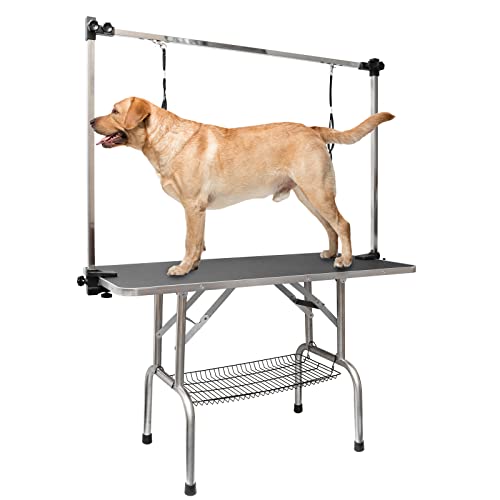 ROOMTEC 46" Dog Grooming Table
- Product Group: Pet Products
- Binding: Target
As an Amazon Associate we earn from qualifying purchases at no extra cost to you. Ratings are shown as listed on Amazon.
Measure your dog from the front of the chest to the base of the tail, then add at least 6 inches (15 cm). For width, measure the widest part of the rib cage and add 6 to 8 inches (15 to 20 cm). These allowances provide room for repositioning without making the table unnecessarily oversized.
Standard Sizes
Grooming tables are commonly sold by tabletop dimensions, not by the dog’s total height. The following sizes cover most home and professional needs:
| Tabletop size | Metric size | Recommended dog size | Typical weight capacity | Best use |
|---|---|---|---|---|
| 30 x 18 in | 76 x 46 cm | Small to medium dogs up to about 40 lb | 100–200 lb | Compact home grooming |
| 36 x 24 in | 91 x 61 cm | Medium to large dogs up to about 70 lb | 200–300 lb | Occasional grooming and bathing |
| 40 x 24 in | 102 x 61 cm | Large dogs up to about 90 lb | 250–350 lb | Home grooming for retrievers and similar breeds |
| 43 x 24 in | 109 x 61 cm | Large and extra-large dogs up to about 110 lb | 300–400 lb | Frequent home or professional grooming |
| 46 x 24 in | 117 x 61 cm | Extra-large dogs and long-bodied breeds | 300–500 lb | Maximum working room |
These weight ranges describe a table’s structural capacity, not a recommendation to place a dog at the maximum limit. A 100-pound dog should not be put on a 100-pound-rated table. Choose a table rated for at least two to three times your dog’s actual weight, particularly if the dog shifts, resists handling, or steps on and off the surface. A high capacity also helps the table remain stable when you use a dryer, clipper, or grooming arm.
Table height matters just as much as the surface. A fixed table around 30 inches high may work for a standing groomer, but an adjustable model is more versatile. A range of 22 to 39 inches (56 to 99 cm) accommodates seated work, bathing tasks, and different groomer heights. Electric tables generally offer the smoothest adjustment for heavier dogs, while hydraulic models do not require a power outlet. Foldable tables save storage space but can have more movement than a heavy professional base.
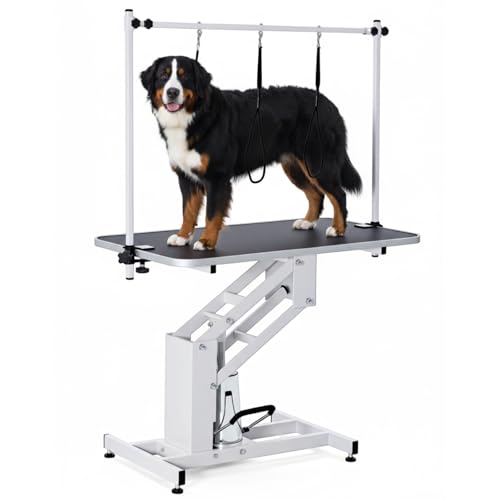
For example, the LEIBOU 45-inch foldable table has an adjustable height range of approximately 23 to 33.8 inches and a stated capacity of up to 260 pounds; its listed price is about $125. The Garvee 43.3-inch hydraulic model adjusts from 22 to 39 inches and lists a 350-pound capacity, with a price around $275. A ROOMTEC 46-inch foldable table is listed at about $125 and includes an adjustable arm, noose, and mesh tray. These products illustrate the common large-dog range, but always verify the tabletop dimensions separately from the overall frame length.
How to Measure Your Space
- Measure the dog first. Record body length from the chest to the tail base, shoulder height from the floor to the top of the shoulders, and body width at the rib cage. Add at least 6 inches to the body length and 6 to 8 inches to the width.
- Measure the storage location. Record the available length, width, and height where the folded or assembled table will live. A 46-inch table may fold nearly flat, but its legs, arm, and tray can still require a storage footprint of roughly 48 by 26 inches.
- Allow working clearance. Leave at least 24 inches (61 cm) on the side where you stand. For a large or nervous dog, 30 to 36 inches (76 to 91 cm) gives you more room to move safely.
- Check doorways and routes. Measure doors, stair landings, elevators, and tight turns between storage and the grooming area. A table that fits in a room may not fit through a 28-inch doorway when assembled.
- Account for the grooming arm. An H-frame or adjustable arm adds height above the tabletop. Check for ceiling fans, shelves, cabinets, and low beams. Plan for at least 12 inches (30 cm) of clearance above the highest arm setting.
- Locate outlets and water. Electric tables and dryers need a grounded outlet, while a bathing station should be close to water and drainage. Keep cords away from wet areas and use a ground-fault circuit interrupter outlet where appropriate.
By Room or Use Case
Small bathroom
Choose a 36 x 24-inch table if your dog is medium-large and the room is tight. A foldable table with a removable arm is easier to store behind a door or beside a washer. Confirm that the legs do not block the toilet, cabinet, or shower entrance. For a 90-pound dog, a 40- to 43-inch table may be safer, but measure the room before buying.
Laundry room or utility room
A 40- to 46-inch table is usually practical in a utility room because these spaces often have durable flooring and nearby water. A mesh tray can catch hair, while a hydraulic or electric lift reduces the need to lift a heavy dog. Leave enough clearance to open appliances and avoid placing the table directly in front of a dryer vent.
Garage
The garage can accommodate a professional-size table, but temperature and floor conditions matter. Look for a rust-resistant frame, non-slip tabletop, and adjustable feet if the concrete is uneven. A 46-inch surface gives extra room for large breeds, but the table should still have a secure grooming arm and at least a 300-pound rating for a dog weighing 100 to 120 pounds.
Professional grooming area
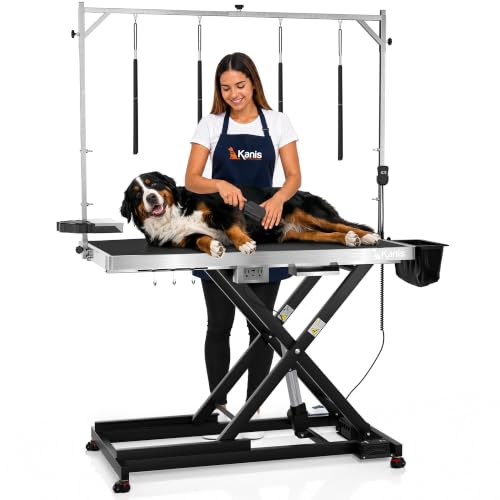
For frequent use, prioritize a rigid base, easy height adjustment, and a replaceable non-slip surface. Electric professional tables commonly cost about $500 to $1,200 or more, depending on lift capacity and controls. The KANIS Professional Electric Dog Grooming Table, for example, is listed around $700. A 43- to 48-inch top works well for many large dogs, while separate small and medium tables may be more efficient than using one oversized table for every breed.
Travel or occasional grooming
Choose a folding 36- to 45-inch table that weighs enough to remain stable but is manageable for one person. Check the folded dimensions and frame weight, not just the tabletop. A carrying handle, locking legs, and a removable grooming arm are useful for storage and transport.
Common Sizing Mistakes
- Buying by dog weight alone: Two dogs with the same weight can have very different body lengths. Measure the dog’s body, not just the scale reading.
- Confusing overall length with tabletop length: A table advertised as 45 or 46 inches may include the frame or grooming arm. Confirm the actual working surface.
- Choosing the maximum weight rating: Select a capacity well above your dog’s weight to account for movement and equipment.
- Ignoring width: A long but narrow table can make a large dog feel unstable. Most large dogs benefit from a surface at least 24 inches wide.
- Skipping height adjustment: A table that is too low can cause back strain; one that is too high makes it harder to control the dog.
- Forgetting the grooming arm: Check the arm’s height, attachment point, and noose arrangement. The restraint should support positioning, never act as a substitute for supervision.
- Underestimating storage: Foldable models still need space for the arm, tray, noose, and folded legs.
FAQ
Is a 36-inch grooming table big enough for a large dog?
It can be adequate for a compact large dog, especially one under about 70 pounds with a short body. For a long-bodied or heavier dog, a 40- to 46-inch table is more comfortable and gives you safer working room.
What is the best grooming table size for a 100-pound dog?
Start with a 43 x 24-inch surface and a weight rating of at least 300 pounds. A 46-inch table is preferable for long-backed breeds or dogs that need frequent repositioning. Choose an adjustable height so the dog can be groomed without excessive bending.
How high should a grooming table be for a large dog?
The ideal height depends on your own height and whether you stand or sit. Many groomers need the tabletop around elbow level, often 28 to 36 inches from the floor. An adjustable range of 22 to 39 inches provides the most flexibility for large dogs.
Do large dogs need an electric grooming table?
Not always. A hydraulic table is suitable when you want height adjustment without a power cord, while a folding table costs less and stores more easily. An electric model is worthwhile for frequent grooming or when lifting a large dog would be difficult. In every case, select a stable base, non-slip surface, secure arm, and capacity comfortably above the dog’s weight.





Write Your Review
No reviews yet. Be the first to share your experience!