
Key takeaways
- Better working height. A raised table can reduce bending, squatting, and twisting. For owners with back, knee, or shoulder discomfort, bringing the dog closer to waist or chest height can make a long brushing session much more manageable.
- More consistent grooming. A defined surface gives you a repeatable place to brush, trim paw hair, clean ears, or inspect skin. Dogs often learn the routine when the table is introduced gradually and paired with treats.
- Improved access to the coat. You can usually reach the legs, underside, tail, and rear more easily than when a dog is standing on the floor. This is particularly helpful for curly, double-coated, and long-haired breeds that need frequent maintenance.
- Less hair and water on the floor. A mesh tray can catch loose hair, while a removable mat is easier to clean than a carpet or bath mat. It will not eliminate mess, but it can make cleanup more contained.
- Useful for routine nail care. The table can keep the dog at a comfortable height while you handle one paw at a time. Good lighting and a calm helper are still more important than the table itself.
- Folds for storage. Many home models collapse to a relatively narrow profile, making them practical for a closet, garage, or laundry room. Check the folded dimensions before buying; a 40-pound table is not something most people want to move frequently.
- Potentially cheaper than repeated salon visits. If professional grooming costs approximately $50 to $120 per appointment depending on coat and location, a $60 to $180 table may pay for itself over several sessions. You still need clippers, brushes, a dryer, shampoo, and the skill to use them safely.
The Short Answer
Yes—if your dog can safely tolerate a grooming loop and you plan to groom at home at least several times a year. A dog grooming table can make brushing, trimming, nail care, ear cleaning, and drying more controlled and less tiring. It is not automatically safer or more comfortable, however. The table only helps when it is the correct size, placed on a stable surface, and used with constant supervision.
For many owners, the real value is improved positioning. Instead of kneeling on the floor or chasing a damp dog around the bathroom, you can keep the dog at a workable height and reach every side more easily. For a nervous, aggressive, very large, or highly active dog, professional grooming may still be the better choice.
Our top picks
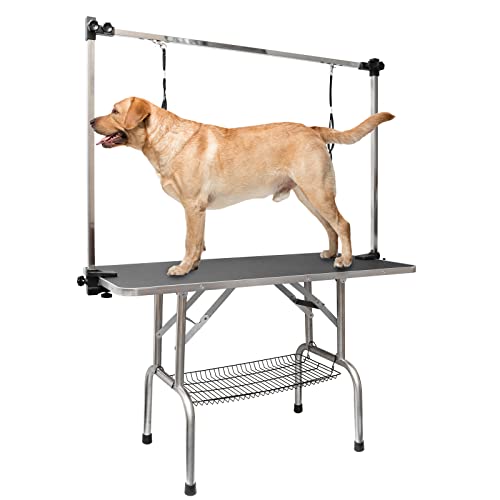 ROOMTEC 46" Dog Grooming Table
- Product Group: Pet Products
- Binding: Target
As an Amazon Associate we earn from qualifying purchases at no extra cost to you. Ratings are shown as listed on Amazon.
What You Actually Get
A home grooming table is usually a raised platform with a textured, non-slip mat, an adjustable grooming arm, and one or two restraints. Common tabletop lengths range from about 30 to 46 inches, while widths are typically 18 to 24 inches. Foldable models often weigh approximately 30 to 55 pounds, depending on the frame, drawers, and accessories.
The grooming arm generally adjusts from roughly 20 to 32 inches above the tabletop. Its purpose is to guide the dog’s head and limit sudden movement, not to lift, hang, or choke the dog. A properly fitted loop should allow normal breathing and should never be left attached without an adult holding or watching the dog.
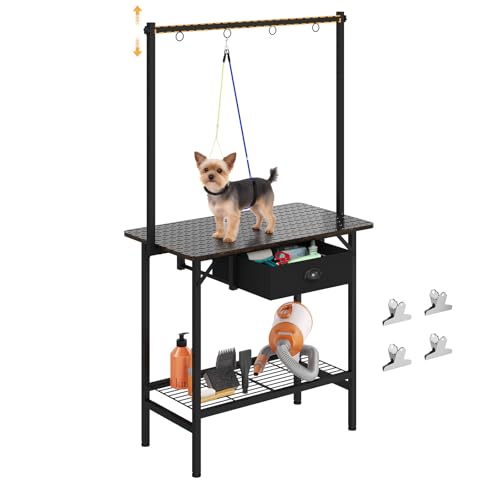
Some tables include a mesh tray beneath the surface to catch hair and water. Others add storage drawers, a removable washable mat, a hair-resistant surface, or a second loop. These extras can be useful, but they do not necessarily indicate better stability or construction.
As a practical price reference for 2026, compact home tables commonly cost about $60 to $90, while larger foldable models with taller arms and more substantial frames often cost about $120 to $180. A product such as the roughly $65, 32-inch table with drawers and a mesh tray is aimed at small dogs and light-duty grooming. A roughly $125, 46-inch ROOMTEC-style table offers more surface area for medium dogs, larger coats, or owners who want additional working room.
Pros
- Better working height. A raised table can reduce bending, squatting, and twisting. For owners with back, knee, or shoulder discomfort, bringing the dog closer to waist or chest height can make a long brushing session much more manageable.
- More consistent grooming. A defined surface gives you a repeatable place to brush, trim paw hair, clean ears, or inspect skin. Dogs often learn the routine when the table is introduced gradually and paired with treats.
- Improved access to the coat. You can usually reach the legs, underside, tail, and rear more easily than when a dog is standing on the floor. This is particularly helpful for curly, double-coated, and long-haired breeds that need frequent maintenance.
- Less hair and water on the floor. A mesh tray can catch loose hair, while a removable mat is easier to clean than a carpet or bath mat. It will not eliminate mess, but it can make cleanup more contained.
- Useful for routine nail care. The table can keep the dog at a comfortable height while you handle one paw at a time. Good lighting and a calm helper are still more important than the table itself.
- Folds for storage. Many home models collapse to a relatively narrow profile, making them practical for a closet, garage, or laundry room. Check the folded dimensions before buying; a 40-pound table is not something most people want to move frequently.
- Potentially cheaper than repeated salon visits. If professional grooming costs approximately $50 to $120 per appointment depending on coat and location, a $60 to $180 table may pay for itself over several sessions. You still need clippers, brushes, a dryer, shampoo, and the skill to use them safely.
Cons
- It does not train the dog for you. A frightened dog may freeze, jump, twist, or bite when placed on a table. Start with short, treat-based sessions while the table is on the floor or at its lowest safe height, and do not force a dog that is panicking.
- Restraints introduce risk. A loop can prevent a jump but can also cause injury if it is too tight, attached incorrectly, or left unattended. Never use the arm as a substitute for holding the dog, and never leave a restrained dog alone, even for a moment.
- Weight and size limits vary. A table may support a certain static weight but still feel cramped or unstable for a long-bodied dog. A 32-inch tabletop may work well for a Shih Tzu, Toy Poodle, or similar small breed but be unsuitable for a Cocker Spaniel or larger dog. Leave enough room for all four feet without crowding the edges.
- Stability can be disappointing. Lightweight folding legs are convenient, but they may wobble when a dog shifts its weight. Look for locking legs, rubber feet, reinforced joints, and a stated weight capacity. Avoid using a table on an uneven floor or slippery tile.
- It takes up storage space. Even a folding table may be 36 to 48 inches long when stored. Models with drawers and a heavy steel frame can be difficult to carry, especially up stairs.
- It cannot replace every grooming tool. A table will not dry a coat, remove severe mats, or safely handle a dog with a skin condition. It also does not make scissor work or clipper use risk-free.
- Cleaning can be tedious. Hair can collect around hinges, drawer tracks, arm clamps, and the mesh tray. A washable mat helps, but you may still need a vacuum, disinfectant safe for pets, and regular inspection for rust or damaged hardware.
Who Should Buy It
Buy a grooming table if you have a small or medium dog that needs regular brushing, sanitary trimming, paw maintenance, or occasional bathing and drying. It is especially worthwhile for owners who groom weekly, have limited mobility, or are tired of working on the floor. Choose a tabletop at least 6 to 10 inches longer than your dog’s body length from shoulders to the base of the tail, and verify both the table’s weight limit and the manufacturer’s recommended dog size.
A 32-inch table in the $60 to $90 range is usually the more sensible choice for compact breeds and limited storage. A 46-inch model around $120 to $180 may be more comfortable for medium dogs or owners who need room to work around a dense coat. In either case, prioritize a firm frame, non-slip feet, rounded edges, and a mat that can be removed and washed.
Who Should Skip It
Skip a home grooming table if your dog has a history of lunging, biting, severe panic, fainting, or dangerous escape attempts during handling. Ask a veterinarian or qualified professional groomer for guidance instead. A table is also a poor purchase if you only brush your dog a few times a year, have no secure storage, or expect the product to solve grooming problems without practice.
Owners of giant breeds should be cautious with consumer folding tables. Even when the stated weight capacity seems adequate, the platform may not provide enough length or stability. A floor-level grooming area, heavy professional table, or salon appointment may be safer.
Cheaper Alternatives
| Option | Cost | Trade-off |
|---|---|---|
| Rubber-backed bath mat on the floor | $15–$35 | Lowest cost and easy to store, but you must kneel or bend and there is no grooming arm. |
| Folding utility table with a non-slip mat | $40–$90 | Provides height and space, but lacks a purpose-built arm, grooming loop, hair tray, and pet-safe edges. |
| Portable pet grooming hammock or sling | $15–$40 | Useful for some nail trims, but unsuitable for full brushing, bathing, or dogs that struggle when suspended. |
| Basic 30- to 32-inch grooming table | $60–$90 | Affordable entry point for small dogs, but less room and often lighter construction than larger models. |
| Professional grooming appointment | $50–$120 per visit | Costs more over time, but provides trained handling, specialized equipment, and a safer choice for difficult coats or behavior. |
FAQ
Are dog grooming tables safe?
They can be safe when the table is level and locked, the dog fits comfortably, and an adult maintains direct supervision. Introduce the table slowly, use rewards, keep sessions brief, and remove the restraint immediately if the dog coughs, struggles, or shows signs of distress.
What size grooming table do I need?
Measure your dog from the shoulders to the base of the tail and choose a tabletop at least 6 to 10 inches longer. The dog should be able to stand naturally without placing its paws near the edge. For many small dogs, a 30- to 32-inch table is sufficient; medium dogs often benefit from a 40- to 46-inch surface.
Can I use a grooming table for bathing?
Only if the model is specifically designed for wet use and the manufacturer permits it. Many folding grooming tables can handle damp brushing or drying but are not intended to sit in standing water. A bathtub, walk-in shower, or dedicated bathing station is usually safer for a full wash.
Is a grooming table worth the money?
Usually, yes, for owners who groom regularly and can train their dog to stand calmly. The best value is not the table with the most drawers or accessories; it is the model with a stable frame, suitable dimensions, a washable non-slip surface, and reliable locking hardware. For occasional grooming or a difficult dog, professional care may offer better value and less risk.






Write Your Review
No reviews yet. Be the first to share your experience!