
Key takeaways
- More control near the quick. A grinder removes tiny amounts of nail at a time. That can be reassuring when trimming dark nails, where the quick is difficult to see.
- Smoother nail edges. Clippers can leave sharp corners or a split edge. Grinding rounds the tip, which is more comfortable for dogs and less likely to scratch skin, floors, or furniture.
- Useful for thick or hard nails. Large dogs and senior dogs often have dense nails that require considerable hand pressure with standard clippers. A motorized grinder does much of the removal work.
- Less risk of crushing the nail. Dull or undersized clippers can squeeze a nail before cutting it. A grinder avoids that particular pressure and may be preferable for brittle nails.
- One tool can serve multiple pets. With the correct speed and bit, the same grinder can work for small, medium, and large dogs, as well as cats. Always clean the grinding surface between pets.
- Often affordable. A $17 to $25 grinder can cost less than several professional nail-trimming appointments. It may pay for itself if you groom regularly.
- Good for gradual maintenance. Short, frequent sessions can keep nails at a manageable length without attempting a stressful full trim every few weeks.
The Short Answer
Yes—a nail grinder can be a safer, smoother choice than clippers for many dogs, but only if your dog can be introduced to the sound and vibration gradually. The best nail grinder for dogs pros and cons decision depends less on the brand than on your dog’s temperament, nail thickness, and your willingness to work slowly.
Grinders use a rotating sanding drum or diamond bit to remove nail material little by little. That makes it easier to round sharp edges and reduce the chance of cutting into the quick. However, the motor can be noisy, the process takes longer than a quick clip, and careless use can create heat or irritation.
Our top picks
 Whisper Quiet Dog Nail Grinder Safe &
- Product Group: Pet Products
- Binding: Misc.
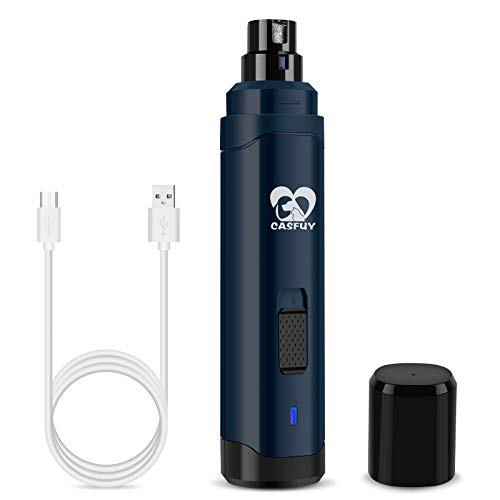 Casfuy Dog Nail Grinder Upgraded
- Product Group: Pet Products
- Binding: Health and Beauty
As an Amazon Associate we earn from qualifying purchases at no extra cost to you. Ratings are shown as listed on Amazon.
What You Actually Get
A typical rechargeable dog nail grinder includes a handheld motor, a sanding wheel or grinding head, one or more speed settings, a protective nail guard, and a USB charging cable. Some models also include interchangeable grinding bands or a small LED light.
Most consumer units are compact, usually about 5 to 7 inches long and 2 to 4 inches wide, with weights in the approximate 5- to 10-ounce range. That size is comfortable for short grooming sessions but can feel bulky if you have small hands or need to hold a nervous dog steady.
Budget pet grinders commonly cost about $15 to $35. The Casfuy Dog Nail Grinder Upgraded, for example, is listed for under $20, while the Whisper Quiet Dog Nail Grinder Safe & Stress-Free for Sensitive Dogs Cats is listed for under $30. At this price level, expect a small rechargeable appliance rather than professional salon equipment. Motor power is often described by speed instead of wattage, and many consumer models do not publish a meaningful watt rating. In practice, the important features are low vibration, usable speed control, a comfortable grip, and a sanding surface that does not clog quickly.
Using one requires more attention than simply pressing a clipper around the nail. You will need to expose one toe at a time, touch the grinder to the nail for only a few seconds, check your progress, and stop before the nail becomes warm. For dark nails, remove small amounts and look for the changing center of the nail rather than trying to shorten it dramatically in one pass.
Pros
- More control near the quick. A grinder removes tiny amounts of nail at a time. That can be reassuring when trimming dark nails, where the quick is difficult to see.
- Smoother nail edges. Clippers can leave sharp corners or a split edge. Grinding rounds the tip, which is more comfortable for dogs and less likely to scratch skin, floors, or furniture.
- Useful for thick or hard nails. Large dogs and senior dogs often have dense nails that require considerable hand pressure with standard clippers. A motorized grinder does much of the removal work.
- Less risk of crushing the nail. Dull or undersized clippers can squeeze a nail before cutting it. A grinder avoids that particular pressure and may be preferable for brittle nails.
- One tool can serve multiple pets. With the correct speed and bit, the same grinder can work for small, medium, and large dogs, as well as cats. Always clean the grinding surface between pets.
- Often affordable. A $17 to $25 grinder can cost less than several professional nail-trimming appointments. It may pay for itself if you groom regularly.
- Good for gradual maintenance. Short, frequent sessions can keep nails at a manageable length without attempting a stressful full trim every few weeks.
Cons
- Noise and vibration can frighten dogs. Even products marketed as whisper-quiet still produce a mechanical hum. A sensitive dog may react to the sound before the grinder touches a paw.
- It takes longer than clipping. A practiced owner might clip all four paws in a few minutes, while grinding may take 10 to 20 minutes, especially during the training phase.
- Heat can build up. Holding the abrasive surface against one nail too long can make it uncomfortable. Use brief touches—often one to three seconds—then pause and feel the nail area.
- Dust and odor are possible. Ground nail material can create fine dust, and friction may produce a faint burnt smell if the bit is pressed too firmly. Work in a ventilated area and wipe paws afterward.
- The tool can snag hair. Long hair around the toes should be secured away from the rotating head. Hair caught in the grinder can cause pain and make future grooming more difficult.
- Battery performance varies. Inexpensive rechargeable models may need charging after several grooming sessions. A unit that slows noticeably as the battery drains can produce uneven results.
- It does not remove the need for restraint and training. A grinder is not automatically safer if the dog is moving constantly. Forcing a frightened dog can create a lasting fear of paw handling.
- Replacement parts may be limited. Sanding bands and heads wear out. Before buying, check whether replacement abrasives are readily available and reasonably priced.
Who Should Buy It
A nail grinder is a strong choice for owners whose dogs have thick, dark, or unusually curved nails. It is also useful if your dog has previously experienced painful clipping, if you want rounded edges, or if you prefer making small corrections over several sessions.
Look for at least two speed settings, a motor that starts smoothly, a guard with openings sized for your dog’s nails, and a grip that does not require constant squeezing. A lower speed is generally more comfortable for small dogs and nervous beginners; a higher speed can make quicker work of thick nails once your dog is accustomed to it. A rechargeable model weighing roughly 5 to 10 ounces is usually easier to control than a heavy corded tool.
Plan a gradual introduction. Let your dog sniff the device while it is off, reward calm behavior, then turn it on several feet away. Over multiple sessions, bring it closer, touch it briefly to a paw without grinding, and eventually work on one nail. Treats, a non-slip mat, and a second person can make the process easier.
Who Should Skip It
Skip a grinder if your dog panics at electric toothbrushes, clippers, vacuums, or other vibrating objects and cannot relax with patient desensitization. A professional groomer or veterinarian may be a better option for a dog that bites, thrashes, or has a medical condition affecting the paws.
You may also prefer traditional clippers if your dog calmly accepts a quick trim and you need the fastest possible routine. Grinders are not ideal when you have limited time, cannot keep loose hair away from the rotating head, or are unlikely to monitor heat and pressure carefully.
Cheaper Alternatives
| Option | Cost | Trade-off |
|---|---|---|
| Manual guillotine or scissor-style dog clippers | About $8–$18 | Fast and quiet, but easier to take off too much nail and more likely to leave sharp edges. |
| Human nail file or coarse pet nail file | About $2–$10 | Very quiet and inexpensive, but slow; best for maintenance or smoothing a single rough edge. |
| Disposable emery boards | About $3–$8 per pack | Useful for tiny dogs and puppies, but impractical for thick nails and frequent full trims. |
| Professional groomer nail trim | About $10–$30 per visit | No equipment or training required, but the recurring cost is higher and some dogs dislike salon handling. |
| Veterinary nail trim | About $20–$50 per visit | Best for difficult, painful, or overgrown nails, but usually the most expensive routine option. |
FAQ
Is a nail grinder safer than clippers?
It can be, particularly for dark or thick nails, because you can remove material gradually. It is not risk-free. Excessive pressure, prolonged contact, or grinding too close to the quick can still cause pain. Safety comes from short passes, frequent checks, and stopping when your dog shows stress.
How often should I grind my dog’s nails?
Many dogs need attention every two to four weeks, although active dogs that walk on concrete may need less and indoor dogs may need more. Instead of following a rigid calendar, listen for clicking on hard floors and check whether the nails touch the ground while your dog is standing.
Can I use a dog nail grinder on a puppy?
Yes, but begin with training rather than trimming. Let the puppy investigate the turned-off grinder, reward paw handling, and introduce the sound at a distance. Use the lowest comfortable speed and work on only one or two nails at first. Puppies have small nails, so a file or puppy-sized grinder opening may be easier to control.
What should I do if I hit the quick?
Stop immediately and apply styptic powder with gentle pressure. If you do not have styptic powder, clean gauze can help maintain pressure while you obtain appropriate first-aid supplies. Contact a veterinarian if bleeding does not stop after several minutes, the nail is badly split, or your dog remains in significant pain.






Write Your Review
No reviews yet. Be the first to share your experience!