
Key takeaways
- More gradual control: You remove nail in tiny increments, making it easier to stop before reaching the quick.
- Helpful for dark nails: Since the quick is harder to see in black or dark-colored nails, slow sanding can feel less risky than making a single clip.
- Smooths sharp edges: Clippers can leave pointed, rough nail edges that catch on rugs, blankets, and hardwood floors. A grinder rounds them off.
- Useful for thick adult nails: Larger dogs can have dense nails that are difficult to cut cleanly with inexpensive clippers. A two-speed grinder can be easier to manage.
- Less crushing pressure: Some dogs dislike the squeezing sensation of clippers. A grinder does not compress the nail in the same way.
- Rechargeable models are inexpensive: Many suitable home-use grinders cost $17 to $25, including models similar in price to the under-$20 Casfuy two-speed grinder or a under-$30 quiet-grinder option.
- Good for frequent touch-ups: Taking off 1 to 2 millimeters at a time can help gradually encourage an overgrown quick to recede over several trims.
The Short Answer
It depends: you need a dog nail grinder if your dog will tolerate the sound and vibration better than the pressure of traditional nail clippers. For many households, a grinder is the easier, lower-stress way to maintain nails between grooming appointments. It gradually sands the nail instead of making one quick cut, which can feel less intimidating when you are worried about hitting the quick.
That said, a grinder is not automatically better for every dog. It takes longer than clippers, creates noise and vibration, and requires a little patience to introduce. If your dog is extremely sound-sensitive, has very long curled nails that need substantial shortening, or already accepts clippers calmly, you may not need one.
Our top picks
 Whisper Quiet Dog Nail Grinder Safe &
- Product Group: Pet Products
- Binding: Misc.
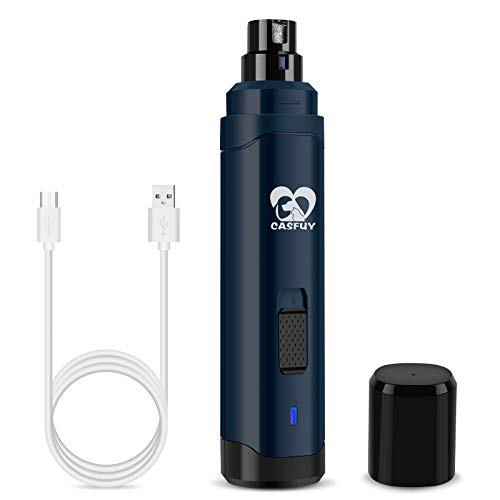 Casfuy Dog Nail Grinder Upgraded
- Product Group: Pet Products
- Binding: Health and Beauty
As an Amazon Associate we earn from qualifying purchases at no extra cost to you. Ratings are shown as listed on Amazon.
For routine home maintenance in 2026, a nail grinder is a practical buy for most dogs—especially dogs with dark nails, thick nails, or owners who are nervous about trimming. Expect to spend roughly $15 to $35 for a basic rechargeable model, with many solid two-speed options falling around $18 to $25.
What You Actually Get
A dog nail grinder is a small handheld electric grooming tool with a rotating abrasive head. Most measure about 5 to 7 inches long, weigh approximately 6 to 10 ounces, and are designed to be held in one hand while you steady your dog’s paw with the other. Rather than clipping through the nail, it files away small amounts of material at a time.
At the budget end, expect a USB-rechargeable grinder with one or two speed settings, a removable safety cap, and a small grinding wheel or sanding drum. Two-speed models commonly run at roughly 6,000 to 10,000 RPM, although manufacturers describe speed differently and do not always list comparable figures. The higher setting is useful for large dogs or thick nails; the lower setting is usually more comfortable for puppies, small dogs, and cautious first sessions.
The safety cap typically has openings sized for small, medium, and larger nails. It can help keep fur away from the spinning head and gives you a little more control, though many owners remove it for large nails or for finishing the side edges. Most grinders charge through USB and may run for 2 to 4 hours per charge, depending on the motor setting and battery size.
A basic grinder will not replace professional care when nails are severely overgrown, broken, infected, or curling into the paw pad. In those cases, a veterinarian or experienced groomer is the safer first stop. But for ordinary upkeep—usually every 1 to 3 weeks, depending on your dog’s activity level—a grinder can make the job more manageable.
Pros
- More gradual control: You remove nail in tiny increments, making it easier to stop before reaching the quick.
- Helpful for dark nails: Since the quick is harder to see in black or dark-colored nails, slow sanding can feel less risky than making a single clip.
- Smooths sharp edges: Clippers can leave pointed, rough nail edges that catch on rugs, blankets, and hardwood floors. A grinder rounds them off.
- Useful for thick adult nails: Larger dogs can have dense nails that are difficult to cut cleanly with inexpensive clippers. A two-speed grinder can be easier to manage.
- Less crushing pressure: Some dogs dislike the squeezing sensation of clippers. A grinder does not compress the nail in the same way.
- Rechargeable models are inexpensive: Many suitable home-use grinders cost $17 to $25, including models similar in price to the under-$20 Casfuy two-speed grinder or a under-$30 quiet-grinder option.
- Good for frequent touch-ups: Taking off 1 to 2 millimeters at a time can help gradually encourage an overgrown quick to recede over several trims.
Cons
- It is slower than clipping: A full four-paw session can take 10 to 20 minutes while your dog is learning, compared with a few minutes for an experienced clipper user.
- Noise and vibration may bother sensitive dogs: “Whisper quiet” does not mean silent. Even a low-noise motor creates a hum and a noticeable vibration at the paw.
- Heat can build up: Holding the grinder on one spot for too long can warm the nail. Use brief 1- to 2-second touches, then pause.
- Long fur can get in the way: Paw fur should be held back or trimmed before grinding, especially around small dogs’ feet.
- Consumable parts eventually wear out: Grinding heads and sanding bands lose effectiveness over time. Check whether replacements are easy to find before buying.
- It still requires technique: A grinder reduces the odds of a sudden deep cut, but it cannot prevent you from reaching the quick if you keep filing too far.
- Not ideal for every nail condition: Split, cracked, bleeding, or dramatically curled nails need professional assessment rather than extra grinding.
Who Should Buy It
Buy a dog nail grinder if you regularly put off nail care because clippers make you nervous. It is particularly worthwhile for first-time dog owners, homes with dogs that have black nails, and anyone who wants smoother nail tips after clipping. Many owners use both tools: clippers for taking off obvious length, then a grinder for rounding and refining the edges.
A grinder also makes sense for dogs whose nails click loudly on hard floors. That clicking is often a useful signal that the nails are reaching the floor too often, although paw shape, flooring, and gait matter too. Frequent short sessions are generally easier on the dog than waiting until the nails are clearly long.
Look for a rechargeable, two-speed model if you have more than one dog or a medium-to-large dog with sturdier nails. A unit in the 6- to 10-ounce range is typically comfortable to hold, and a removable guard is useful if you are new to the process. For a single small dog, a simpler one-speed or lower-powered grinder may be enough—as long as it is quiet enough for your dog’s temperament.
The best candidates are dogs that can learn through gradual exposure. Start with the grinder turned off: let your dog sniff it, reward calm behavior, and touch it briefly to a paw. Then turn it on several feet away before progressing to one nail. Treats, a lick mat, and sessions limited to 2 to 5 minutes can make a major difference.
Who Should Skip It
Skip the grinder, or at least do not make it your only tool, if your dog panics at electric toothbrushes, hair dryers, vacuums, or other low mechanical noises. Training can help, but some dogs simply find vibration more upsetting than a quick clip.
You may also skip it if you already use quality scissor-style or guillotine clippers confidently and your dog stays relaxed. Clippers are faster, silent, and require no charging. For a cooperative dog with light-colored nails and a calm owner, they can remain the most efficient option.
Do not rely on a home grinder for nails that are embedded in the paw pad, severely curved, visibly infected, or bleeding. Likewise, avoid grinding if your dog cannot be handled safely without significant restraint. A vet or groomer can shorten problem nails quickly, assess the paw, and give you a manageable maintenance starting point.
Cheaper Alternatives
| Option | Cost | Trade-off |
|---|---|---|
| Basic scissor-style dog nail clippers | $7–$15 | Fast and silent, but easier to take off too much at once and may leave sharp edges. |
| Guillotine-style nail clippers | $6–$12 | Compact and inexpensive, but less effective on very thick nails and requires accurate positioning. |
| Manual pet nail file | $4–$10 | Quiet and nearly foolproof, but slow for anything beyond smoothing one or two rough tips. |
| Clipper plus manual file | $12–$25 | Often costs less than a grinder and gives smooth results, but takes two tools and more hand effort. |
| Professional nail trim | $10–$25 per visit | No equipment or training required, but recurring visits cost more than a grinder over time. |
FAQ
Are dog nail grinders safer than clippers?
They can be safer for owners who tend to overthink clipping because grinders remove nail gradually. However, they are not risk-free: filing too long in one area can reach the quick or create heat. Use short passes, inspect the nail often, and stop when you see a darker center in a light nail or a small dark dot developing on the filing surface.
How often should I grind my dog’s nails?
Most dogs need nail maintenance every 1 to 3 weeks. Dogs that walk frequently on pavement may need less work, while indoor dogs, seniors, and dogs with less active routines may need more. A good goal is to keep the nails from consistently touching the floor when your dog stands naturally.
Can I use a human nail grinder on my dog?
It is better to use a tool made for pets. Dog nail grinders usually have protective guards, a shape that is easier to hold around paws, and abrasive heads suited to thicker nails. A human manicure tool may lack power for large nails and can be awkward around fur.
What if my dog is scared of the nail grinder?
Slow down and train in stages. For several days, reward your dog for calmly seeing and sniffing the switched-off tool. Next, run it briefly at a distance while offering treats. Gradually move closer, touch the running grinder to a single nail for one second, and end on a positive note. If fear remains intense, use clippers, seek a groomer’s help, or ask your veterinarian for handling guidance.






Write Your Review
No reviews yet. Be the first to share your experience!