
Key takeaways
- No speed information: If the listing does not provide even a general speed range, it is difficult to judge whether the tool suits small or thick nails.
- Unclear battery details: Be cautious when runtime, charging time, and battery type are omitted.
- Only one exposed grinding surface: Beginners benefit from a guard or smaller port that limits contact.
- Exaggerated safety claims: No grinder is automatically painless. Pressure, speed, and technique still matter.
- Disposable accessories: Avoid models with no replacement bands, caps, or grinding heads.
- Loose or poorly fitted parts: A wobbling head can create uneven grinding and extra vibration.
- Reviews focused on shipping problems or dead batteries: A low price is not a bargain if returns are difficult.
Buying a dog nail grinder seems simple until you compare models that promise “whisper-quiet” operation, painless trimming, LED lights, multiple ports, and professional results. For beginners, the biggest mistake is choosing by the lowest price or the most impressive feature list. A grinder that is too loud, too powerful, awkward to hold, or fitted with the wrong grinding head can make nail care stressful for both you and your dog.
This dog nail grinder buying guide for beginners focuses on the details that affect everyday use: how well the tool fits your hand, how gently it removes nail material, how long the battery lasts, and whether replacement parts are easy to find. The goal is not the fanciest device. It is a grinder you can control comfortably and use consistently in 2026.
Our top picks
 Whisper Quiet Dog Nail Grinder Safe &
- Product Group: Pet Products
- Binding: Misc.
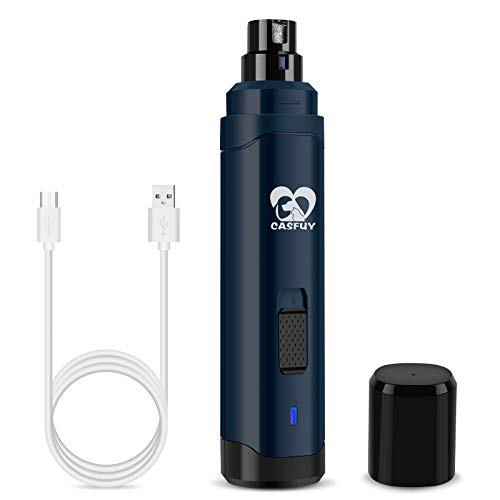 Casfuy Dog Nail Grinder Upgraded
- Product Group: Pet Products
- Binding: Health and Beauty
 Heusom Silent Groom Pro Pet Nail Grinder
- Item Package Dimensions L x W x H: 6.38 x 2.83 x 1.46 inches
- Target Audience Keyword: Birds, Cats, Dogs, Small Animals
- Specific Uses for Product: Indoor, Outdoor
| Product | Key specs | Amazon rating | |
|---|---|---|---|
| Whisper Quiet Dog Nail Grinder Safe & | Product Group: Pet Products Binding: Misc. | 4.8★ | Check price |
| Casfuy Dog Nail Grinder Upgraded | Product Group: Pet Products Binding: Health and Beauty | 4.9★ | Check price |
| Heusom Silent Groom Pro Pet Nail Grinder | Item Package Dimensions L x W x H: 6.38 x 2.83 x 1.46 inches Target Audience Keyword: Birds, Cats, Dogs, Small Animals Specific Uses for Product: Indoor, Outdoor | 3.9★ | Check price |
 Petsaunter Dog Nail Grinder Petsaunter Dog Nail Grinder | Item Package Dimensions L x W x H: 8.27 x 3.46 x 1.85 inches Item Dimensions LxWxH: 6.69 x 1.34 x 1.38 inches Target Audience Keyword: dogs | 4.4★ | Check price |
As an Amazon Associate we earn from qualifying purchases at no extra cost to you. Ratings are shown as listed on Amazon.
Decide These 3 Things First
- Your dog’s size and nail type: A Chihuahua and a Great Dane do not need the same grinding surface or motor strength. Consider nail diameter, thickness, and whether the nails are dark, curved, brittle, or overgrown.
- Your dog’s tolerance for sound and vibration: Nervous dogs usually do better with a low-vibration, two-speed grinder than with a high-powered model that removes material quickly but feels harsh.
- Where and how often you will use it: A cordless model is convenient for quick touch-ups, while USB-C charging, an LED light, and a long battery runtime may matter if you groom several pets.
Once those decisions are clear, compare the construction and specifications rather than relying on vague claims such as “professional” or “painless.”
Size and Grinding-Port Fit
The grinder should be small enough to control but substantial enough not to feel flimsy. Most handheld pet grinders measure approximately 5 to 7 inches long, 1.5 to 2.5 inches wide, and weigh between 4 and 10 ounces. A very light tool can be comfortable for short sessions, but an overly lightweight plastic body may vibrate more or feel difficult to steady.
Look for a grinding port or guard with at least two openings. A smaller opening, roughly 3/16 to 1/4 inch, is useful for small dogs and cats. A larger opening around 5/16 to 1/2 inch gives you more room for medium and large nails. Some models also include a broad exposed grinding surface for thick nails. That option is useful, but beginners should use it cautiously because it removes material faster.
For small breeds, choose a fine grinding band or small port rather than a large, coarse stone. For medium and large dogs, look for a broader port and a motor that can maintain speed against thicker nails. A removable guard is helpful because it allows you to start with more protection and remove it later as your technique improves.
Material Quality
The exterior does not need to be made of metal to be durable. A quality grinder commonly uses ABS or polycarbonate plastic for the housing, with a rubberized or silicone grip. These materials keep the tool light while making it easier to hold during a 5- to 15-minute grooming session.
Pay closer attention to the grinding surface. Diamond-coated wheels and bands are common because they remove nail material gradually and tend to last longer than very soft abrasive pads. A coarse surface works faster on thick nails, while a fine surface is better for smoothing edges and finishing a trim. Ideally, the grinder includes at least one replacement band or cap.
Avoid relying on the word “diamond” alone. Check whether the abrasive part is replaceable and whether replacement pieces are sold separately. A grinder that costs $15 but becomes unusable when its only band wears out may be less economical than a $35 model with readily available replacements.
Construction and Safety Details
Good construction shows up in small details: a battery cover that closes securely, a grinding head that does not wobble, buttons that are easy to locate by touch, and a guard that stays attached during use. The motor housing should not flex noticeably when you hold it. Seams should be even, with no sharp edges around the charging port or grinding head.
For beginners, a two-speed motor is usually more useful than a single high-speed setting. A low setting around 5,000 to 7,000 revolutions per minute can help you introduce the tool gradually. A higher setting in the 8,000- to 12,000-RPM range may be useful for large or thick nails, but it should be used in short passes. Manufacturers measure speed differently, so treat these figures as comparison points rather than guaranteed performance.
Look for automatic shutoff or overload protection if available. These features can reduce the chance of the motor overheating when you press too firmly. A built-in LED light may help you see the nail surface, but it does not replace proper identification of the quick. On dark nails, remove only a small amount at a time and stop when you see a small darker or chalky center, depending on the nail.
Comfort and Performance
Noise and vibration often determine whether a dog accepts a grinder. A product described as “quiet” may still produce an audible whine, so do not assume the label means silent operation. For sensitive pets, prioritize low vibration, a gradual start, and a low-speed mode over maximum power.
The handle should allow a relaxed grip. A diameter of approximately 1.25 to 1.75 inches suits many adult hands, although personal comfort varies. Controls should be reachable without changing your grip. A slider or clearly raised button is easier to use than a flush touch control when your attention is on the dog’s paw.
Battery capacity is usually listed in milliamp-hours. A range of 600 to 1,500 mAh is common in cordless pet grinders. Runtime depends on speed, pressure, and battery age, so consider a stated runtime of at least 2 hours for occasional home use. USB-C charging is convenient, especially if you already use that cable, but check whether the package includes a wall adapter. Some include only a cable.
Models such as the Casfuy two-speed grinder, the Heusom Silent Groom Pro, and the Petsaunter grinder with an LED and three grinding ports illustrate different feature priorities. A lower-priced tool can be perfectly adequate if its controls and abrasive surface match your dog’s needs. More features do not automatically mean smoother performance.
Price Tiers
Budget grinders generally cost about $12 to $22. They often include one or two speeds, a basic USB cable, and a small selection of ports or grinding bands. The Petsaunter example for under $20 and the Casfuy example for under $20 fall into this range. These models can be suitable for occasional touch-ups, especially for small or medium dogs, but inspect the return policy and replacement-head availability.
Midrange models typically cost $23 to $40. They may offer a better grip, quieter motor design, more consistent speed control, LED illumination, and extra abrasive pieces. The under-$30 “whisper quiet” example sits near the lower edge of this category, while the Heusom example for under $40 is near the upper edge.
Premium pet grinders usually cost $41 to $80, although a higher price is not proof of better results. You should expect sturdier construction, a more refined motor, stronger battery support, useful accessories, and clearer warranty coverage. For most beginners, a well-reviewed $18 to $40 grinder offers the best balance.
Warranty and Replacement Support
Look for at least a 12-month limited warranty. Some brands offer 18 or 24 months, but read the exclusions: accidental damage, worn grinding bands, water exposure, and unauthorized repairs may not be covered. A warranty is more useful when the seller clearly lists a customer-service email or support process.
Replacement parts matter more than an extended warranty for a simple grooming tool. Confirm that abrasive bands, grinding caps, guards, and charging cables can be replaced. If the manufacturer provides no parts information, assume the accessory supply may be limited. Keep the receipt and packaging until you have tested the grinder and completed at least one successful session.
Delivery and Assembly
Most cordless grinders require little assembly, but check what arrives in the box. You may need to install a grinding band, attach a protective cap, or charge the battery for two to three hours before first use. A clear manual should explain which port is intended for small, medium, and large nails.
Before ordering, verify the listed package dimensions, included accessories, charging method, and estimated delivery window. A compact box around 7 by 5 by 2 inches is typical, but dimensions vary. Inspect the tool immediately for cracks, loose parts, or a grinding head that spins unevenly. Do not use a damaged unit or one that becomes hot after only a few minutes.
Spec Checklist
| Spec | Budget | Mid | Premium |
|---|---|---|---|
| Typical price | $12–$22 | $23–$40 | $41–$80 |
| Motor settings | 1–2 speeds | 2 speeds | 2–3 speeds or smoother adjustment |
| Approximate speed range | 5,000–10,000 RPM | 5,000–12,000 RPM | 5,000–15,000 RPM |
| Battery capacity | 400–800 mAh | 600–1,500 mAh | 1,000–2,000 mAh |
| Charging | USB cable | USB-C preferred | USB-C, faster or clearer charging indicator |
| Grinding options | 1–2 bands or ports | 2–3 ports or surfaces | Multiple replaceable bands, caps, or stones |
| Warranty target | 6–12 months | 12 months | 12–24 months |
Red Flags
- No speed information: If the listing does not provide even a general speed range, it is difficult to judge whether the tool suits small or thick nails.
- Unclear battery details: Be cautious when runtime, charging time, and battery type are omitted.
- Only one exposed grinding surface: Beginners benefit from a guard or smaller port that limits contact.
- Exaggerated safety claims: No grinder is automatically painless. Pressure, speed, and technique still matter.
- Disposable accessories: Avoid models with no replacement bands, caps, or grinding heads.
- Loose or poorly fitted parts: A wobbling head can create uneven grinding and extra vibration.
- Reviews focused on shipping problems or dead batteries: A low price is not a bargain if returns are difficult.
FAQ
Is a dog nail grinder better than clippers for beginners?
It can be easier to control because it removes small amounts of nail at a time. Clippers are faster, but they require more confidence about where the quick is located. A grinder still requires patience, especially on dark nails, and should be introduced gradually with treats and short sessions.
What speed should I use?
Start with the lowest setting, commonly around 5,000 to 7,000 RPM, and use brief one- to three-second passes. Increase speed only if the grinder is not removing material efficiently. Stop if the nail becomes hot, your dog pulls away repeatedly, or you feel yourself pressing harder.
How long should a battery-powered grinder last?
For occasional home grooming, two hours of stated runtime is a practical minimum. Actual use will be shorter when you work at high speed or apply heavy pressure. Recharge the grinder before a grooming session rather than starting with a nearly empty battery, since low power can produce inconsistent performance.
What is the best grinder for a nervous dog?
Choose a low-vibration model with two speeds, a comfortable rubberized grip, and a protective port or guard. Practice turning it on several feet away before touching the paw. Let your dog investigate the inactive tool, then run it briefly near the paw without grinding. Several calm sessions are usually more effective than trying to finish every nail at once.





Write Your Review
No reviews yet. Be the first to share your experience!