
Key takeaways
- Table of Contents 6 sections 9 min read 1 The Short Answer 2 Standard Sizes 3 How to Measure Your Space 4 By Room or Use Case 4.1 Small Dogs and Puppies 4.2 Medium Double-Coated Dogs 4.3 Large and Giant…
What's inside
The Short Answer
For most dogs, choose an undercoat rake with pins that reach through the topcoat without pressing hard into the skin. That usually means 1/2- to 3/4-inch pins for short or medium double coats, 3/4- to 1-inch pins for dense medium-to-long coats, and 1 to 1 1/2-inch pins for long, thick double coats. The rake head should generally be narrower for small dogs and wider for large dogs: about 2 to 2 1/2 inches wide for small breeds, 2 1/2 to 3 1/2 inches for medium dogs, and 3 1/2 to 5 inches for large breeds.
The correct size is determined more by coat depth than by body weight. A compact 15-pound Pomeranian with a dense coat may need longer pins than a 55-pound Boxer with a short, smooth coat. For many households, a double-row rake with rounded pins around 3/4 inch long is the most versatile choice for medium and large double-coated dogs.
As an Amazon Associate we earn from qualifying purchases at no extra cost to you. Product prices and availability are accurate as of the date shown and are subject to change.


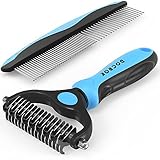

Undercoat rakes are intended for loose undercoat and light tangles, not for cutting through tight mats. If the tool catches, pulls, or needs force to move through the coat, switch to shorter pins, work in smaller sections, or use a dematting comb for isolated knots.
Standard Sizes
| Dog Coat Type | Recommended Pin Length | Recommended Rake Head Width | Typical Dog Size | Best For |
|---|---|---|---|---|
| Short, dense double coat | 1/2 to 5/8 in. (1.3 to 1.6 cm) | 2 to 3 in. (5.1 to 7.6 cm) | Small to large | Beagles, Pugs, short-coated mixed breeds, smooth-coated dogs with seasonal shedding |
| Medium double coat | 5/8 to 3/4 in. (1.6 to 1.9 cm) | 2 1/2 to 3 1/2 in. (6.4 to 8.9 cm) | Medium to large | Labrador Retrievers, Australian Shepherds, Corgis, German Shepherds |
| Long or thick double coat | 3/4 to 1 in. (1.9 to 2.5 cm) | 3 to 4 in. (7.6 to 10.2 cm) | Medium to giant | Golden Retrievers, Collies, Bernese Mountain Dogs, Chow Chows |
| Very deep, heavy undercoat | 1 to 1 1/2 in. (2.5 to 3.8 cm) | 3 1/2 to 5 in. (8.9 to 12.7 cm) | Large to giant | Huskies, Alaskan Malamutes, Great Pyrenees, Newfoundland dogs |
| Fine, silky, or lightly coated hair | 3/8 to 1/2 in. (1.0 to 1.3 cm) | 1 1/2 to 2 1/2 in. (3.8 to 6.4 cm) | Small to medium | Fine-coated dogs that only need occasional loose-hair removal |
Most handheld undercoat rakes measure roughly 6 to 8 inches (15.2 to 20.3 cm) from handle end to pin tips. A standard grooming rake head has one or two rows of metal pins, often with 9 to 20 pins total. Wider heads cover a large back quickly, but a smaller head is easier to control around the neck, behind the ears, under the chest, and along the legs.
Basic undercoat rakes commonly cost about $10 to $18, while multi-tool sets with a slicker brush, comb, or flea comb often fall around $14 to $25. Price is less important than smooth, rounded pin ends, a secure handle, and pin length that matches your dog’s coat.
How to Measure Your Space
In this case, “space” means the space between your dog’s skin and the outer layer of fur. You do not need a ruler for every grooming session, but taking a few quick measurements helps you avoid buying a rake that is too shallow or too aggressive.
- Choose a representative area. Check the shoulder, side of the neck, rump, or “pants” on the back legs. These areas often reveal the dog’s true coat depth better than the flatter fur along the back.
- Part the coat with your fingers. Separate the hair until you can see the skin. Do not measure from the fluffy outer tips; measure the denser layer the rake needs to reach.
- Estimate coat depth. If the dense coat is about 1/4 to 1/2 inch deep (0.6 to 1.3 cm), start with 1/2-inch pins. For a 1/2- to 3/4-inch coat depth (1.3 to 1.9 cm), choose 5/8- to 3/4-inch pins. Coats deeper than 3/4 inch usually need 1-inch or longer pins.
- Measure the broadest grooming area. For a small dog’s back, a 2-inch (5.1 cm) head is usually manageable. A medium dog’s body is comfortable with a 2 1/2- to 3 1/2-inch head (6.4 to 8.9 cm). Large dogs can benefit from a 4-inch (10.2 cm) head for efficient work.
- Check sensitive areas separately. The belly, armpits, tail base, ears, and lower legs often have thinner skin or finer fur. Even if your dog needs a long-pin rake for the body, use gentle pressure and shorter strokes in these areas.
- Test the tool before a full session. Make three to five short passes in the direction of hair growth. The rake should glide through the outer coat and lift loose undercoat without scratching, snagging, or making the dog pull away.
By Room or Use Case
Small Dogs and Puppies
For small dogs, toy breeds, and young dogs, choose a lightweight rake with a 1 1/2- to 2 1/2-inch head (3.8 to 6.4 cm). Pins around 3/8 to 5/8 inch (1.0 to 1.6 cm) provide more control and reduce the chance of dragging delicate skin. A narrow head also makes it easier to groom behind the ears and around the collar line. Puppies with adult coats still developing may only need a soft slicker brush or a fine comb rather than a full undercoat rake.
Medium Double-Coated Dogs
Dogs such as Corgis, Australian Shepherds, and many retriever mixes often do well with a 2 1/2- to 3 1/2-inch-wide rake head and 5/8- to 3/4-inch pins. This is the everyday “standard size” category. A double-row rake can be useful during spring and fall shedding periods because it removes loose undercoat from a larger area per stroke. Work in sections no wider than 3 to 4 inches (7.6 to 10.2 cm), especially over dense hips and shoulders.
Large and Giant Breeds
For Huskies, Malamutes, Newfoundlands, and similarly coated breeds, look for 1- to 1 1/2-inch pins (2.5 to 3.8 cm) and a 3 1/2- to 5-inch head (8.9 to 12.7 cm). A broad rake saves time on the back and sides, but keep a narrower comb or rake for legs, the chest, and the tail. Long pins should not mean heavy pressure: let the pin length do the work. A large dog may need several 10- to 15-minute grooming sessions rather than one long session.
Seasonal Shedding in the Living Room
If your main goal is controlling hair on sofas, rugs, and bedding, select a rake based on coat depth rather than buying the widest tool available. A properly sized rake removes loose undercoat more comfortably, which makes regular grooming more realistic. Brush outdoors, on a washable towel, or in a designated grooming area. For most shedding dogs, one or two sessions weekly is enough outside heavy shedding periods; increase frequency gradually when the undercoat is blowing out.
Common Sizing Mistakes
Buying by dog weight alone: Weight does not tell you whether the coat is short, fine, thick, or deeply layered. Always assess fur depth first.
Choosing pins that are too long: Long pins can feel efficient, but they may scrape skin on a short-coated dog. If you can see the pins pressing against the skin, the rake is too long or you are using too much pressure.
Choosing an extra-wide head for a small dog: A 4-inch-wide head may be fast on a large back, but it is clumsy on a 10-pound dog. Smaller heads offer safer control around curves and joints.
Using an undercoat rake on a single-coated breed: Dogs with continuously growing hair, including many Poodles, Bichons, and Yorkies, generally need combing and detangling tools more than an undercoat rake. Their grooming needs are different from those of seasonal shedders.
Raking over mats: An undercoat rake is not a substitute for careful dematting. For a tight mat, hold the hair near the skin, separate the mat with fingers when possible, and use an appropriate dematting tool or seek professional grooming help.
Grooming a dry, irritated, or damaged area: Skip the rake over rashes, hot spots, scabs, lumps, or tender skin. If shedding suddenly changes or the coat has bald patches, consult a veterinarian.
FAQ
What size undercoat rake should I get for a Golden Retriever?
Most Golden Retrievers do well with 3/4- to 1-inch pins (1.9 to 2.5 cm) and a 3- to 4-inch-wide head (7.6 to 10.2 cm). Choose the shorter end for a lighter coat and the longer end for a particularly dense feathered coat.
Can an undercoat rake be too big for my dog?
Yes. A rake can be too big if its pins reach skin before moving through the coat, if its head cannot follow the dog’s body contours, or if it pulls hair instead of lifting loose fur. Smaller, shorter-pin tools are usually safer when you are unsure.
How often should I use an undercoat rake?
For most double-coated dogs, use it about once a week during routine maintenance and up to two or three times weekly during major shedding periods. Keep sessions brief, usually 5 to 15 minutes, and stop if the skin becomes pink or the dog seems uncomfortable.
Is a double-row undercoat rake better than a single-row rake?
Not always. A double-row rake can remove more loose undercoat in fewer passes on thick, large coats. A single-row rake is often easier to control on small dogs, fine coats, and sensitive areas. In 2026, many affordable grooming sets include both a rake and a metal comb, which can be a practical combination for households with more than one coat type.






Write Your Review
No reviews yet. Be the first to share your experience!