
Key takeaways
- The Short Answer For most dogs, choose a nail grinder guard with an opening that is only slightly wider than the nail being filed. A good rule is to allow about 1/16 to 1/8 inch (1.5 to 3 mm) of…
The Short Answer
For most dogs, choose a nail grinder guard with an opening that is only slightly wider than the nail being filed. A good rule is to allow about 1/16 to 1/8 inch (1.5 to 3 mm) of clearance around the nail. That usually means a 3/16-inch (5 mm) opening for tiny dogs, a 1/4-inch (6 mm) opening for most small and medium dogs, and a 5/16- to 3/8-inch (8 to 10 mm) opening for large dogs.
There is no universal guard-sizing standard across pet nail grinders. Many cordless models use a removable safety cap with one or two pre-set ports rather than interchangeable guard sizes. Others, including attachment-style guards such as the Dremel Pet Grooming Nail Guard Attachment, are designed around a specific tool and sanding drum diameter. The right fit depends on the dog’s nail width, the grinder’s port shape, and whether you need extra visibility or extra containment of nail dust.
Our top picks
 Whisper Quiet Dog Nail Grinder Safe &
- Product Group: Pet Products
- Binding: Misc.
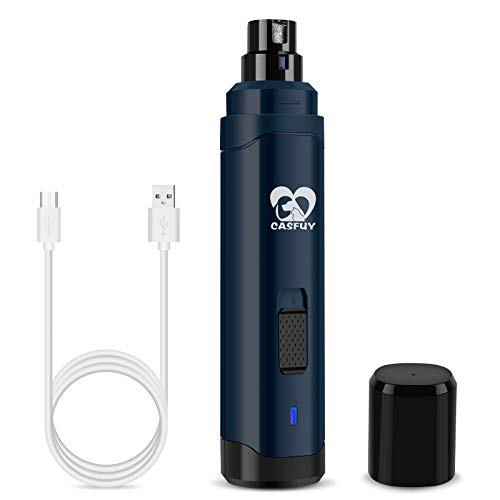 Casfuy Dog Nail Grinder Upgraded
- Product Group: Pet Products
- Binding: Health and Beauty
| Product | Key specs | Amazon rating | |
|---|---|---|---|
| Whisper Quiet Dog Nail Grinder Safe & | Product Group: Pet Products Binding: Misc. | 4.8★ | Check price |
| Casfuy Dog Nail Grinder Upgraded | Product Group: Pet Products Binding: Health and Beauty | 4.9★ | Check price |
 Whisper Quiet Dog Nail Grinder Safe & Whisper Quiet Dog Nail Grinder Safe & | – | Check price | |
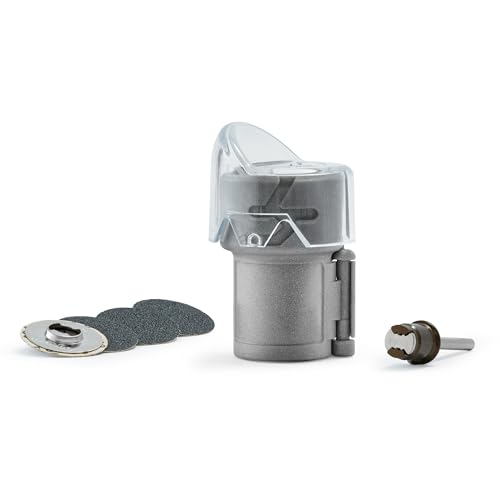 Dremel Pet Grooming Nail Guard Attachment Dremel Pet Grooming Nail Guard Attachment | – | Check price |
As an Amazon Associate we earn from qualifying purchases at no extra cost to you. Ratings are shown as listed on Amazon.
In 2026, the most practical choice for most households is a grinder with a two-port guard: a smaller opening for front dewclaws, puppies, cats, and toy breeds, plus a larger opening for regular dog nails. If your dog has thick, dark, or curved nails, a removable guard can be easier to use because it gives you a clearer view of the nail tip and quick.
Standard Sizes
Guard openings are generally described by the width of the access port, not by the overall size of the grinder. Use the chart below as a buying and fitting guide. Measure the nail at its widest point near the tip, rather than guessing from your dog’s body weight alone.
| Guard Opening Size | Opening in Inches | Opening in Centimeters | Typical Nail Width | Best For |
|---|---|---|---|---|
| Extra-small port | 1/8 to 3/16 in. | 0.3 to 0.5 cm | Up to 1/8 in. / 0.3 cm | Cats, puppies, Chihuahuas, Yorkies, toy poodles, and dewclaws |
| Small port | 3/16 to 1/4 in. | 0.5 to 0.6 cm | 1/8 to 3/16 in. / 0.3 to 0.5 cm | Small dogs from about 5 to 20 pounds |
| Medium port | 1/4 to 5/16 in. | 0.6 to 0.8 cm | 3/16 to 1/4 in. / 0.5 to 0.6 cm | Many dogs from about 20 to 50 pounds |
| Large port | 5/16 to 3/8 in. | 0.8 to 1.0 cm | 1/4 to 5/16 in. / 0.6 to 0.8 cm | Large breeds, thick nails, and rear nails with a broader profile |
| Open guard or no guard | More than 3/8 in. | More than 1.0 cm | More than 5/16 in. / 0.8 cm | Giant breeds, very thick nails, curved nails, and experienced users |
Most consumer nail grinders are compact handheld tools measuring roughly 6 to 8 inches long and 1.5 to 2.5 inches wide. Battery-powered versions often weigh about 5 to 10 ounces, while corded rotary-tool setups may be heavier. Typical pet grinders use low-voltage rechargeable motors or household-powered adapters, with many consumer units priced from about $18 to $30. The example products listed fall within that range: approximately $20 to under $30, while a dedicated Dremel guard attachment is around $25.
How to Measure Your Space
For nail grinder guards, “space” means the clearance between your dog’s nail and the guard opening, plus the room you have to safely hold the paw. A port that is too tight can rub the nail or trap fur. One that is too large can make it easier for a wiggling paw to touch the sanding surface.
- Wait until the dog is relaxed. Measure when your dog is standing or resting comfortably. Nails spread slightly differently when a dog is excited or pulling away.
- Measure the nail’s widest point. Use a small ruler or caliper to measure across the nail about 1/8 to 1/4 inch from the tip. Do not measure the toe or paw pad.
- Measure more than one nail. Front nails are often wider than rear nails, and dewclaws are usually narrower. Check at least one front nail, one rear nail, and a dewclaw if present.
- Add clearance. Add 1/16 to 1/8 inch (1.5 to 3 mm) to the measured nail width. This is the minimum useful port size.
- Check the guard depth. A shallow guard keeps the nail tip close to the sanding disc and is easier for small nails. A deeper guard offers more shielding but can make it harder to see where the nail meets the abrasive.
- Test with the grinder switched off. Before turning it on, insert the nail into the port. The nail should enter easily without squeezing fur or forcing the toe into an awkward angle.
For example, if your beagle’s front nail measures 3/16 inch (0.5 cm) wide, a 1/4-inch (0.6 cm) port is usually the best starting point. If your Labrador’s nail measures 1/4 inch (0.6 cm), look for a 5/16- to 3/8-inch (0.8 to 1.0 cm) port or use the grinder with its guard removed if the manufacturer allows it.
By Room or Use Case
Small Apartment Grooming
In a small apartment, prioritize a guarded grinder with a dust-catching cap and a compact body around 6 to 7 inches long. A small or medium port is usually the most versatile option for dogs under 35 pounds. Work on a towel, nonslip bath mat, or washable pet bed to catch fine nail dust. Choose a quiet model if neighbors are close or your dog is sensitive to sound, but do not assume “whisper quiet” means silent; all grinding tools produce some motor and abrasive noise.
Multi-Pet Households
A two-port guard is especially useful for homes with dogs and cats of different sizes. Use the smaller port for cats, puppies, toy breeds, and dewclaws, then switch to the larger port for standard dog nails. If one pet needs a 3/16-inch opening and another needs a 3/8-inch opening, a single fixed-port guard may be inconvenient. In that case, choose a grinder with a removable cap or separate attachments.
Large Dogs With Thick Nails
Large dogs may need a wider port, but bigger is not always better. If the guard opening exceeds the nail width by more than about 1/4 inch (6 mm), the toe can shift around too much. For thick nails, use short grinding sessions of one to two seconds per contact, then pause. This helps limit heat buildup at the nail tip. A larger sanding surface and a firm grip are often more important than a deep guard.
Nervous Dogs and First-Time Grooming
For a nervous dog, start with the smallest guard that comfortably fits the nail. The guard acts as a physical boundary and can help prevent accidental contact with surrounding fur. Introduce the tool in stages: let the dog inspect it while off, run it briefly at a distance, touch the guard to the paw without grinding, and then file only one nail edge. The goal is smooth, gradual shortening, not completing every nail in one sitting.
Professional-Style Rotary Tool Setups
Attachment-style guards should be matched to the exact grinder or rotary tool specified by the manufacturer. Do not assume that a guard made for one sanding drum, collet, or housing will fit another. The Dremel Pet Grooming Nail Guard Attachment, for example, is intended as an accessory rather than a universal replacement guard. Confirm tool compatibility before purchasing, particularly if you already own a rotary tool.
Common Sizing Mistakes
Buying by dog weight only: A 40-pound greyhound may have narrower nails than a 20-pound bulldog mix. Nail diameter is the key measurement.
Choosing the tightest possible opening: A snug fit sounds safer, but it can pinch fur, limit your view, and make a nervous dog pull away. Leave at least 1/16 inch of clearance.
Using a small port for thick nails: Forcing a large nail into a narrow guard can scrape the nail sides and place pressure on the toe. Move up one port size or remove the guard if the tool’s instructions permit it.
Using a large opening on a tiny nail: Small nails can slip deeply into an oversized port, making it easier to remove too much material. Use a smaller port for dewclaws and toy-breed nails.
Ignoring fur length: Long feathering around the feet can enter a wide opening. Hold fur back with your fingers, use a smaller port where appropriate, and keep the grinder moving away from hair.
Expecting one guard to fit every tool: Guard attachments are not universally interchangeable. Match the accessory to the stated grinder model, sanding drum, and housing design.
FAQ
What size nail grinder guard should I use for a small dog?
Most small dogs do well with a 3/16- to 1/4-inch opening (0.5 to 0.6 cm). Measure the widest nail and choose a port that leaves about 1/16 to 1/8 inch of free space around it. Dewclaws may need the smaller opening even when the main nails fit a 1/4-inch port.
Can a large dog use a small nail grinder guard?
Only if the individual nail fits without pressure. Many large dogs need a 5/16- to 3/8-inch opening (0.8 to 1.0 cm), especially on front paws. If the nail does not slide into the port easily while the grinder is off, use a larger opening or an approved open-guard configuration.
Is it safer to use a guard or no guard?
A guard is generally safer for beginners, wiggly pets, and households grooming small nails. It helps limit contact with fur and guides the nail toward the abrasive. Removing the guard can improve visibility for thick, curved, or dark nails, but it requires steadier handling and close attention to the quick.
How often should I replace a nail grinder guard?
Replace a guard if it cracks, becomes loose, no longer stays securely attached, or develops rough edges that could catch fur. Clean it after use with a dry brush or soft cloth. The guard itself may last far longer than the sanding band or grinding head, which typically needs replacement once it becomes noticeably smooth or slow to file nails.




Write Your Review
No reviews yet. Be the first to share your experience!