
Key takeaways
- Toy and very small puppies: Look for a 1.5- to 2-inch-wide head.
- Small and medium puppies: A 2- to 2.5-inch-wide head is usually the most versatile.
- Large-breed or thick-coated puppies: A 2.5- to 3.5-inch medium brush can work on the body, but use a smaller brush on the face and feet.
- Curly or easily matted coats: Prioritize flexible, rounded pins and a compact head over a very large brush.
What's inside
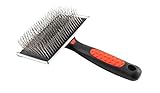
If you are searching for what size slicker brush for puppies, start with the brush head—not the total handle length. For most puppies, a small slicker brush with a head about 2 to 2.5 inches wide is the safest starting point. It is easier to control around the face, legs, ears, and belly than a large brush, and it lets you work in short sections without pressing too hard.
The right size also depends on your puppy’s adult breed, coat density, and tolerance for grooming. A tiny short-haired puppy may need only a small, soft-pin brush, while a Goldendoodle, Labradoodle, Poodle, or other curly-coated puppy may eventually need a medium slicker for faster body grooming. Use the smallest brush that covers the area comfortably without forcing the pins into the skin.
As an Amazon Associate we earn from qualifying purchases at no extra cost to you. Product prices and availability are accurate as of the date shown and are subject to change.


The Short Answer
Choose a small slicker brush measuring approximately 2 to 2.5 inches wide by 1.5 to 2 inches deep for most puppies. This size typically has a total length of about 6 to 8 inches (15 to 20 cm), including the handle.
- Toy and very small puppies: Look for a 1.5- to 2-inch-wide head.
- Small and medium puppies: A 2- to 2.5-inch-wide head is usually the most versatile.
- Large-breed or thick-coated puppies: A 2.5- to 3.5-inch medium brush can work on the body, but use a smaller brush on the face and feet.
- Curly or easily matted coats: Prioritize flexible, rounded pins and a compact head over a very large brush.
For a first brush, small is generally better than oversized. A smaller head makes it easier to use light pressure and see whether you are brushing through the coat or simply skimming over tangles.
Standard Sizes
Slicker brush sizes are not standardized across brands. One manufacturer’s “small” may be another brand’s “extra small,” so compare the actual brush-head measurements whenever they are listed. The table below gives practical size ranges for puppy grooming.
| Brush size | Brush-head width | Brush-head depth | Approximate overall length | Best use |
|---|---|---|---|---|
| Extra small | 1.5–2 in (3.8–5.1 cm) | 1.25–1.75 in (3.2–4.4 cm) | 5.5–7 in (14–17.8 cm) | Toy breeds, faces, paws, and sensitive areas |
| Small | 2–2.5 in (5.1–6.4 cm) | 1.5–2 in (3.8–5.1 cm) | 6–8 in (15.2–20.3 cm) | Most puppies and small dogs |
| Medium | 2.5–3.5 in (6.4–8.9 cm) | 2–2.5 in (5.1–6.4 cm) | 7–9 in (17.8–22.9 cm) | Medium puppies and larger body areas |
| Large | 3.5–4.5 in (8.9–11.4 cm) | 2.5–3 in (6.4–7.6 cm) | 8–10 in (20.3–25.4 cm) | Large dogs, not usually the best first puppy brush |
Most puppy owners will be choosing between extra-small and small. A compact brush such as the small versions commonly sold for Doodles, Poodles, and other long-haired breeds is easier to maneuver than a full-size adult brush. A medium brush may save time on the torso once the puppy grows, but it can be awkward around joints and narrow legs.
Prices also vary by pin quality, handle design, and brand. Basic puppy slickers commonly cost about $12 to $20, while premium small slickers often range from $25 to $45. The example products in this category span about $15.99 to $42.89. A higher price does not automatically mean the brush is safer; pin softness, head size, and your technique matter more.
How to Measure Your Space
“Space” means the area you are grooming, not just the room where you store the brush. Measure your puppy’s body zones and compare them with the brush head.
- Measure the narrowest areas first. Check the width of the puppy’s cheek, leg, paw, and area behind the ears. If these zones are about 1.5 to 2 inches wide, a small or extra-small brush will be easier to control.
- Estimate the coat length. For coats under 1 inch (2.5 cm), a slicker may be unnecessary or should be used lightly. Coats around 1 to 3 inches (2.5 to 7.6 cm) often benefit from a small slicker. Longer, curly coats may need a small brush for detail work and a medium brush for the torso.
- Measure the grooming section. Divide the body into sections no wider than the brush head. A 2-inch head can cover a small strip at a time, which is helpful for checking that you are reaching the roots.
- Check your hand clearance. Hold the brush as you would during grooming. You should be able to see the brush head and keep your wrist relaxed. A bulky handle or oversized head can cause you to press too hard.
- Account for movement. Puppies rarely stay perfectly still. Leave enough room to reposition your hand without bumping the puppy’s ribs, spine, or legs. A compact brush is usually easier to use during short training sessions.
To test the size, brush a small area for a few strokes with almost no pressure. The pins should separate the hair gradually rather than scratch the skin. Stop if your puppy flinches, tries to escape, or develops redness.
By Room or Use Case
Face, ears, and paws
Use an extra-small or small brush with a head about 1.5 to 2 inches wide. These areas are narrow and curved, so a large slicker can catch hair unevenly or make it difficult to avoid the eyes, ear opening, and toe webs. Brush the outer ear feathering and cheeks in short strokes, and use your free hand to shield the skin.
Body and sides
A small 2- to 2.5-inch brush works well for most puppies. It gives you enough coverage without encouraging aggressive, repetitive brushing. On a medium or large puppy with a dense coat, a medium 2.5- to 3.5-inch brush can cover the shoulder, rib cage, and hips more efficiently. Always work in layers so the brush reaches beneath the topcoat.
Curly-coated puppies
Poodle mixes and other curly-coated puppies often need frequent, thorough brushing because tangles can form close to the skin. Start with a small slicker, especially around the legs, armpits, tail, and ears. If the puppy is growing quickly and has a broad body, add a medium brush later rather than buying a large brush immediately.
Travel and puppy-training sessions
For car trips, puppy classes, or short daily sessions, choose a small brush with an overall length of about 6 to 8 inches. It should fit in a grooming pouch and be light enough to use for two- to five-minute practice sessions. A compact self-cleaning design can be convenient, but make sure the release mechanism does not make the head too bulky.
Professional or multi-dog grooming
If you groom several dogs, a small brush is useful for detail work and a medium brush is faster on larger bodies. You may need different pin lengths and stiffness levels rather than one universal size. Keep a separate soft, compact brush for puppies and sensitive areas.
Common Sizing Mistakes
- Choosing by handle length alone: A long handle does not mean a larger or better brush. Compare the head dimensions.
- Buying for the adult dog too soon: A brush sized for a future 60-pound dog may be unwieldy on a 10-pound puppy.
- Assuming a bigger head works faster: Large heads can skim over knots and hide areas that were not brushed through.
- Ignoring pin softness: The correct dimensions cannot compensate for sharp, rigid, or poorly finished pins.
- Using one brush everywhere: The body, face, feet, and ears may need different levels of control.
- Pressing harder to reach the undercoat: Use a line-brushing technique and small sections instead of increasing pressure.
FAQ
What size slicker brush is best for a toy puppy?
Choose an extra-small or small brush with a head about 1.5 to 2 inches wide (3.8 to 5.1 cm). A narrow head is easier to control around the face, legs, and paws.
Can I use a medium slicker brush on a puppy?
Yes, if the puppy is medium or large and has a thick or long coat. Use it mainly on broad body areas, and keep a small brush for the ears, legs, face, and feet.
How often should I use a slicker brush?
Begin with brief sessions several times a week. Curly or long coats may need daily brushing, while short coats may need less frequent grooming. Stop before the puppy becomes frustrated.
How do I know if a slicker brush is too large?
It is probably too large if you cannot comfortably brush around the legs and face, the head does not follow the body’s curves, or you find yourself pressing down to control it. Move to a smaller head and use lighter, slower strokes.




Write Your Review
No reviews yet. Be the first to share your experience!