
Key takeaways
- Leaving a dog unattended: Falls and strangulation can happen in seconds.
- Using the wrong size table: A dog should not have to balance on an edge or crouch continuously.
- Skipping weight and stability checks: Confirm the table’s rating before every new or heavier dog uses it.
- Tightening the loop too much: It should guide the dog, never choke or suspend it.
- Forcing a frightened dog: Take a break, shorten the session, and use rewards. Consider professional help for severe fear.
- Working through mats aggressively: Severe mats can hide irritated skin and may require clipping by a professional.
- Using human products or overheated tools: Human shampoos, hot dryers, and hot clipper blades can irritate or burn dogs.
A dog grooming table can make brushing, trimming, nail care, and drying safer and less tiring—but only when it is set up correctly. A poorly adjusted arm, slippery surface, unstable base, or overly tight restraint can cause falls, panic, choking, or injury. The goal is not to force a dog to stay still; it is to create a secure, calm workstation and use short sessions with constant supervision. This guide explains how to use a dog grooming table at home in 2026, whether you are maintaining a small dog’s coat or handling routine care on a larger breed.
What You Need
| Item | Why | Optional? |
|---|---|---|
| Grooming table | Provides a stable, elevated, non-slip work surface. Choose a table rated for your dog’s weight and large enough for the dog to stand, sit, and turn without stepping off. | No |
| Adjustable grooming arm and safety loop | Helps keep a cooperative dog positioned on the table. The loop should support positioning without tightening around the throat. | No for most table setups |
| Brushes and combs | Match the tool to the coat: a slicker brush for many medium or long coats, an undercoat rake for appropriate double coats, and a metal comb for checking tangles. | No |
| Clippers or scissors | Useful for coat maintenance, but only after you understand the tool and your dog remains calm. Clippers should be designed for pet grooming. | Yes |
| Nail trimmer or grinder | Allows nail care while the dog is positioned securely. | Yes |
| Treats and a quiet reward | Builds a positive association and gives you a way to reward calm behavior. | Recommended |
| Ear and eye-safe cleaning supplies | Useful for routine wiping, but use only products labeled for dogs and follow veterinary guidance for ears. | Yes |
| Non-slip mat or washable table mat | Improves footing and can make cleanup easier. Replace it if it curls, tears, or becomes slick. | Sometimes included |
For home use, basic folding grooming tables commonly cost about $60 to $130, depending on size, materials, drawers, wheels, and height adjustment. For example, a 32-inch table with drawers and a mesh tray may suit small dogs, while a 46-inch foldable bathing station with an adjustable arm may offer more room for larger pets. Always verify the manufacturer’s maximum weight, assembled dimensions, and safety instructions rather than assuming a longer table automatically supports a heavier dog.
Our top picks
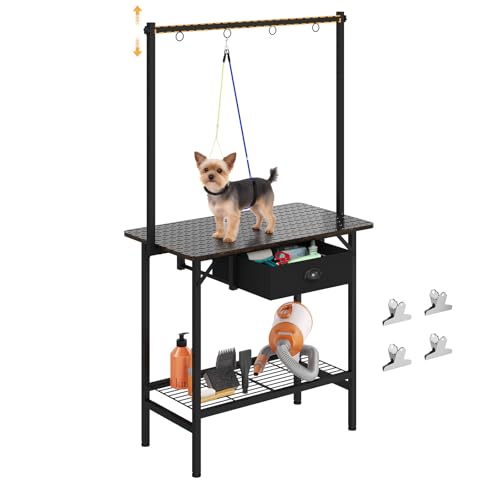
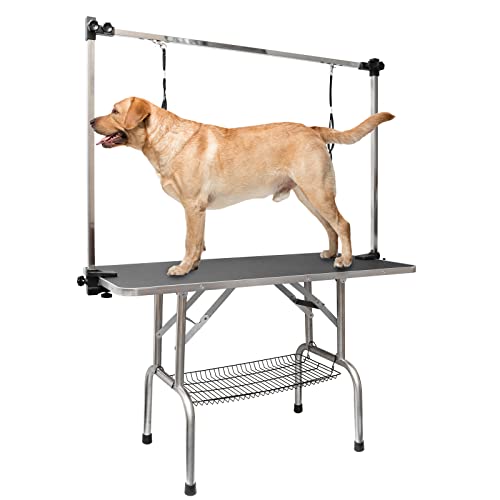 ROOMTEC 46" Dog Grooming Table
- Product Group: Pet Products
- Binding: Target
As an Amazon Associate we earn from qualifying purchases at no extra cost to you. Ratings are shown as listed on Amazon.
Step-by-Step
1. Choose a safe location (5 minutes)
Set the table on a level, hard floor with enough space to walk around all four sides. Keep it away from stairs, open doors, heaters, ceiling fans, and sharp furniture edges. Do not place it on a slippery rug or an unstable outdoor surface. Leave room for your tools, but keep cords and bottles outside the dog’s reach.
Before placing your dog on the table, lock the legs, check every hinge, and confirm that the tabletop does not rock. If the table has adjustable feet or casters, engage the locks. Check that the weight rating exceeds your dog’s current weight with a comfortable margin.
2. Inspect and prepare the equipment (3 minutes)
Install the grooming arm according to the instructions and tighten every knob by hand. Check the attachment point, loop, clips, and stitching for wear. Lay the clean, non-slip mat flat. If the surface has a mesh tray or removable insert, make sure it is fully seated and cannot shift under a paw.
Arrange brushes, towels, treats, and clippers before lifting your dog. A prepared station prevents you from leaving the dog unattended to retrieve something.
3. Introduce the table at floor level (5 to 10 minutes)
Let your dog sniff the table while it is empty. Reward a calm approach. If the table has a folding mechanism, prevent your dog from investigating pinch points. For a nervous dog, begin with treats on the floor beside the table, then reward placing one paw and eventually all four paws on the surface.
Lift small dogs with one hand supporting the chest and the other supporting the hindquarters. For larger dogs, use a ramp or have a second adult assist. Never drag a dog onto the tabletop by the grooming loop.
4. Position and secure your dog (1 to 2 minutes)
Place the dog near the center of the table, with all four feet on the non-slip surface. Adjust the arm so the safety loop reaches comfortably without pulling the head upward. It should not press into the throat, restrict breathing, or allow the dog to jump or fall from the edge. The dog should be able to swallow, pant, and move its head naturally.
Use the loop for positioning, not as a substitute for supervision. Keep one hand on a restless dog when appropriate, and never leave a dog tethered on the table—even for a quick phone call or to answer the door.
5. Start with calming contact (2 to 5 minutes)
Stroke the dog’s shoulders and back, touch each paw briefly, and reward stillness. Speak in a low, steady voice. Begin with an easy area, such as the back or shoulder, rather than a sensitive paw, tail, face, or tangled spot. If the dog freezes, pants heavily, trembles, growls, snaps, or repeatedly tries to escape, pause and lower the difficulty.
6. Brush in small sections (10 to 20 minutes)
Part the coat into manageable sections and work from the skin outward with gentle strokes. Use your free hand to protect loose skin around armpits, groin, ears, and the tail. Check your progress with a comb. Do not yank through mats; painful pulling can make future grooming more difficult.
For a dense coat, complete several short sessions instead of trying to finish everything at once. Stop if the dog becomes overheated, fatigued, or distressed. A grooming table is not a reason to rush.
7. Trim, clip, or do nails only if the dog is ready (5 to 20 minutes)
Use clippers only on a clean, dry coat unless the manufacturer specifically permits another use. Check the blade temperature against your inner wrist frequently; warm blades can burn skin. Keep scissors pointed away from the dog and avoid cutting close to the skin, eyelids, ear edges, or paw pads unless you have been properly trained.
For nails, remove only small amounts at a time. In light-colored nails, stop before the pink quick. In dark nails, make several tiny cuts and watch for the center to become darker or softer. If your dog pulls hard, stop rather than trying to overpower it.
8. Finish, release, and clean up (3 to 5 minutes)
Give a final reward while the dog is calm. Remove the loop before lifting the dog down. Carry a small dog with chest and hindquarters supported; for a larger dog, use a ramp or a second person. Never allow the dog to jump from the table.
Remove hair and disinfect the surface with a pet-safe product, following its label. Wash a removable mat as directed and dry it completely before storing. Inspect the table again after use.
Mistakes to Avoid
- Leaving a dog unattended: Falls and strangulation can happen in seconds.
- Using the wrong size table: A dog should not have to balance on an edge or crouch continuously.
- Skipping weight and stability checks: Confirm the table’s rating before every new or heavier dog uses it.
- Tightening the loop too much: It should guide the dog, never choke or suspend it.
- Forcing a frightened dog: Take a break, shorten the session, and use rewards. Consider professional help for severe fear.
- Working through mats aggressively: Severe mats can hide irritated skin and may require clipping by a professional.
- Using human products or overheated tools: Human shampoos, hot dryers, and hot clipper blades can irritate or burn dogs.
How Often
Use the table as often as your dog’s coat and care routine require. Short training sessions of two to five minutes can occur several times a week for puppies or nervous dogs. Brushing may be needed daily for long, curly, or easily matted coats; many short-coated dogs may need only weekly brushing. Nail checks every one to two weeks are practical, though trimming frequency depends on how quickly nails grow and how much the dog walks on hard surfaces.
Keep full grooming sessions brief at first—about 10 to 15 minutes—and extend them gradually if your dog remains relaxed. Clean and inspect the table after every use.
When to Call a Pro or Replace
Call a professional groomer or veterinarian if your dog bites, cannot remain calm, has painful mats, bleeding skin, ear discharge, suspected infection, or nails that are severely overgrown. A groomer can also show you safe techniques for breed-specific trimming and difficult coats.
Replace the table if the frame bends, legs wobble, locks fail, the surface becomes permanently slippery, or the arm, loop, clips, or stitching show damage. Stop using it immediately if the stated weight capacity is unclear or your dog can shift the table while standing on it.
FAQ
Can I use a grooming table for bathing?
Only if the product is specifically designed for wet use and has appropriate drainage and rust-resistant components. A standard grooming table should not be treated as a bathtub. Water can make the surface slippery and may damage folding hardware.
Should a dog wear a collar or harness on the table?
Follow the table’s instructions, but never attach a grooming loop to a choke chain or use a setup that tightens around the neck. A properly fitted grooming loop is intended for brief positioning under constant supervision. Ask a professional about safer alternatives for dogs with respiratory or neck problems.
What if my dog keeps trying to jump off?
Stop and lower the dog safely. Reintroduce the table at floor level with treats, then practice brief elevated sessions. Check footing, table stability, noise, and the loop adjustment. If repeated attempts continue, use professional guidance rather than increasing restraint.
Can beginners trim a dog’s coat on a grooming table?
Beginners can usually learn basic brushing and simple nail care, but close trimming requires practice. Start with clippers on a calm, cooperative dog and avoid sensitive areas. For intricate cuts, severe tangles, or a dog that moves suddenly, use a trained groomer.






Write Your Review
No reviews yet. Be the first to share your experience!