
Best slicker brush for doodles comes down to one hard requirement: pins long enough to reach the skin through a coat that never sheds out. A doodle keeps every hair it loses, and anything left trapped near the skin felts within days, which is why most shave-downs happen to dogs whose owners brushed them regularly.
Our top picks
 2PCS Slicker Brush for Dogs & Pet
- 【Premium Dog Grooming Kit】Owning a professional dog slicker…
- 【Professional Slicker Brush for Dogs】Designed for medium-length and…
- 【High Quality Dog Comb】Made of high quality stainless…

 Slicker Brush for Dogs
- 【Enhanced Combing Function】We've carefully designed each pin to…
- 【Suitable For Various Hair Types】Especially suitable for all…
- 【Ergonomic Handle Design】This pet grooming brush features an…


As an Amazon Associate we earn from qualifying purchases at no extra cost to you.
As an Amazon Associate we earn from qualifying purchases.
By Laura Simmons
🛒 Best Price Today on Amazon
Prime members get fast, free shipping on everything above, plus member-only deals. New members get a 30-day free trial — cancel anytime.
Start 30-Day Prime Free Trial →See Today’s Amazon DealsHow to Choose the Best Slicker Brush for Doodles
Doodle coats behave unlike anything else on a grooming table. They are curly or wavy, they trap shed hair rather than releasing it, and they mat from the skin outward where you cannot see it happening. Four factors separate a brush that prevents that from one that only makes the surface look tidy.
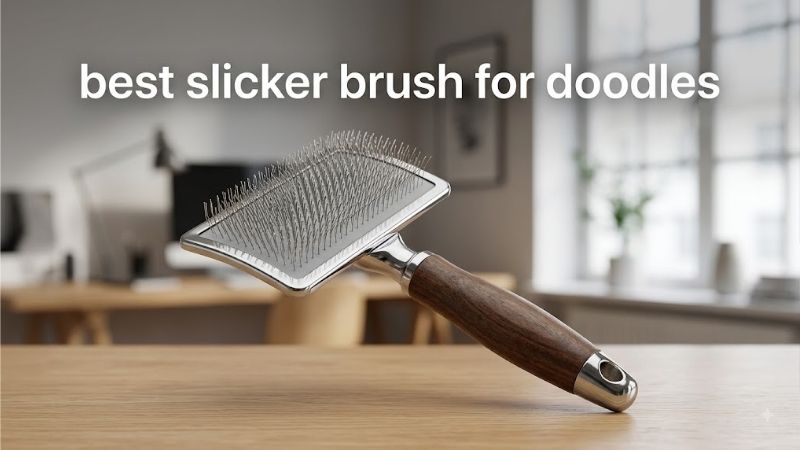
Pin Length Is Not Negotiable
A doodle coat kept at two inches needs pins that can travel most of that distance. The Chris Christensen Big G uses 27 mm bent pins, measured independently at around 26.5 mm, and Paw Brothers sits near 25 mm. Budget brushes typically run under 20 mm, which is not enough on any doodle kept in a longer trim.
This is why owners so often feel blindsided. They brush daily, the coat looks and feels smooth, and the groomer still finds felting against the skin. The short pins were combing the outer third of the coat and never touching the layer where the matting actually starts and spreads.
Longer pins also glide with less pulling, because they enter the coat and separate it rather than dragging against the surface. That matters for a dog’s tolerance as much as for the result, since a doodle that associates brushing with pain becomes very difficult to groom at home.
Pin Density for Curly Versus Wavy Coats
Chris Christensen builds the Big G with roughly 30 to 40 percent more pins than the Big K, and the two are designed for different coats. The dense Big G suits curly, cottony poodle-type coats, while the sparser bent pins of the Big K penetrate wavier, double-coated doodles more easily on the first pass.
Groomers describe the pair as the coarse and fine sides of a comb. On a heavily coated dog you open the coat with the sparser brush and finish with the denser one, and owners with a genuinely thick goldendoodle often end up owning both rather than choosing between them. Salons almost always keep the pair side by side.
Line Brushing Technique and the Comb Test
The brush only works if the technique does. Line brushing means lifting a section of coat, brushing the layer beneath it from the skin outward, then dropping the next layer down and repeating. Working at a shallow twenty to thirty degree angle rather than straight down protects the skin and reaches deeper.
Finish every session with a metal comb. If the comb passes from skin to tip without snagging, that section is genuinely clear. If it catches, the slicker has smoothed the surface and left work underneath. A light conditioning spray before brushing reduces static and breakage considerably.
Doodle ownership has driven a large share of grooming demand growth, and salon prices have climbed with it. A long-pinned brush plus a steel comb costs roughly what one professional groom does, and the pair is what keeps a coat long enough to avoid the shave-down that follows serious matting.
Brush Size and Awkward Areas
Most mats form in the same places: behind the ears, in the armpits, along the harness line, and around the sanitary area. A full-size brush head cannot work in any of them properly, which is why Chris Christensen sells the Big G in Large, Medium, and Baby sizes rather than one shape.
The Large head at roughly 3¾ by 3¾ inches covers a body quickly, the Medium at 2⅜ by 3¾ suits legs and columns, and the Baby at 2⅜ inches square gets into armpits and between the legs. Owners who buy only the large size tend to find mats exactly where the brush would not fit.
Top Picks: Six Brushes That Reach Doodle Skin
The six below are ordered by how well they penetrate a curly coat rather than by price. The table lists pin length and best use before each individual assessment, and every entry closes with the drawback that would rule that brush out for some doodle owners. No single best slicker brush for doodles covers body, legs, and armpits equally well.
| Brush | Pin Length | Density | Best For |
|---|---|---|---|
| Chris Christensen Big G, Large | 27 mm | Dense | Body work, curly coats |
| Chris Christensen Big G, Medium | 27 mm | Dense | Legs and columns |
| Chris Christensen Baby G | 27 mm | Dense | Armpits, behind ears |
| Chris Christensen Big K | Bent, long | Sparser | Wavy double coats |
| Paw Brothers Stainless Slicker | Approx. 25 mm | Medium | Value long-pin option |
| Hertzko Self-Cleaning Slicker | Short | Fine | Quick daily tidying |
Chris Christensen Big G Slicker Brush, Large
Known in grooming circles simply as the doodle brush, the large Big G pairs 27 mm bent pins with a dense pin bed, a flexible cushion pad, a curved back for control, and a long non-slip handle. On a body it removes tangles and undercoat in noticeably fewer strokes than anything cheaper.
The price is the obvious barrier, and the large head is too big for legs, faces, and armpits, which is where matting concentrates. Chris Christensen covers manufacturing defects for six months only, which feels short given what the brush costs relative to the rest of the market.
Chris Christensen Big G, Medium
With a head around 2⅜ by 3¾ inches, the medium size is the one most single-doodle owners should buy first. It handles legs, columns, and poms properly while still covering a body in reasonable time, which makes it the more sensible single purchase for a home groomer rather than a salon.
It takes longer than the large head on a big goldendoodle’s back and sides, and the price sits close enough to the large version that the saving is modest. Owners with two or more doodles usually find they want both sizes within a few months. Buying the pair together is often cheaper in the long run.
Chris Christensen Baby G
The Baby G exists for the places mats actually form. At roughly 2⅜ inches square it reaches armpits, the area behind the ears, and between the back legs, where a full-size brush simply cannot be angled correctly no matter how careful you are with it. Those areas are where nearly every shave-down begins.
It is far too small to groom a body and would take an unreasonable amount of time if you tried. Buying it alone is a mistake, so treat it as the second brush that completes a set rather than a standalone answer to a matting problem. Paired with a body brush it completes the best slicker brush for doodles kit.
Chris Christensen Big K Slicker Brush
Among the best slicker brush for doodles options, this is the one for wavier, denser, double-coated doodles the Big K’s sparser bent pins enter the coat more easily than the Big G’s packed bed. It is the brush that opens a thick coat so a denser tool can finish it, and it is the better first pass on a dog that has been left slightly too long. It is the recovery brush as much as the maintenance one.
On a tightly curled poodle-type coat it does less per stroke and can leave tougher knots behind. Owning both is the professional answer and an expensive one for a household with a single dog, so choose based on whether your doodle is curly or wavy. Coat texture is the deciding factor, not the breed name on the papers.
Paw Brothers Stainless Steel Slicker
At roughly 25 mm the pins reach almost as deep as the Big G, making this the practical value option for owners who cannot justify premium pricing. The stainless build lasts, and it delivers genuine coat penetration rather than the surface work that budget brushes are limited to.
The pad is firmer and the handle less comfortable, so hand fatigue arrives sooner and there is less give when the pins meet an elbow or a hock. Lower pin density also means more strokes to reach the same finish on a dense curly coat. Budget for slightly longer sessions rather than worse results.
Hertzko Self-Cleaning Slicker Brush
The best slicker brush for doodles is never a self-cleaning model, but push-button retraction clears the pad in seconds, which makes this the brush you actually reach for during a quick tidy after a muddy walk. Fine angled bristles lift loose hair without scratching, and the comfort grip is easy on the hand during short sessions. It is the tool most owners actually reach for mid-week.
The pins are far too short for real doodle work, and relying on it alone is how coats end up felted at the skin. It is a convenience tool rather than the best slicker brush for doodles, so pair it with a long-pinned brush and a metal comb. Convenience tools cannot prevent matting on their own.
Frequently Asked Questions
These questions come up repeatedly from doodle owners between grooms, particularly around how often brushing is genuinely needed and what to do once matting has already started forming close to the skin. The answers assume you are using the best slicker brush for doodles on a coat kept in a longer trim.
How often does a doodle need brushing?
Most doodles kept in a longer trim need thorough line brushing every day or every other day. Coat that is clipped short can stretch to a few times a week. Frequency matters far more than session length, because felting builds continuously rather than in occasional bursts. Two short sessions a day beat one long one on a heavy coat.
Can I brush out an existing mat?
A small loose tangle, yes: hold the coat at the base so you are not pulling skin and work from the outer edge inward. A tight mat sitting against the skin should be clipped out underneath by a groomer, since brushing it causes real pain and can tear the skin. Skin under a tight mat is often already inflamed.
Does a self-cleaning brush work on doodles?
Only for surface tidying. Every self-cleaning mechanism uses shorter, softer pins, and on a doodle those pins stop well above the layer that matters. Use one for convenience if you like, but it cannot replace a long-pinned brush in the routine. Keep it for tidying and nothing more than that.
Should I brush a wet or dry coat?
Dry, or lightly misted with a conditioning spray. Brushing a soaking coat pulls and breaks hair, and any mat present will tighten as it dries. Always brush thoroughly before a bath rather than afterwards, since water sets existing tangles into solid felt. Drying with a brush in hand keeps the coat straight.
See More:
- Best smelling dog shampoo and conditioner
- Best dog mite shampoo
- Hartz Groomer’s Best Soothing Oatmeal Dog Shampoo
- Best professional dog nail grinder
- Best cat brush medium hair
Final Thoughts
The best slicker brush for doodles is whichever long-pinned tool matches your dog’s curl: the Big G for curly cottony coats, the Big K for wavier double coats, and the Baby G for the armpits and ears where mats really start. Finish every session with a metal comb to confirm the work is done.



Write Your Review
No reviews yet. Be the first to share your experience!