
Key takeaways
- Toy and small breeds: A small head, about 1.5 to 2 inches wide by 2 to 2.5 inches long.
- Medium breeds: A small-to-medium head, about 2 to 3 inches wide by 2.5 to 3.5 inches long.
- Large and giant breeds: A medium head, about 2.5 to 3.5 inches wide by 3 to 4 inches long while the puppy is still young.
- Curly or easily tangled coats: Choose a compact head that lets you work in small sections, even if the puppy will eventually need a larger adult brush.
What's inside
Choosing the right slicker brush for a puppy is less about buying the biggest brush available and more about matching the brush head to your puppy’s body, coat, and tolerance for grooming. A brush that is too large can be awkward around the face, legs, and belly. One that is too small may take too long to use and encourage you to press harder.
For most puppies, a small slicker brush with a head approximately 1.5 to 2.5 inches wide and 2 to 3 inches long is a sensible starting point. Medium- and large-breed puppies may move into a medium brush as their bodies and coats grow. In 2026, many affordable puppy slicker brushes cost about $14 to $20, but size and pin design matter more than a small price difference.
As an Amazon Associate we earn from qualifying purchases at no extra cost to you. Product prices and availability are accurate as of the date shown and are subject to change.


The Short Answer
The best slicker brush size for a puppy is usually:
- Toy and small breeds: A small head, about 1.5 to 2 inches wide by 2 to 2.5 inches long.
- Medium breeds: A small-to-medium head, about 2 to 3 inches wide by 2.5 to 3.5 inches long.
- Large and giant breeds: A medium head, about 2.5 to 3.5 inches wide by 3 to 4 inches long while the puppy is still young.
- Curly or easily tangled coats: Choose a compact head that lets you work in small sections, even if the puppy will eventually need a larger adult brush.
Look for flexible, rounded pins and a pin length of roughly 5 to 10 millimeters, or 0.2 to 0.4 inches. Shorter pins are often easier for a puppy’s fine coat and sensitive skin. A lightweight brush weighing approximately 2 to 5 ounces is also easier to control during short training sessions.
Do not select a brush solely by the manufacturer’s label. Terms such as “small,” “one size,” and “puppy” are not standardized. Compare the actual brush-head measurements, not just the overall package dimensions.
Standard Sizes
The table below describes useful slicker-brush size ranges. Measurements refer to the brush head, excluding the handle. The listed weights are typical target ranges for comfortable puppy grooming, not a requirement for every brush.
| Brush size | Brush-head dimensions | Metric dimensions | Typical weight | Best suited to |
|---|---|---|---|---|
| Extra small | 1.25–1.75 in W × 1.75–2.25 in L | 3.2–4.4 cm W × 4.4–5.7 cm L | 1.5–3 oz (43–85 g) | Tiny puppies, toy breeds, faces, paws, and ears |
| Small | 1.5–2.5 in W × 2–3 in L | 3.8–6.4 cm W × 5.1–7.6 cm L | 2–5 oz (57–142 g) | Most puppies, small breeds, and detailed grooming |
| Medium | 2.5–3.5 in W × 3–4 in L | 6.4–8.9 cm W × 7.6–10.2 cm L | 3–7 oz (85–198 g) | Medium and large puppies with fuller coats |
| Large | 3.5–5 in W × 4–5.5 in L | 8.9–12.7 cm W × 10.2–14 cm L | 5–10 oz (142–284 g) | Adult-sized bodies, not usually necessary for young puppies |
A small brush is often the most versatile first purchase. It can reach behind the ears, around the legs, and along the chest without forcing the puppy into an uncomfortable position. For a Goldendoodle, Poodle, Shih Tzu, or another curly-coated puppy, a small or medium brush is useful because you can divide the coat into narrow sections and brush from the skin outward.
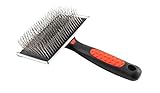
Examples in this category include compact designs such as the PETPAWJOY slicker brush, while products such as the Swihauk, Aumuca, and Poodle Pet brushes may be offered in shapes intended for small dogs, cats, or longer coats. Check each listing’s head dimensions before ordering because “one size” does not tell you whether the head is appropriate for your puppy.
How to Measure Your Space
For a slicker brush, “space” means the area you need to groom comfortably, including your puppy’s body and the room around each section of coat. Use these steps before choosing a size:
- Measure the puppy’s narrow areas. Use a ruler to estimate the width of the space behind the ears, between the front legs, and around the lower legs. If these areas are only 1.5 to 2.5 inches wide, a brush head larger than about 3 inches may be difficult to maneuver.
- Check the coat length. For coats under 1 inch long, choose shorter pins around 5 to 7 millimeters. For coats over 1 inch or curly coats, pins around 7 to 10 millimeters may reach through more hair, provided they remain gentle.
- Measure your grip and hand clearance. Hold the brush as you would during grooming. You should be able to see the brush head and move your wrist without the handle hitting the table, your leg, or the puppy’s body.
- Test a small section first. Place the brush flat against the coat and use two or three light strokes. A suitable head should cover the section without pulling the skin or making the puppy twist away.
- Allow a safe grooming area. Use a stable, nonslip surface with enough room for the puppy to stand, sit, and turn. A grooming mat about 24 by 18 inches, or 61 by 46 centimeters, gives many small puppies useful working space without letting them wander.
Never use the brush to force out a tight mat. Stop if the skin becomes red, the puppy cries, or the pins catch repeatedly. Severe mats are better handled by a professional groomer or veterinarian.
By Room or Use Case
For a toy-breed puppy
Choose an extra-small or small brush. A head around 1.5 to 2 inches wide is easier to use on a Yorkie, Chihuahua, Maltese, or similarly sized puppy. A narrow head also helps you avoid the eyes and nose. Use brief sessions of one to three minutes and reward calm behavior.
For a medium-breed puppy
A small brush remains appropriate for puppies with short or moderately thick coats. A medium brush measuring about 2.5 by 3 inches may be more efficient for a spaniel, terrier, or mixed-breed puppy with a fuller coat. Choose the smaller option if your puppy is nervous or has sensitive skin.
For a large-breed puppy
Start with a medium brush rather than an adult-size large brush. A 3-by-4-inch head can cover the back and sides efficiently while remaining manageable around the legs and chest. As the puppy grows, you can add a larger brush for broad areas and keep the medium brush for detail work.
For curly or doodle-type coats
Prioritize pin reach and control. A small-to-medium slicker brush with pins about 7 to 10 millimeters long is generally easier to use in sections than a very broad head. Brush gently from the ends toward the skin, checking that the pins reach through the coat rather than merely smoothing the surface.
For faces, ears, and paws
Use the smallest brush you can control, often 1.25 to 2 inches wide. Keep the brush away from the eyes, and use your free hand to protect loose skin around the ears. A full-size brush may be suitable for the body but unnecessarily cumbersome for these areas.
Common Sizing Mistakes
- Buying the largest brush for a long-haired puppy: A large head may skip over tangles and make it harder to groom in layers.
- Ignoring pin length: A small head with very long, stiff pins can still irritate a puppy’s skin.
- Confusing overall length with head size: A long handle does not mean the brush has a large grooming surface. Measure the head itself.
- Using a slicker as a de-matting tool: Slicker brushes can help prevent tangles, but forcing one through a mat can hurt.
- Pressing harder when hair does not move: Use smaller sections, improve your technique, or select a brush with a suitable pin length instead.
- Choosing a brush that is too heavy: A 6- to 10-ounce brush may tire your hand during a puppy session, especially when working around the body.
FAQ
Is a small slicker brush better for a puppy?
Usually, yes. A small brush gives you better control around the face, legs, ears, and belly. It is also easier to use in short sections. A medium brush can be appropriate for a large puppy or a very full coat, but the head should still be easy to maneuver.
What size slicker brush should I use for a Goldendoodle puppy?
Start with a small or medium brush, commonly about 2 to 3 inches wide and 2.5 to 4 inches long. Choose pins around 7 to 10 millimeters long if the coat is curly and dense. Work in thin sections and check the brush reaches the skin without scraping it.
How often should I brush a puppy?
Frequency depends on coat type. Short coats may need brushing once or twice a week, while curly, long, or easily tangled coats may need gentle daily attention. Keep early sessions short—often one to five minutes—and stop before the puppy becomes frustrated.
How much should a puppy slicker brush cost?
Many basic slicker brushes fall in the approximate $14 to $20 range, with examples around $14.97, $16.03, and $16.99. Prices can change, so compare the brush-head dimensions, pin length, handle comfort, and cleaning mechanism rather than choosing solely by price.




Write Your Review
No reviews yet. Be the first to share your experience!