
Key takeaways
- A height range that starts above 28 inches when you groom small dogs.
- No stated tabletop dimensions, weight capacity, warranty, or product weight.
- A smooth surface without a non-slip mat or textured covering.
- Legs that wobble when the table is pressed at the corners.
- A grooming arm that bends, rotates, or slips under moderate hand pressure.
- Electrical controls with no information about voltage, overload protection, or replacement parts.
- A capacity rating that is high but paired with a narrow base, tiny feet, or unlocked casters.
- Instructions that suggest leaving a dog restrained on the table unattended.
What's inside
- Decide These 3 Things First
- Size: Match the Tabletop to the Dog
- Material: Prioritize a Secure, Cleanable Surface
- Construction: Stability Matters More Than Maximum Capacity
- Comfort and Performance: Choose the Right Adjustment Range
- Price Tiers: Spend on Adjustment and Stability
- Warranty: Check What Is Actually Covered
- Delivery and Assembly: Plan for the Table’s Real Weight
- Spec Checklist
- Red Flags
- FAQ
Choosing the right grooming table height is less about finding the tallest or most powerful lift and more about matching the table to your dog, your body, and the way you groom. A table that is too low can force you to bend over for an hour. One that is too high can make your dog feel unstable and leave you reaching awkwardly for legs, paws, and the underside of the coat.
- Decide These 3 Things First
- Size: Match the Tabletop to the Dog
- Material: Prioritize a Secure, Cleanable Surface
- Construction: Stability Matters More Than Maximum Capacity
- Comfort and Performance: Choose the Right Adjustment Range
- Price Tiers: Spend on Adjustment and Stability
- Warranty: Check What Is Actually Covered
- Delivery and Assembly: Plan for the Table’s Real Weight
- Spec Checklist
- Red Flags
- FAQ
Common buying mistakes include measuring the dog’s back instead of its withers, trusting a listed weight capacity without considering table stability, and overlooking the lowest height setting. Buyers also sometimes choose a fixed-height table because it costs less, only to discover that the table is uncomfortable for both a small dog and a tall groomer. This guide explains how to choose dog grooming table height and which specifications matter most in 2026.
As an Amazon Associate we earn from qualifying purchases at no extra cost to you. Product prices and availability are accurate as of the date shown and are subject to change.


Decide These 3 Things First
- Measure the dog. Measure from the floor to the top of the shoulders, or withers, while the dog is standing naturally. A 12-inch dog and a 26-inch dog need very different working surfaces.
- Measure the groomer. Stand with your upper arms relaxed and elbows close to your sides. The comfortable tabletop height is usually near your elbows or up to about 2 inches below them, depending on whether you prefer to work seated or standing.
- Choose the lifting style. Electric tables offer the easiest, most precise adjustment. Hydraulic models can be excellent for occasional grooming and do not require a power outlet. Fixed or folding tables are the most affordable but provide less flexibility.
As a starting point, many home groomers will be comfortable with a table that adjusts from roughly 22 to 39 inches. Small dogs may need a low setting around 20 to 24 inches, while large dogs are often easier to groom at 30 to 36 inches. Always prioritize stability and the dog’s ability to stand securely over maximum height.
Size: Match the Tabletop to the Dog
Table height gets most of the attention, but tabletop size determines whether the dog can stand, turn, and reposition safely. For toy and small breeds, a surface around 30 by 18 inches may be sufficient. For medium dogs, look for approximately 36 by 23 inches. Large dogs generally benefit from at least 43 by 24 inches, with extra length useful for long-bodied breeds.
Measure your dog from nose to the base of the tail, then add at least 6 inches for working room. The dog should not have its front or back feet close to the edge when standing normally. A larger surface also gives you room for clippers, brushes, and towels, although tools should stay in a tray rather than on the grooming area.
Pay attention to the folded dimensions if storage matters. A folding table weighing 35 to 55 pounds may be manageable for one person, while a heavy electric model can weigh substantially more and may need a permanent location. If you groom in a bathroom, laundry room, or garage, measure doorways and storage clearances before ordering.
Material: Prioritize a Secure, Cleanable Surface
The best grooming tabletops are rigid, waterproof, and textured enough to prevent slipping without catching nails. Rubber or PVC-style non-slip coverings are common and easy to wipe clean. Avoid smooth painted metal, polished wood, or deeply grooved surfaces that can become slippery when wet or trap hair and shampoo.
For the frame, steel is generally preferable to lightweight aluminum when you need a high weight capacity or a large tabletop. Steel adds weight and can reduce shaking, although it also makes the table harder to move. Look for a coated or powder-coated frame to help resist moisture and surface corrosion.
Edges should be rounded or capped rather than sharp. A raised lip can help keep a nervous dog from stepping off, but it should not interfere with brushing legs or trimming around the feet. The tabletop should also be easy to disinfect without swelling, peeling, or absorbing water.
Construction: Stability Matters More Than Maximum Capacity
A listed capacity of 260 or 350 pounds does not automatically mean the table will feel stable with a moving dog. Look for a broad base, locking casters, reinforced legs, and a grooming arm that does not flex excessively. A large dog shifting its weight creates more movement than its static scale weight suggests.
For dogs under about 25 pounds, a compact table with a 100-pound-or-more rating is usually ample if the frame is rigid. Dogs from 25 to 75 pounds are better served by a steel frame rated for at least 200 pounds. For giant breeds or dogs that move frequently, consider a rating of 300 pounds or more, along with a wide base and a tabletop at least 43 inches long.
The grooming arm should lock securely at multiple heights. An H-shaped arm can provide useful support around the dog, but the noose must never be used to lift, suspend, or tightly restrain a dog. Stay beside the table, use quick-release equipment, and never leave the dog unattended.
Comfort and Performance: Choose the Right Adjustment Range
To estimate your ideal height, subtract the dog’s withers height from your preferred elbow-level tabletop height. For example, if your comfortable working surface is 32 inches high and your dog’s withers are 18 inches above the floor, a table set around 30 to 32 inches may put the coat and legs in a comfortable position. You may still lower it for bathing, clipping paws, or helping the dog onto the surface.
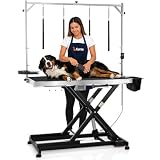
Electric adjustment is most convenient when you groom multiple dogs or need frequent height changes. The KANIS Professional Electric Dog Grooming Table – Heavy Duty, listed at $674.99, represents the premium end of the examples here. The YORKING 50-inch Professional Electric Dog Grooming Table, listed at $489.99, includes hand and foot controls among its advertised features. Foot controls can be useful when both hands are occupied, but verify that the control placement will not be bumped accidentally.
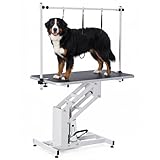
Hydraulic tables offer smooth height changes without a motor. The Garvee 43.3-inch Hydraulic Pet Grooming Table is listed at $269.99, with an advertised 22- to 39-inch height range and a maximum capacity of 350 pounds. Hydraulic systems can be a good compromise for home users, but confirm that the pump raises the table smoothly with your dog on it.
Price Tiers: Spend on Adjustment and Stability
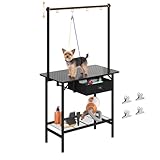
Budget, roughly $100 to $200: Expect folding frames, manual or limited height adjustment, and fewer convenience features. The LEIBOU 45-inch table is listed at $136.99 and advertises a 23- to 33.8-inch range, a foldable iron frame, an H-shaped grooming arm, and a 260-pound maximum capacity. This category can work well for occasional grooming if the folded size and weight are manageable.
Midrange, roughly $200 to $450: This tier commonly offers hydraulic lifting, larger surfaces, stronger frames, or more flexible restraints. It is often the best value for owners grooming one or more dogs regularly, especially when the table needs to serve dogs of different sizes.
Premium, roughly $450 to $750 or more: Expect electric height adjustment, improved controls, heavier construction, and features such as trays or integrated lighting. Premium pricing is justified when you groom frequently, have back or shoulder concerns, or need very precise positioning. It is less useful if the table will be stored after every session and used only a few times per year.
Warranty: Check What Is Actually Covered
Look for at least a one-year warranty on the frame, motor, hydraulic mechanism, and electrical controls. A longer warranty is helpful, but read the exclusions. Some warranties cover the motor but not the tabletop, casters, grooming arm, or labor.
Confirm whether replacement parts are available in the United States and whether the seller provides a clear process for a defective lift. For electric models, check the voltage and plug requirements, usually 110 to 120 volts for American homes, and look for overload protection. A warranty is far more useful when the manufacturer can supply a controller, actuator, pump, or caster without requiring the entire table to be returned.
Delivery and Assembly: Plan for the Table’s Real Weight
Folding tables may arrive mostly assembled, while electric and hydraulic models can require attaching legs, controls, grooming arms, or trays. Set aside at least 30 to 60 minutes for basic assembly and have a second person available for a heavy top or frame.
Before accepting delivery, inspect the carton for crushed corners, punctures, or exposed metal. Photograph damage and check that every listed part is included. A table weighing 70 pounds or more may be difficult to move upstairs, so verify the package weight and delivery method rather than relying on the product’s tabletop dimensions.
After assembly, test the table empty at every height. Then apply pressure near each corner and inspect for rocking, uneven feet, loose bolts, or a grooming arm that slips. Do not place a dog on it until the locks, non-slip surface, and height controls work correctly.
Spec Checklist
| Spec | Budget | Mid | Premium |
|---|---|---|---|
| Typical price | $100-$200 | $200-$450 | $450-$750+ |
| Useful height range | 23-34 inches | 22-39 inches | 20-40 inches |
| Small-dog tabletop | About 30 x 18 inches | About 36 x 23 inches | 30-43 x 20-24 inches |
| Large-dog tabletop | At least 36 x 23 inches | About 43 x 24 inches | 43-50 x 24-26 inches |
| Capacity target | 100-200 pounds | 200-350 pounds | 300 pounds or more |
| Adjustment type | Folding or manual | Hydraulic or reinforced manual | Electric, often with hand or foot control |
Red Flags
- A height range that starts above 28 inches when you groom small dogs.
- No stated tabletop dimensions, weight capacity, warranty, or product weight.
- A smooth surface without a non-slip mat or textured covering.
- Legs that wobble when the table is pressed at the corners.
- A grooming arm that bends, rotates, or slips under moderate hand pressure.
- Electrical controls with no information about voltage, overload protection, or replacement parts.
- A capacity rating that is high but paired with a narrow base, tiny feet, or unlocked casters.
- Instructions that suggest leaving a dog restrained on the table unattended.
FAQ
What is the best grooming table height for a small dog?
Start with the tabletop around your elbow height minus the dog’s withers height, then adjust for comfort. In practice, a setting between 20 and 28 inches often works for small dogs, provided the dog can stand securely and you can reach the coat without bending.
Should a grooming table be at waist height?
Usually, it should be near elbow height rather than waist height. Elbow-level positioning helps reduce back and shoulder strain during brushing and trimming. The ideal setting changes depending on the task, so a table with at least a 10-inch adjustment range is more versatile than a fixed-height model.
Is hydraulic or electric better for a dog grooming table?
Electric is generally easier for frequent use and precise adjustments. Hydraulic models are quieter in some setups, do not require a power outlet, and can offer strong lifting capacity at a lower price. Choose electric for convenience and repeated height changes; choose hydraulic for value and simpler occasional use.
How much weight capacity does a grooming table need?
Choose a table rated for at least twice your dog’s body weight when possible, especially if the dog shifts, jumps, or is difficult to position. A 60-pound dog is better matched with a table rated around 200 pounds or more. Capacity is only one part of safety: the base, locks, tabletop, and grooming arm must also remain stable.




Write Your Review
No reviews yet. Be the first to share your experience!