
Key takeaways
- 6–10 mm: short coats, light shedding, small facial areas, and finishing work.
- 10–15 mm: medium coats, spaniel-type furnishings, and everyday all-purpose grooming.
- 15–20 mm: dense double coats and medium-to-long curly or wavy coats.
- 20–25 mm: very dense, long, or heavily layered coats, including some doodle coats.
What's inside
- Decide These 3 Things First
- 1. Match Pin Length to Coat Depth
- 2. Choose the Right Brush-Head Size
- 3. Evaluate Pin Material and Tip Finish
- 4. Check Construction, Pin Density, and Flex
- 5. Prioritize Comfort and Grooming Performance
- 6. Compare Price Tiers Realistically
- 7. Review Warranty, Returns, and Delivery Details
- Spec Checklist
- Red Flags
- FAQ
Choosing a slicker brush by pin length alone is a common mistake. Longer pins are not automatically better, and short pins are not automatically gentler. The right choice depends on how deeply the brush must reach, how dense the coat is, how sensitive your dog’s skin may be, and whether you can use the brush without pressing hard.
- Decide These 3 Things First
- 1. Match Pin Length to Coat Depth
- 2. Choose the Right Brush-Head Size
- 3. Evaluate Pin Material and Tip Finish
- 4. Check Construction, Pin Density, and Flex
- 5. Prioritize Comfort and Grooming Performance
- 6. Compare Price Tiers Realistically
- 7. Review Warranty, Returns, and Delivery Details
- Spec Checklist
- Red Flags
- FAQ
Other buying errors are just as easy to make. Some shoppers choose an oversized head for a small dog, buy extra-long pins for a coat that only needs surface smoothing, or assume “soft pin” means the brush cannot irritate skin. A brush can also look substantial in a product photo while having flexible pins, a cramped handle, or a head too large for precise work.
As an Amazon Associate we earn from qualifying purchases at no extra cost to you. Product prices and availability are accurate as of the date shown and are subject to change.
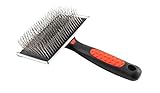


This guide explains how to choose slicker brush pin length in 2026, using practical dimensions, price ranges, and construction details rather than marketing language.
Decide These 3 Things First
- How far into the coat must you reach? A short, single-layer coat may need pins about 6–10 mm long. Medium coats commonly suit 10–15 mm pins, while dense double coats, doodle coats, and long furnishings may need 15–25 mm.
- How much control do you need? A small dog, narrow legs, ears, and face require a compact brush and shorter working strokes. A large dog with a broad body can benefit from a larger curved head and longer pins.
- How sensitive is the skin and how skilled is the user? Long, stiff pins can reach dense tangles but may scratch if used with too much pressure. A beginner or a dog with delicate skin may do better with rounded or coated tips and moderate pin length.
Pin length is only one part of the decision. The following factors determine whether that length will work safely and efficiently.
1. Match Pin Length to Coat Depth
Measure the coat from the skin to the outermost hair, then choose pins long enough to reach the undercoat without forcing the brush through. As a general starting point:
- 6–10 mm: short coats, light shedding, small facial areas, and finishing work.
- 10–15 mm: medium coats, spaniel-type furnishings, and everyday all-purpose grooming.
- 15–20 mm: dense double coats and medium-to-long curly or wavy coats.
- 20–25 mm: very dense, long, or heavily layered coats, including some doodle coats.
Do not select a 25 mm brush simply because the dog has long hair. If the coat is fine or loosely packed, those pins can bend, snag, or contact the skin unnecessarily. Likewise, 8 mm pins may glide over the top of a compact undercoat without removing much loose hair.
For severe mats, a slicker brush is not a substitute for careful dematting, clipping, or professional grooming. Pulling repeatedly at a tight mat can hurt the dog regardless of pin length.
2. Choose the Right Brush-Head Size
Brush-head dimensions affect both coverage and control. A practical range for most buyers is approximately 2.5–4 inches wide and 3–5 inches long, not including the handle.
- Small head, about 2–2.75 inches: best for toy breeds, puppies, legs, paws, faces, and detail work.
- Medium head, about 2.75–3.5 inches: a versatile choice for small to medium dogs.
- Large head, about 3.5–4.5 inches: useful on large dogs and broad body areas, particularly with a thick coat.
A large head can reduce the number of passes across a Labrador, golden retriever, or standard poodle, but it can be awkward around elbows and ears. A smaller head provides better section-by-section control and makes it easier to brush in a straight line from skin outward.
Curved heads can increase contact across the body, while flatter heads may offer more predictable control in narrow areas. Neither shape is universally superior.
3. Evaluate Pin Material and Tip Finish
Most slicker brush pins are made from stainless steel or another steel alloy. Stainless steel is desirable because it resists rust and is easy to wipe clean, but the quality of the wire, its thickness, and its attachment matter more than the label alone.
Look for pins that are evenly spaced and have smooth, rounded, or coated tips. Coated tips can make a brush feel less sharp, although they do not make aggressive pressure safe. Uncoated pins can work well when the user maintains a light touch and checks the skin frequently.
Pin diameter is rarely listed, but visible differences matter. Very fine pins can penetrate dense coats efficiently but may flex or bend more easily. Thicker pins usually tolerate more force but may not separate fine hair as gently. When specifications are available, a pin diameter around 0.2–0.4 mm is common for flexible slicker designs; treat that figure as a reference, not a guarantee of quality.
Run a clean finger lightly across the tips before using a new brush. Reject any brush with a burr, hooked wire, loose pin, or sharp irregularity.
4. Check Construction, Pin Density, and Flex
A slicker brush should have a secure pin bed with no obvious gaps, loose wires, or movement where the head meets the handle. A flexible cushion can make brushing more forgiving, while a firm pin bed may provide more direct control through a dense coat.
Pin density changes how the brush behaves. A head with roughly 100–200 pins may be easier to clean and less likely to drag through a light coat. A densely packed head with 200–400 or more pins can collect more loose hair but may require smaller sections and gentler strokes.
The pins should flex slightly under light finger pressure and return to position. If they collapse immediately, they may not reach the undercoat effectively. If they barely move and feel needle-sharp, the brush demands more careful technique.
Inspect the handle-to-head connection. A brush weighing about 3–6 ounces is usually manageable for routine home grooming. Heavier models can feel stable on a large dog but may cause hand fatigue during a 20- to 30-minute session.
5. Prioritize Comfort and Grooming Performance
Ergonomics matter because the safest slicker brush is one you can control. Seek a handle approximately 4–5.5 inches long, with a grip wide enough to hold without clenching. A rubberized or textured grip can help if you groom with wet hands or brush thick coats.
Use short, light strokes of roughly 1–3 inches rather than dragging the brush through an entire section. Separate the coat into layers and brush from the ends toward the roots, checking that the pins are reaching the hair instead of scraping the skin. For curly coats, line-brushing small sections is generally more effective than making broad surface passes.
For a nervous or sensitive dog, soft-pin or coated-tip models may be more acceptable. For an experienced owner working through a dense undercoat, longer, moderately firm pins may save time. Stop if the dog flinches, turns to bite at the brush, or develops visible redness.
6. Compare Price Tiers Realistically
Price often reflects handle design, head construction, finishing, and consistency rather than a magical difference in detangling ability.
- Budget, about $7–$12: basic plastic handles, fixed heads, and standard pin lengths. The Millers Forge MF120 example is listed around $8.25, while the Worinkley long-pin example is around $9.99.
- Midrange, about $13–$22: better grips, larger heads, curved designs, coated tips, or longer pins. The Paw Brothers soft-pin example is listed around $14.99, and the Paw Brothers extra-long example around $17.99.
- Premium, about $23–$45 or more: specialized pin layouts, refined handles, replaceable components, or professional-oriented construction.
A $10 brush can be perfectly suitable for occasional grooming if the pins are smooth and the head remains secure. Paying more makes sense when you groom frequently, need extra-long pins, have multiple dogs, or want better comfort and control.
7. Review Warranty, Returns, and Delivery Details
Slicker brushes rarely require assembly, but packaging and return terms still matter. A brush should arrive with its head protected so the pins are not bent. If the product includes a removable head or cleaning mechanism, confirm that replacement parts are available before buying.
Warranty coverage may range from no stated warranty to one year or more against manufacturing defects. It generally does not cover bent pins caused by misuse, chewing, or normal wear. Check whether the retailer accepts returns after the package has been opened, since pin sharpness and handle comfort are difficult to judge from a photo.
On delivery, inspect the brush immediately. Count obvious missing pins, check the head for cracks, and make sure the handle does not wobble. Do not use a damaged brush on a dog.
Spec Checklist
| Spec | Budget | Mid | Premium |
|---|---|---|---|
| Typical price | $7–$12 | $13–$22 | $23–$45+ |
| Pin length | 8–15 mm | 12–20 mm | 15–25 mm, often specialized |
| Head width | 2.5–3.5 in. | 2.75–4 in. | 2.5–4.5 in., with more options |
| Head construction | Fixed plastic or basic cushion | Curved or cushioned head | Refined cushion, replaceable parts, or specialized layout |
| Tip finish | Rounded or standard steel | Rounded, polished, or coated options | Consistently finished or coated pins |
| Best use | Light to medium coats | Regular home grooming | Dense coats, frequent grooming, or professional use |
Red Flags
- No pin-length information when the brush is marketed for long or dense coats.
- Pins that are visibly uneven, bent, hooked, or sharp at the tips.
- A head that flexes away from the handle or has a loose perimeter.
- Claims that one brush removes every mat without pulling, cutting, or discomfort.
- A large brush head paired with a very small handle, which can reduce control.
- Reviews or photos showing missing pins after minimal use.
- No return instructions, defect coverage, or clear seller information.
- Instructions that encourage pressing firmly against the skin.
FAQ
What pin length is best for a doodle?
For many medium-to-long doodle coats, 15–20 mm is a useful starting range. A very dense or long coat may need 20–25 mm, while a short, fine coat may be better served by 10–15 mm. Brush in small sections and confirm that the pins reach the roots without scraping the skin.
Are longer slicker brush pins better for removing mats?
Longer pins can reach deeper into a dense coat, but they do not automatically remove mats better. A tight mat may require a detangling product, careful separation, a dematting tool, or professional grooming. Never force long pins through a mat with repeated hard strokes.
Should I choose coated tips for a sensitive dog?
Coated or rounded tips may feel gentler, especially for beginners, but technique remains critical. Use light pressure, short strokes, and frequent skin checks. If the dog shows discomfort or the skin becomes red, stop and reassess the brush and method.
How often should I replace a slicker brush?
Replace it when pins become bent, sharp, loose, or too flattened to separate the coat. With regular use, a brush may last several months to a few years, depending on construction and coat density. Cleaning out hair after each session and storing the brush with its pins protected can extend its useful life.


Write Your Review
No reviews yet. Be the first to share your experience!