
Key takeaways
- Removes loose hair: Regular brushing can reduce the amount of shed fur on bedding, clothing, and furniture.
- Helps prevent small tangles: Short, frequent sessions are useful for puppies with wavy, curly, or longer coats.
- Reaches beneath the surface: The fine pins can lift loose undercoat and debris more effectively than a basic soft-bristle brush.
- Supports coat inspection: Brushing gives you a chance to notice fleas, burrs, irritated skin, scabs, or unusual lumps.
- Usually affordable: Many everyday slicker brushes cost about $10 to $25, making them less expensive than repeated professional brushing.
- Can build grooming skills: When paired with treats, a short brushing routine teaches a puppy that handling can be calm and predictable.
- Easy to store: Most are compact hand tools rather than powered devices, so they do not need batteries, charging, or a specific wattage.
What's inside
The Short Answer
Yes—a slicker brush is generally safe for puppies if you use light pressure, short sessions, and keep the pins from scraping the skin. The brush itself is not the main safety issue; technique, coat type, and your puppy’s comfort matter more. A slicker brush can remove loose fur and small tangles, but it can also cause “brush burn” if you repeatedly rake the same area or press hard enough for the wire pins to touch skin.
For most puppies, start with sessions of two to five minutes once or twice a week. Stop if your puppy tries to escape, cries, turns to nip, or develops redness. A slicker brush should make grooming easier—not become a wrestling match.
As an Amazon Associate we earn from qualifying purchases at no extra cost to you. Product prices and availability are accurate as of the date shown and are subject to change.


What You Actually Get
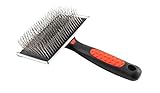
A slicker brush has a rectangular or oval pad filled with many fine, angled wire pins. The pins separate loose hair, lift debris, and work through minor knots. Unlike a bristle brush, which mostly smooths the outer coat, a slicker can reach farther into curly, wavy, medium, or long fur.
That design is useful, but it is also why a puppy needs a gentle approach. Fine wire pins can catch skin in thin-coated areas such as the belly, armpits, inside of the legs, ears, and around the tail. Puppies also have less patience than adult dogs, so a brush that feels comfortable to you may be too intense for a young or sensitive dog.
Product descriptions often use phrases such as “gentle touch,” “skin friendly,” or “self-cleaning.” Those features can improve convenience, but they do not make a brush automatically safe. A self-cleaning button usually retracts the pins so collected hair can be wiped away. It does not control brushing pressure. A puppy-focused model may have shorter pins, a smaller head, or a softer pad, but you still need to check the tool before every use.
Two examples in this category are the Warren London Gentle Touch Slicker Brush for Puppies & Small Dogs, listed at $15.99, and the Swihauk Self Cleaning Slicker Brush, listed at $16.99. Either price is reasonable for a basic grooming tool, but the better choice is the brush that fits your puppy’s size and coat and that you can use without pressing down.
Before brushing, run your fingers through the coat. If you find a tight mat, do not repeatedly attack it with the slicker. Mats pull the skin and make even gentle brushing uncomfortable. Separate a small section with your fingers, use a suitable detangling product if your veterinarian or groomer approves, or have a professional remove the mat.
Pros
- Removes loose hair: Regular brushing can reduce the amount of shed fur on bedding, clothing, and furniture.
- Helps prevent small tangles: Short, frequent sessions are useful for puppies with wavy, curly, or longer coats.
- Reaches beneath the surface: The fine pins can lift loose undercoat and debris more effectively than a basic soft-bristle brush.
- Supports coat inspection: Brushing gives you a chance to notice fleas, burrs, irritated skin, scabs, or unusual lumps.
- Usually affordable: Many everyday slicker brushes cost about $10 to $25, making them less expensive than repeated professional brushing.
- Can build grooming skills: When paired with treats, a short brushing routine teaches a puppy that handling can be calm and predictable.
- Easy to store: Most are compact hand tools rather than powered devices, so they do not need batteries, charging, or a specific wattage.
Cons
- Can irritate skin: Too much pressure or too many passes can cause redness, tenderness, or brush burn.
- Not ideal for every coat: Very short, smooth coats may need only a rubber curry brush or soft bristle brush.
- May snag sensitive areas: Ears, legs, armpits, groin, and tail require extra caution and often a smaller tool.
- Does not safely remove severe mats: Pulling through a dense mat can hurt your puppy and damage the skin beneath it.
- Some puppies dislike the sensation: A puppy that is fearful, overtired, or teething may resist even gentle grooming.
- Quality varies: Bent, sharp, uneven, or loose pins can scratch skin and should be treated as a reason to replace the brush.
- It is easy to overuse: Daily brushing is not automatically better. The right schedule depends on coat length, density, and how quickly tangles form.
Who Should Buy It
Buy a slicker brush if your puppy has a medium, long, curly, or wavy coat that develops small tangles. It can also be useful for breeds and mixes that shed a noticeable amount and need loose fur lifted from the coat. A smaller head is generally easier to control on a puppy than a large adult-dog brush.
Look for a brush with pins that are evenly spaced and not sharp at the tips, a handle that does not slip, and a head size that lets you work in sections of roughly 1 to 2 inches at a time. You should be able to move the brush with your fingertips rather than gripping it tightly and pushing through resistance.
Use the “line brushing” method for longer coats: part the fur with your free hand, expose a small strip near the skin, and brush outward toward the ends. Start at the tips of a tangle instead of pulling from the roots. Reward calm behavior every few strokes. For a puppy new to grooming, touching the brush to the coat for 10 to 20 seconds and then offering a treat may be enough for the first session.
Who Should Skip It
Skip a slicker brush—or ask a professional groomer for guidance—if your puppy has open sores, a rash, sunburn, healing stitches, painful joints, or a skin condition. Do not brush over suspected parasites, hot spots, or areas your puppy guards. A veterinarian should assess persistent itching, flaky skin, hair loss, or redness rather than having you brush more often.
You may also skip it if your puppy has a short, smooth coat with no tangles. A rubber grooming mitt or soft bristle brush is often more comfortable and sufficient. If the coat is severely matted, a groomer can determine whether clipping is safer than painful dematting.
Cheaper Alternatives
| Option | Cost | Trade-off |
|---|---|---|
| Soft-bristle puppy brush | $6–$15 | Gentler for short coats, but does little for mats or dense undercoats. |
| Rubber curry brush or grooming mitt | $5–$12 | Comfortable for smooth coats and bathing, but limited for long or curly fur. |
| Stainless-steel grooming comb | $8–$18 | Excellent for checking tangles and finishing a coat, but slower for removing loose fur. |
| Wide-tooth comb | $5–$14 | Useful for curls and light detangling, though it may not lift shedding undercoat as well. |
| Professional puppy grooming visit | $30–$75 | Costs more, but provides hands-on instruction and may be safer for a matted or nervous puppy. |
A slicker brush in the $15 to $20 range is not necessarily better than every cheaper tool. Spend more only when your puppy’s coat needs the extra reach, when the handle is easier to control, or when the pin quality appears more consistent. For many short-coated puppies, a $6 to $12 alternative is the more sensible purchase.
FAQ
At what age can a puppy use a slicker brush?
There is no single age that applies to every puppy. Puppies can usually begin gentle grooming acclimation soon after coming home, but early sessions should focus on handling rather than thorough brushing. Use a soft touch, keep the session to a few minutes, and avoid forcing the puppy to stay still. If the coat is long or prone to tangles, ask your breeder, veterinarian, or groomer to demonstrate the appropriate brush and technique.
How often should I slicker-brush my puppy?
For a short coat, once every week or two may be enough, and some puppies need only occasional brushing. A longer, curly, or easily tangled coat may need two to four brief sessions per week. Brush only as much as needed to keep the coat comfortable and free of small tangles. If you see redness or your puppy becomes increasingly resistant, reduce the frequency and reassess your technique.
How do I know if I am brushing too hard?
Hold the brush lightly and make short strokes. If the pins bend noticeably, the brush is catching, or you hear repeated scraping against skin, reduce pressure. Brush a small area on your own forearm first; it should feel like light contact, not scratching. After grooming, check the skin for redness, raised marks, or tenderness. Any reaction that does not quickly settle warrants a pause and, if needed, veterinary advice.
Can a slicker brush remove fleas?
No. A slicker brush may reveal debris or a flea, but it is not a flea-control tool. Fleas can remain close to the skin and may be missed by the pins. Use parasite prevention recommended for your puppy’s age, weight, and health status, and consult a veterinarian before applying a flea product. Never use a grooming brush as a substitute for treatment.




Write Your Review
No reviews yet. Be the first to share your experience!