
Key takeaways
- Only one impressive number: A high wattage or horsepower claim without airflow controls, hose details, or temperature information is not enough.
- No cool-air option: This limits comfort and makes the dryer less versatile.
- Unclear electrical information: Confirm the voltage and plug are appropriate for American household use.
- Loose accessories: Nozzles that pop off or a hose that slips during use are safety and convenience problems.
- No replacement parts: A missing filter or hose-support policy can turn a minor failure into a full replacement.
- Promised quiet operation without a rating: “Low noise” is vague unless the manufacturer provides test conditions and a decibel figure.
- Automatic high heat: Choose separate heat and speed controls so you can reduce warmth when needed.
What's inside
Buying a dog dryer is not as simple as choosing the model with the highest horsepower number. Shoppers often confuse motor wattage with usable airflow, assume “high velocity” means faster drying for every coat, or overlook noise, hose reach, and nozzle control. Others buy a warm-air dryer when their dog really needs a cool, powerful blast to separate a dense undercoat.
This dog dryer buying guide airflow speed comparison focuses on the specifications that affect real grooming: adjustable airflow, temperature control, handling, construction, safety, and total cost. Prices and features vary widely, from compact dryers around $60 to heavier professional-style units approaching $200. The right choice depends on your dog’s coat, your grooming routine, and where the dryer will live.
As an Amazon Associate we earn from qualifying purchases at no extra cost to you. Product prices and availability are accurate as of the date shown and are subject to change.
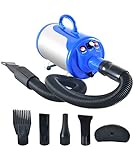


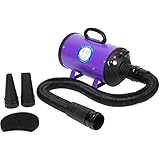
Decide These 3 Things First
- What coat are you drying? A short-coated dog may only need moderate airflow, while a double-coated or long-haired dog benefits from a force dryer with a flexible hose and narrow nozzle.
- Where will you use it? A tabletop or bathroom setup favors a compact unit. A garage, grooming room, or multi-dog household can justify a larger floor-standing dryer with a 6- to 8-foot hose.
- How much noise and heat can your dog tolerate? Powerful motors can be loud. Adjustable speed and temperature are more useful than maximum output if your dog is nervous or has sensitive skin.
Size and Storage
Measure the storage area before shopping. Portable force dryers commonly occupy roughly 12 to 18 inches in length, 8 to 12 inches in width, and 8 to 12 inches in height. Floor-standing or stand-mounted models may require a footprint of about 18 by 18 inches or more, plus clearance for the hose and dog.
Weight matters when you carry the dryer to a tub or grooming table. A budget handheld or compact blower may weigh about 3 to 7 pounds. Many canister-style units fall in the 8- to 15-pound range, while heavy professional models may exceed 15 pounds. A heavier body can be more stable, but it is less convenient to move.
For one small dog, look for a unit under 10 pounds with a hose of at least 5 feet. For large dogs or multiple pets, an 8-foot hose gives you more freedom to work around the body without repeatedly repositioning the motor. Confirm whether the advertised dimensions include the hose, stand, or nozzle storage; many listings do not.
Material and Heat Management
Look for a sturdy plastic or metal housing with smooth surfaces that are easy to wipe clean. Thick molded plastic can keep weight down, while metal housings may feel more substantial but can add bulk. Either material can work well if the seams, switches, and hose connection are secure.
Heat control is more important than a high temperature. A useful dryer should offer at least two speed settings and two temperature choices, including a cool or room-temperature setting. For most home grooming, air that feels warm rather than hot is the safer target. Keep the nozzle moving and hold it several inches from the skin, especially on thin-coated dogs.
Do not assume a “heater” makes a dryer better. Heat can shorten drying time in some conditions, but excessive warmth may irritate skin or make a nervous dog resist grooming. A separate heat switch is preferable to a dryer that automatically adds heat whenever the motor runs.
Construction and Nozzle Design
Inspect the hose connection, power cord, switches, and included nozzles. A flexible hose should attach firmly without twisting loose during use. A cord around 6 feet is workable, although 8 feet or more is easier around a grooming table. Avoid relying on an extension cord unless the manufacturer permits it and the cord is rated for the dryer’s wattage.
Two or three nozzles are more useful than a long list of interchangeable tips. A wide nozzle spreads air over the body. A narrow cone concentrates airflow on dense areas and helps push water from an undercoat. A flat or “air spreader” tip can be useful for longer coats, but it should not snag or pull hair.
Check the intake filter as well. A removable filter that can be cleaned without tools is a practical advantage in homes with shedding dogs. Hair and dander can restrict airflow, increase motor strain, and make a dryer seem weaker over time. The housing should also have stable feet or a handle that lets you set it down without blocking the intake.
Comfort and Performance
Airflow speed should be adjustable, not simply advertised as “high velocity.” Product listings may use horsepower, watts, miles per hour, or cubic feet per minute, and these figures are not directly interchangeable. A 3,800-watt listing, for example, describes electrical power consumption or a claimed rating; it does not by itself prove that the dryer moves more usable air than a lower-wattage model.
For home use, a practical target is a variable-speed motor with a low setting for the face, legs, and first-time users, plus a stronger setting for the torso and undercoat. Many force dryers fall somewhere around 1,000 to 3,800 watts, but actual electrical draw and performance depend on the motor and design. If a listing gives only horsepower and no speed control details, treat that as incomplete information.
Noise is another performance specification. Manufacturers do not always publish decibel ratings, and ratings can be measured differently. Instead, favor models with gradual speed adjustment, a long hose, and a low setting. Start several feet away from your dog and increase airflow slowly. Never direct a powerful stream into the ears, eyes, nose, or mouth.
Price Tiers
Budget dryers generally cost about $50 to $90. Products in this group, such as a basic high-velocity dog dryer listed around $59.99 or a SHELANDY unit around $75.99, may offer variable speed, a heater, and multiple nozzles. They can be suitable for occasional bathing, but verify replacement hose and filter availability.
Midrange models usually cost $90 to $150. An example is an EGFKI dryer listed around $119.99 with a claimed 5.2-horsepower/3,800-watt rating, adjustable speed and temperature, and four nozzles. Treat those figures as listing specifications rather than standardized performance measurements. At this price, look for better switches, stronger hose fittings, and clearer support information.
Premium home or light-professional models generally cost $150 to $250. A Flying Pig Flying One model, for example, is listed around $187. The extra cost may buy a sturdier shell, better balance, longer service life, or more refined controls—not necessarily dramatically faster drying. Pay for construction and usability when you groom frequently, not for a large horsepower number alone.
Warranty and Service
A warranty of at least 12 months is a sensible minimum for a powered grooming appliance. A two-year warranty is preferable if the dryer costs more than $150 or will be used several times a week. Read whether the coverage includes the motor, switches, hose, and heating element, since accessories may be excluded.
Also check the return window, typically 30 to 90 days, and find out who handles support. Replacement filters, hoses, brushes, and nozzles can determine whether the dryer remains useful after a small part fails. Keep the receipt and photograph the model and serial label when it arrives.
Delivery and Assembly
Most canister dryers require little assembly: attaching the hose, inserting a nozzle, and possibly securing a handle or stand. Allow about 5 to 15 minutes for setup. A floor or cage dryer may take 20 to 45 minutes if it includes a stand, wheels, or an adjustable arm.
Before accepting delivery, check the box for crushed corners and inspect the housing, hose, cord, and nozzle tips. Test the lowest speed first. Make sure the motor does not rock, the hose does not collapse when bent, and the heater can be switched off independently. Save the packaging until you know the dryer works correctly.
Spec Checklist
| Spec | Budget | Mid | Premium |
|---|---|---|---|
| Typical price | $50–$90 | $90–$150 | $150–$250+ |
| Motor rating listed | About 1,000–2,000 watts | About 1,800–3,000 watts | About 2,000–3,800 watts |
| Speed control | At least 2 settings | Variable or dial control | Wide variable range with a gentle start |
| Temperature | Cool and warm | Independent heat control | Cool, warm, and precise adjustable heat |
| Hose length | 5–6 feet | 6–8 feet | 6–10 feet |
| Weight | 3–10 pounds | 8–15 pounds | 12–25 pounds |
| Nozzles | 2–3 | 3–4 | 3–5, with secure storage |
| Warranty target | 12 months | 12–24 months | 24 months or more |
Red Flags
- Only one impressive number: A high wattage or horsepower claim without airflow controls, hose details, or temperature information is not enough.
- No cool-air option: This limits comfort and makes the dryer less versatile.
- Unclear electrical information: Confirm the voltage and plug are appropriate for American household use.
- Loose accessories: Nozzles that pop off or a hose that slips during use are safety and convenience problems.
- No replacement parts: A missing filter or hose-support policy can turn a minor failure into a full replacement.
- Promised quiet operation without a rating: “Low noise” is vague unless the manufacturer provides test conditions and a decibel figure.
- Automatic high heat: Choose separate heat and speed controls so you can reduce warmth when needed.
FAQ
What airflow speed is best for a dog dryer?
Choose adjustable airflow rather than a single maximum speed. Start low for the face, ears, legs, and anxious dogs, then increase power on the torso and dense coat. The best setting is the strongest comfortable airflow that does not make your dog panic or heat the skin.
Is higher wattage better for drying a dog?
Not necessarily. Wattage indicates electrical demand, not a standardized airflow result. Motor design, hose diameter, nozzle shape, and speed control all affect drying. Compare the complete specification, and favor a variable-speed model with a cool setting.
Can I use a dog dryer on the face?
Use caution. Select the lowest speed, use a wide nozzle or indirect airflow, and keep the stream away from the eyes, nose, ear canals, and mouth. For sensitive dogs, towel-dry the face and use the dryer only around the neck and body.
How long should a dog dryer last?
A home dryer should provide several years of service when the filter is cleaned, the hose is not kinked, and the motor is kept away from loose hair and water. Frequent users should prioritize a longer warranty, available replacement parts, and a sturdy hose connection over extra nozzles.




Write Your Review
No reviews yet. Be the first to share your experience!