
Key takeaways
- Better positioning. A grooming arm can keep a dog near the working area, which is especially helpful when brushing dense coats, trimming paw hair, or using clippers.
- More control during routine tasks. It can reduce backing away, turning in circles, or stepping toward the table’s edge. That may make short grooming sessions more orderly.
- Useful for two-handed work. When a dog is calm, the arm can provide light support while you use a brush, comb, dryer, or nail grinder with both hands.
- Adjustable height. Models with roughly 35 inches of height adjustment can accommodate different table heights and dog sizes better than a fixed support.
- Helpful features at modest prices. Around $30, a basic clamp arm can cost less than a single professional grooming appointment. Higher-priced kits around $47 may add multiple nooses, width adjustment, or a more substantial frame.
- Potentially less strain on the owner. Keeping a dog in a consistent position may reduce repeated bending, reaching, and lifting during brushing.
- Works well for regular maintenance. Dogs that already accept grooming may benefit from a predictable setup for weekly brushing, sanitary trims, or paw care.
- Can grow with your setup. If you change tables later, an adjustable arm may remain useful as long as the clamp and dimensions are compatible.
What's inside
The Short Answer
Yes—if you already have a stable grooming table and your dog can tolerate gentle restraint, a grooming arm can make brushing, drying, nail trimming, and clipping easier and safer. The one condition is that you use it as a positioning aid, never as a way to force a fearful, struggling, or unattended dog to stay in place.
That is the honest answer to the dog grooming arm pros and cons question. A grooming arm is useful equipment, but it is not a substitute for training, supervision, or professional handling. For many owners, a $30-to-$50 arm is a practical upgrade. For others, it adds another piece of equipment without solving the real problem: a dog that panics during grooming.
As an Amazon Associate we earn from qualifying purchases at no extra cost to you. Product prices and availability are accurate as of the date shown and are subject to change.

What You Actually Get
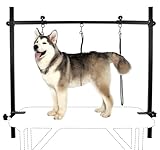
A grooming arm is an upright support that attaches to the edge of a grooming table, usually with a clamp. A loop, noose, or second restraint connects from the arm to the dog’s collar or harness area. The arm helps keep the dog positioned near the center of the table while you work.
The two related models illustrate the typical price and feature range. The SHELANDY arm costs about $29.99 and has a height-adjustable 35-inch arm, a clamp, and a separate no-sit haunch holder. The LEIBOU H-Shape model costs about $46.99 and includes a 35.4-inch adjustable height, an adjustable width from 36.2 to 50 inches, an aluminum-alloy frame, a clamp, and three nooses. These measurements describe the equipment—not a guarantee that every dog will fit comfortably or safely.
Most arms are intended for a table rather than the floor. Before buying, check your table’s edge thickness, available clamp clearance, and maximum recommended dog size. The clamp must sit fully and securely on the table. A lightweight folding table may flex or tip even when the arm itself is properly attached.
The restraint should be adjusted so your dog can stand, sit, and turn its head naturally while remaining on the table. It should not tighten around the neck or allow the dog to step off the edge. A well-positioned arm reduces wandering; it does not eliminate the need to keep one hand on the dog when necessary.
Pros
- Better positioning. A grooming arm can keep a dog near the working area, which is especially helpful when brushing dense coats, trimming paw hair, or using clippers.
- More control during routine tasks. It can reduce backing away, turning in circles, or stepping toward the table’s edge. That may make short grooming sessions more orderly.
- Useful for two-handed work. When a dog is calm, the arm can provide light support while you use a brush, comb, dryer, or nail grinder with both hands.
- Adjustable height. Models with roughly 35 inches of height adjustment can accommodate different table heights and dog sizes better than a fixed support.
- Helpful features at modest prices. Around $30, a basic clamp arm can cost less than a single professional grooming appointment. Higher-priced kits around $47 may add multiple nooses, width adjustment, or a more substantial frame.
- Potentially less strain on the owner. Keeping a dog in a consistent position may reduce repeated bending, reaching, and lifting during brushing.
- Works well for regular maintenance. Dogs that already accept grooming may benefit from a predictable setup for weekly brushing, sanitary trims, or paw care.
- Can grow with your setup. If you change tables later, an adjustable arm may remain useful as long as the clamp and dimensions are compatible.
Cons
- It is not a safety system by itself. A dog can pull against a restraint, damage a clamp, tip a table, or become tangled. Never leave a restrained dog unattended, even for a brief interruption.
- It can increase panic. A dog that already fears grooming may feel trapped when attached to an arm. Struggling can create more risk than simply taking a break and using gradual desensitization.
- Clamp compatibility matters. The arm may not fit every tabletop. An edge that is too thick, rounded, narrow, or flexible can prevent the clamp from seating securely.
- The table is part of the safety equation. A strong arm attached to an unstable table is still an unstable grooming station. Check the table legs, nonslip surface, and overall weight capacity.
- Restraints can be misused. A noose that is too loose may allow an escape attempt; one that is too tight can restrict breathing or cause injury. A restraint should never be used as a substitute for a properly fitted harness or careful handling.
- Some dogs are simply too strong or reactive. A large, athletic, or aggressive dog can place considerable force on a small tabletop clamp. Professional equipment and a second handler may be more appropriate.
- Extra setup and storage. You must attach the arm, adjust its height, connect the restraint, and remove it afterward. That may be inconvenient if you only groom occasionally.
- Marketing features do not guarantee comfort. Multiple nooses, an H-shaped frame, or a height range can improve versatility, but they do not guarantee a good fit for your dog or a calm grooming experience.
Who Should Buy It
Buy a grooming arm if your dog is reasonably calm, your grooming table is stable, and you perform maintenance often enough to benefit from a repeatable setup. It is particularly useful for owners of small and medium dogs who brush regularly, maintain long or curly coats, or need help keeping the dog centered while working around the feet and face.
It can also make sense for owners who are building a home grooming station on a budget. A basic arm around $30 is a relatively inexpensive way to add positioning support. Choose an adjustable model if more than one dog will use the table or if you are unsure which height will be comfortable. A kit with multiple nooses may be worthwhile when you need different attachment points, but use only the restraint that fits the dog and task.
Who Should Skip It
Skip it, at least for now, if your dog bites, thrashes intensely, collapses in fear, or has a history of escaping restraints. Start with cooperative-care training: reward the dog for approaching the table, touching grooming tools, standing briefly, and accepting handling in small increments. A professional groomer or veterinary behavior professional can help if fear or aggression is significant.
You should also skip a clamp-on arm if you do not have a stable grooming table or a safe place to use one. Do not attach it to a kitchen chair, flimsy desk, countertop, or any surface that could tip. If your dog is very large or powerful, professional-grade equipment may be a better choice than a compact home kit.
Cheaper Alternatives
| Option | Cost | Trade-off |
|---|---|---|
| Second person as a handler | $0 if available | More responsive and often safer, but requires another person every time. |
| Nonslip grooming mat on the floor | About $10–$25 | Reduces slipping for brushing, but does not keep a dog positioned or prevent walking away. |
| Handheld grooming loop used with proper supervision | About $8–$20 | Lower cost and portable, but offers less height adjustment and less control than a table arm. |
| Basic grooming arm such as the SHELANDY model | About $29.99 | Affordable table support, but limited to compatible tables and still requires constant supervision. |
| Professional grooming appointment | About $40–$150+ per visit | Higher ongoing cost, but provides experienced handling and specialized equipment. |
FAQ
Are dog grooming arms safe?
They can be safe when attached to a stable table, adjusted correctly, and used with continuous supervision. Keep the restraint loose enough for comfortable breathing and normal head movement, and never leave the dog alone on the table. Stop immediately if the dog coughs, gags, shows distress, or struggles intensely.
Can I use a grooming arm without a grooming table?
Usually, no. Clamp-on arms are designed for compatible tabletops. A sturdy grooming table with a nonslip surface and secure legs is the appropriate foundation. Do not improvise by clamping an arm to furniture that was not designed to support a moving dog.
What size dog can use a grooming arm?
That depends on the arm, clamp, table, and dog’s behavior—not just the listed height. A 35-inch adjustable arm may work for many small and medium dogs, while a width-adjustable H-frame may suit a broader range of table setups. Check the manufacturer’s weight and size guidance, and choose equipment with a margin of safety for your dog’s strength.
Is a grooming arm worth buying in 2026?
For a calm dog that receives regular home grooming, yes. Spending roughly $30 to $50 can improve positioning and reduce hassle. For a fearful, powerful, or unpredictable dog, training and professional handling are usually a better investment than adding a restraint device.




Write Your Review
No reviews yet. Be the first to share your experience!