
Key takeaways
- More gradual than clipping. A grinder removes tiny amounts of nail at a time, which can make it easier to avoid a dramatic cut into the quick.
- Useful for thick or dark nails. Dark nails can make the quick difficult to see. Grinding lets you inspect the center as you work instead of making one decisive cut.
- Smoother finish. Clippers can leave sharp corners that catch on rugs, upholstery, or skin. A grinder can round those edges.
- Good for dogs that dislike clipper pressure. Some dogs tolerate a steady buzzing tool better than the sudden squeezing sensation of guillotine or scissor-style clippers.
- Works across several sizes. With the right speed and patience, one grinder can serve a 10-pound dog and a large dog with heavier nails.
- Helpful for maintenance. Short, frequent sessions can keep nails from becoming dramatically overgrown. Removing a small amount every week or two is often easier than tackling very long nails all at once.
- Can be economical. A $15 to $30 grinder may pay for itself after one or two avoided professional nail appointments, depending on local grooming prices.
The Short Answer
Yes, a dog nail grinder is worth buying if your dog tolerates gradual handling and you want more control than traditional clippers provide. The one condition is that you must introduce it slowly—usually over several short sessions—because the vibration and buzzing can frighten dogs that are sensitive to sound or paw handling.
That is the practical answer to the dog nail grinder pros and cons question. A grinder can smooth sharp edges, reduce the chance of cutting into the quick, and work well on thick nails. It is not automatically safer, faster, or calmer for every dog. Your dog’s temperament matters as much as the tool itself.
Our top picks
 Whisper Quiet Dog Nail Grinder Safe &
- Product Group: Pet Products
- Binding: Misc.
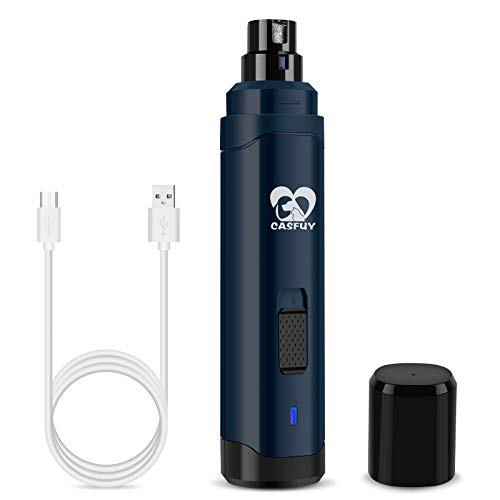 Casfuy Dog Nail Grinder Upgraded
- Product Group: Pet Products
- Binding: Health and Beauty
As an Amazon Associate we earn from qualifying purchases at no extra cost to you. Ratings are shown as listed on Amazon.
What You Actually Get
A dog nail grinder is a small, battery-powered rotary tool with a sanding drum or abrasive wheel. Instead of cutting through the nail in one squeeze, it gradually removes material. Most models are cordless, weigh roughly 5 to 10 ounces, and measure about 6 to 8 inches long. They typically include a grinding head, a protective guard or opening, a USB charging cable, and sometimes multiple sanding bands or ports for different nail sizes.
Many consumer grinders offer two or three speed settings. Lower speeds are useful for puppies, small dogs, and nervous pets; higher speeds can make quicker progress on large, thick nails. Battery life varies considerably, but a typical unit may run for about 2 to 4 hours between charges. Charging commonly takes 2 to 3 hours. Treat those figures as shopping ranges rather than guarantees, since motor strength, battery size, and use pattern differ.
For comparison, a basic electric pet grinder may cost about $15 to $30. The Casfuy upgraded grinder referenced here is listed for under $20, while the Whisper Quiet Dog Nail Grinder is listed for under $30. Neither price alone proves that one will be quieter, stronger, or more durable for your dog. Fit, handling, and your pet’s response are more important than a small price difference.
The tool removes nail material by friction, so it creates a small amount of dust and heat. You should use brief contact—often 1 to 2 seconds at a time—rather than holding the grinder against one spot continuously. Stop if the nail becomes warm, your dog pulls away repeatedly, or you see the quick approaching.
Pros
- More gradual than clipping. A grinder removes tiny amounts of nail at a time, which can make it easier to avoid a dramatic cut into the quick.
- Useful for thick or dark nails. Dark nails can make the quick difficult to see. Grinding lets you inspect the center as you work instead of making one decisive cut.
- Smoother finish. Clippers can leave sharp corners that catch on rugs, upholstery, or skin. A grinder can round those edges.
- Good for dogs that dislike clipper pressure. Some dogs tolerate a steady buzzing tool better than the sudden squeezing sensation of guillotine or scissor-style clippers.
- Works across several sizes. With the right speed and patience, one grinder can serve a 10-pound dog and a large dog with heavier nails.
- Helpful for maintenance. Short, frequent sessions can keep nails from becoming dramatically overgrown. Removing a small amount every week or two is often easier than tackling very long nails all at once.
- Can be economical. A $15 to $30 grinder may pay for itself after one or two avoided professional nail appointments, depending on local grooming prices.
Cons
- Noise and vibration can cause fear. “Whisper quiet” is a marketing description, not a guarantee that your dog will find the tool silent. A dog can react to the vibration through the nail even when the motor sounds relatively soft.
- It is slower than clipping once you are practiced. Grinding every nail may take 10 to 20 minutes, particularly with a large dog, while an experienced owner may clip in a few minutes.
- It can generate heat. Holding the abrasive surface in place too long can make the nail uncomfortable. Short passes and frequent breaks are essential.
- Dust can be messy. Nail dust may land on your floor, clothing, or the dog’s paws. Grinding outdoors or over an easy-to-clean surface helps.
- Training is required. You may need several days or weeks to teach a sensitive dog that the grinder is not a threat.
- Consumable parts wear out. Sanding bands and grinding heads eventually become less effective. Replacements add a small ongoing cost, often around $5 to $15 depending on the model and pack size.
- A grinder does not eliminate injury risk. Poor positioning, excessive pressure, or rushing can still expose the quick or irritate the surrounding skin.
- Cheap models can be frustrating. Weak motors may stall on thick nails, while poorly balanced units can vibrate more than expected. A low price is attractive, but reliability is difficult to judge from a product listing alone.
Who Should Buy It
Buy a grinder if your dog has thick, dark, unusually curved, or brittle nails, or if you want to round the edges after clipping. It is also a sensible choice for owners who are nervous about taking a large cut. Dogs that already tolerate paw touching, brushing, or an electric toothbrush are often easier candidates.
Look for a model with at least two speeds, a comfortable grip, a visible grinding area, and a guard that does not block your view. A rechargeable unit is generally easier to use than one that requires disposable batteries. A 6- to 8-inch tool weighing under about 10 ounces is usually manageable for most owners, especially during a session involving multiple paws.
Introduce it in stages: show the grinder while it is switched off, reward calm behavior, turn it on several feet away, then bring it closer over multiple sessions. Touch the tool briefly to a nail only after your dog remains relaxed around the sound.
Who Should Skip It
Skip a grinder, at least for now, if your dog panics around buzzing appliances, cannot remain still, or guards its paws. Forcing the process can create a stronger fear response and make future grooming harder. A professional groomer or veterinary team may be safer for a dog that snaps, thrashes, or has a history of painful nail problems.
You should also reconsider it if you need a very fast solution. A grinder is not ideal for an emergency trim, a dog with severely overgrown nails, or an owner who cannot commit to short practice sessions. If your dog’s nails are cracked, bleeding, infected, or painful, ask a veterinarian for advice before using any home tool.
Cheaper Alternatives
| Option | Cost | Trade-off |
|---|---|---|
| Basic nail clippers | $8–$15 | Fast and quiet, but easier to remove too much nail and leave sharp edges. |
| Manual nail file | $3–$8 | Very quiet and inexpensive, but slow and tiring on thick nails. |
| Scratch board | $20–$40 | Can teach a dog to file front nails independently, but does not reliably shorten every nail or the rear paws. |
| Professional nail trim | $15–$35 per visit | Requires appointments and repeat spending, but is useful for fearful or difficult dogs. |
Clippers are the best budget choice for a calm dog with light-colored nails and an owner who knows where the quick is. A manual file is the least intimidating option for a puppy or noise-sensitive dog, although patience is required. A scratch board can supplement—not replace—regular nail care.
FAQ
Is a dog nail grinder safer than clippers?
It can be easier to control because it removes nail gradually, but it is not automatically safer. Use light pressure, work for 1 to 2 seconds at a time, and stop before the nail becomes warm or the quick looks close. Proper handling matters more than the tool category.
How often should I grind my dog’s nails?
Many dogs need maintenance every 1 to 3 weeks, though growth rates and activity levels vary. Check the nails weekly. If they click loudly on hard floors, catch on fabric, or touch the ground while your dog is standing, they may be overdue.
How do I make my dog accept a grinder?
Use rewards and progress slowly. Let your dog investigate the switched-off tool, then reward calm behavior when it is running at a distance. Practice touching the paw without grinding, followed by one brief contact on a single nail. End before your dog becomes upset, and repeat over several days.
What should I look for when buying one in 2026?
Prioritize a comfortable grip, two or more speeds, a rechargeable battery, replaceable abrasive parts, and a grinding opening that lets you see the nail. “Quiet” can be helpful, but it should not outweigh controllability and your dog’s comfort. A $18 to $25 model may be adequate for occasional use; owners of large dogs or multiple pets may prefer a sturdier unit with a stronger motor.






Write Your Review
No reviews yet. Be the first to share your experience!