
Best stair vacuum pet hair shopping usually starts with the wrong question. Suction figures matter far less than whether the machine reaches the top tread from where you are standing, and whether your stairs are carpeted or bare wood. These six are picked around reach, weight, and filtration rather than headline power figures.
Our top picks





As an Amazon Associate we earn from qualifying purchases at no extra cost to you.
As an Amazon Associate we earn from qualifying purchases.
By Laura Simmons
🛒 Best Price Today on Amazon
Prime members get fast, free shipping on everything above, plus member-only deals. New members get a 30-day free trial — cancel anytime.
Start 30-Day Prime Free Trial →See Today’s Amazon DealsHow to Choose the Best Stair Vacuum Pet Hair Setup
Stairs are the most awkward surface in the house to clean and the one that collects the most hair per square foot. The best stair vacuum pet hair solution depends less on the motor than on how the machine is carried, where the hose reaches, and what your treads are actually made of.
Carpeted Treads Need Agitation, Bare Wood Does Not
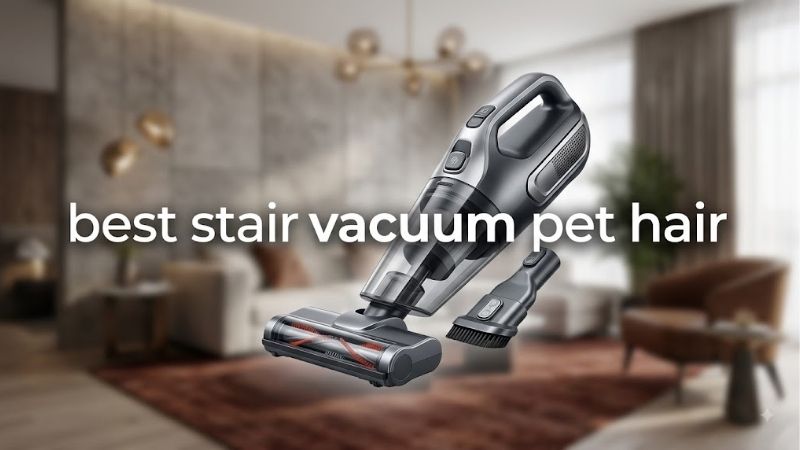
On carpeted stairs, hair works down into the pile and locks around the fibres. Only a motorised mini turbo head with a spinning brush will lift it, so the best stair vacuum pet hair option for a carpeted flight always has one; plain suction nozzles glide over the top and leave most of it behind. This is the single biggest reason people think their vacuum has lost power.
Bare wooden or laminate stairs are the opposite case. A stiff brush scatters hair off the edge of the tread and onto the flight below, so a soft dusting brush or plain nozzle actually collects more. Homes with a wooden staircase and a carpeted runner need both heads, which rules out several single-tool machines.
Measure Reach Before You Buy
A canister or lift-away machine with a long hose can sit at the bottom of a flight while you work upward, which removes the weight problem entirely. The number to check is hose plus wand length, since anything under about eight feet means moving the body of the vacuum every three or four steps.
Cordless handhelds solve reach differently by having nothing to trail. You carry three pounds and nothing else, which suits narrow or turning staircases where a canister keeps catching on the newel post. The trade is a small bin and a short run time on the boost setting.
Take Filtration Seriously in Pet Homes
Stairs sit in the middle of the house and stir air with every step, so dander disturbed there travels everywhere. A sealed system with a HEPA-grade filter keeps fine particles inside the machine, which matters much more here than on a kitchen floor and is worth paying for in allergy households.
Check the running cost as well as the specification. Washable filters need drying fully before reuse or airflow drops noticeably, and disposable bags in canister machines add a small recurring expense. Neither is a dealbreaker, but both surprise people who bought on suction figures alone.
Storage Decides How Often It Gets Used
A stair vacuum that lives in a cupboard on another floor gets used monthly at best. Something wall-docked or small enough to sit in a hall closet gets picked up two or three times a week, and that frequency does more for a hairy staircase than any specification on the box.
Autumn is when this shows up. The seasonal coat turnover from September onward puts noticeably more hair on carpeted treads just as the house is being shut up against colder weather, and vacuum discounting is heaviest around the early-October sale window, so a replacement bought then costs less and arrives when it is needed.
Top Picks: Best Stair Vacuum Pet Hair Options
These six cover three different answers to the stair problem: a light cordless you carry, a lift-away or canister that stays put while the hose does the work, and a cheap handheld kept nearby. The best stair vacuum pet hair choice depends on which of those suits your staircase.
| Vacuum | Best For | Type | Key Feature |
|---|---|---|---|
| Dyson V12 Detect Slim | Light cordless carrying | Cordless stick | Low weight, strong mini head |
| Shark Vertex Cordless | Carpeted treads | Cordless stick | Anti-hair-wrap brush roll |
| Bissell Pet Hair Eraser Lift-Off | Whole house plus stairs | Upright with pod | Detachable canister |
| Miele Classic C1 | Long reach, allergies | Canister | Sealed filtration, long hose |
| Black+Decker Dustbuster | Quick daily pickups | Handheld | Cheap, always to hand |
| Hoover ONEPWR Evolve Pet | Mixed stairs and floors | Cordless upright | Removable battery system |
Dyson V12 Detect Slim
Lighter than the flagship V15 while keeping most of the cleaning ability, which is exactly the trade-off stairs reward. In handheld mode with the mini motorised head it clears hair from carpeted treads quickly, and the reduced weight is obvious by the time you reach a second flight.
It is still expensive for a machine you may only use on stairs and upholstery, and the bin is small enough that a heavy shedding session means emptying partway through. Run time on the high setting is short, so a full staircase plus landings needs a moderate power mode.
Shark Vertex Cordless
The anti-hair-wrap brush roll is the reason to look here. Long dog and cat hair that would rope around a conventional roller gets guided off instead, which removes the recurring job of cutting hair free with scissors every few sessions on a carpeted staircase.
In hand it is heavier than the lighter cordless options, and the balance is slightly nose-heavy during extended upholstery work. Battery life on the motorised head is adequate rather than generous, so households with three flights should expect to plan around the charge.
Bissell Pet Hair Eraser Lift-Off
An upright that detaches into a portable pod, so one machine covers the floors and then goes up the stairs without dragging the full body behind it. For households that want a single vacuum rather than a main machine plus a stair tool, this is the practical answer.
The pod is heavier in hand than a dedicated cordless handheld, and the corded design means finding a socket for each flight. Filtration is decent rather than sealed to HEPA standard, which matters a great deal if anyone in the house reacts to dander during shedding season.
Miele Classic C1
A canister that sits on the landing while the hose and wand do the climbing, which sidesteps the weight problem completely. Miele’s sealed filtration and bagged system are the strongest option here for allergy households, and the build quality is a genuine step above the plastic competition.
Bags are a recurring cost and the canister needs somewhere to sit safely on a staircase, which is not always easy on a narrow flight. It is also a poor choice for quick pickups, since dragging out a full canister for one dusty tread rarely happens in practice.
Black+Decker Dustbuster
The cheapest way to make sure the stairs actually get done. A small cordless handheld kept on the landing gets used for two-minute pickups several times a week, and on bare wooden treads that frequency comfortably beats a far better machine that only comes out of the cupboard once a month.
It has real limits. The bin is tiny, the run time is short, and without a motorised head it will not lift hair embedded in carpet pile. Treat it as a maintenance tool that lives alongside something stronger, rather than as the only vacuum in a household with a heavy shedder.
Hoover ONEPWR Evolve Pet
A cordless upright with a removable battery that fits other tools in the same range, which suits households already invested in the system. It handles both carpeted and bare treads reasonably well, and it converts for above-floor work without much fuss or extra attachments to hunt for.
It is bulkier than a slim cordless stick, and manoeuvring an upright body on a narrow staircase is awkward regardless of weight. Suction is mid-range rather than class-leading, so hair driven deep into thick stair carpet may well need a second slower pass to come up properly.
Frequently Asked Questions
These are the questions that come up most often once owners start comparing the best stair vacuum pet hair options rather than trying to make their main machine work. The four answers below cover handhelds, hardwood treads, filter maintenance, and how often a staircase really needs doing in a shedding home.
Is a handheld enough for a whole staircase?
On bare wood, usually yes. On carpeted treads a handheld without a motorised brush leaves embedded hair behind, however good the suction sounds. If your stairs are carpeted, the motorised mini head is the feature to insist on rather than a higher power rating.
What works best on hardwood stairs?
A soft brush or plain nozzle with moderate suction. Stiff bristles flick hair off the front edge of each tread onto the flight below, which is why hardwood stairs often look worse after vacuuming. Lower power and a gentler head collect far more than maximum settings do.
How often should filters be cleaned?
Check monthly in a pet home and follow the manufacturer’s washing interval, usually every one to three months. Dander clogs filters faster than household dust, and a blocked filter is the most common reason a vacuum seems to lose suction long before anything has actually failed.
How often do stairs need vacuuming with pets?
Weekly as a baseline, twice weekly during a seasonal shed. Stairs concentrate traffic into a small area, so hair builds up faster there than on open floor. Brushing the pet more often through the shedding months reduces the load more effectively than upgrading the vacuum.
See More:
- Best dog shampoo for Australian Shepherds
- Best natural dog shampoo
- Best slicker brush for dogs
- Best toothbrush for small dog
- Best cat brush for ragdolls
Final Thoughts
The best stair vacuum pet hair setup is whichever one you will pick up without thinking about it. Match the head to your treads, check the hose reach before buying, and give filtration real weight if anyone in the house has allergies. Keeping it within arm’s reach of the staircase matters more than any figure on the specification sheet.

Write Your Review
No reviews yet. Be the first to share your experience!