
Best roborock vacuum for pet hair is a harder question than it should be, because the naming runs across the Saros, Qrevo, Q and S ranges with overlapping numbers. What actually matters in a shedding household is the brush design, the dock, and obstacle avoidance rather than the model number. These six sort the range out.
Our top picks




As an Amazon Associate we earn from qualifying purchases at no extra cost to you.
As an Amazon Associate we earn from qualifying purchases.
By Laura Simmons
🛒 Best Price Today on Amazon
Prime members get fast, free shipping on everything above, plus member-only deals. New members get a 30-day free trial — cancel anytime.
Start 30-Day Prime Free Trial →See Today’s Amazon DealsHow to Choose the Best Roborock Vacuum for Pet Hair
Roborock’s line-up splits into the premium Saros series, the mid-range Qrevo series, and the older Q and S models that remain on sale at lower prices. The best roborock vacuum for pet hair in your home depends on four things: brush type, dock, navigation, and how much mopping you actually want.
Anti-Tangle Brush Design Comes First
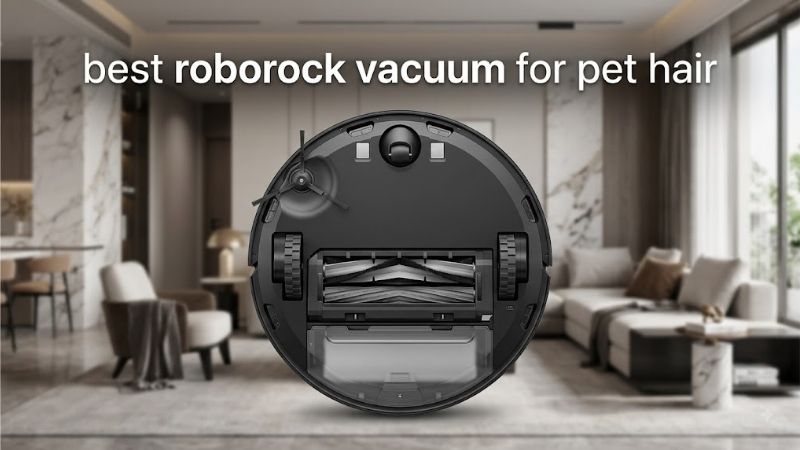
Long hair wrapping the brush roll is the failure mode that kills robot vacuums in pet homes. The best roborock vacuum for pet hair therefore starts with the brush: the rubber DuoRoller and the newer dual-roller systems are built to guide hair off the roller instead of letting it wind into a rope around the bearings.
No design is completely immune. Even the best anti-tangle systems collect some hair around the side bearings and in the brush housing, so plan on a check every few weeks. What the good designs buy you is minutes of maintenance a month instead of scissors every second run.
A Self-Emptying Dock Is Close to Essential
Onboard bins on robot vacuums are small, and in a shedding household they fill within a run or two. Once a bin is full the robot keeps driving but stops collecting, which is why a self-emptying dock changes the experience more than any suction figure for owners of heavy shedders.
Docks vary in what else they do. Basic versions empty the bin into a bag; the fuller docks also wash and dry the mop pads with hot water, which matters if a dog brings damp paws indoors. Every extra function adds price, size, and something else that needs cleaning.
Weigh Suction Figures Against Real Conditions
Roborock’s headline suction numbers have climbed steeply, from around 5,500 Pa on the older Q8 Max to figures in the tens of thousands on the current Saros models. Those ratings are measured under lab conditions, so treat them as a rough ranking rather than a promise about deep carpet.
What matters more in practice is airflow at the brush and how the machine handles thick pile. Hard-floor homes see very little benefit from the highest numbers, while households with deep carpet and a heavy shedder are the ones who genuinely notice the difference.
Obstacle Avoidance Matters More With Pets
Cameras and structured light let the newer models identify and drive around dog toys, charging cables, and the occasional accident. In a home with pets that is not a luxury feature, since a robot that spreads a mess across a floor turns a five-minute clean into an afternoon.
Robot vacuum pricing drops sharply around the early-October and late-November sale events, which is also the point in the year when seasonal shedding starts filling floors again. For anyone already considering one, buying into last season’s model at that point usually gets the useful features without the launch price.
Top Picks: Best Roborock Vacuum for Pet Hair
The list runs from the current flagship down to genuinely affordable models that still carry the features that count. Choosing the best roborock vacuum for pet hair mostly comes down to whether you need mopping and how much dock automation you are willing to pay for.
| Model | Best For | Brush | Key Feature |
|---|---|---|---|
| Roborock Saros 20 | Maximum performance | Dual anti-tangle | Highest rated suction |
| Roborock Saros 10R | Premium all-rounder | DuoDivide zero-tangle | Hot water mop washing |
| Roborock Qrevo S5V | Mid-range value | Zero-tangle system | Strong suction, full dock |
| Roborock Q7 M5+ | Budget with a dock | Anti-tangle brush | Self-emptying under $500 |
| Roborock Q8 Max | Vacuum-only homes | DuoRoller rubber | Pet-focused brush design |
| Roborock S8 MaxV Ultra | Hard floors and mopping | Dual rubber rollers | Self-washing mop pads |
Roborock Saros 20
The current performance benchmark, launched in early 2026 with the highest suction rating in the consumer robot market and a chassis that lifts itself over thresholds it has learned. For deep carpet and a heavy-shedding dog, nothing else in the range picks up more per pass.
It is also the most expensive option by a wide margin, and much of what you are paying for is dock automation rather than pickup. The dock’s auto-empty cycle is loud enough to unsettle a noise-sensitive pet, so it is worth scheduling it for a time when nobody is home.
Roborock Saros 10R
A premium model with a zero-tangle dual brush, very high rated suction, and a dock that washes the mop with hot water, which is the feature that stops mop pads smelling in a home with dogs. The built-in camera also doubles as a way to check on pets remotely.
It sits close enough to the flagship in price that the decision usually comes down to whether the extra suction is worth it. As with all camera-equipped robots, the pet-monitoring function means a camera driving around your house, which not everyone is comfortable with.
Roborock Qrevo S5V
The sensible mid-range choice. It carries a certified zero-tangle brush system and suction in the five figures, along with a full self-maintaining dock, at a price well below the Saros models. For most pet households this is the point where the value curve flattens out.
The dock is large and needs a permanent spot with clearance, which is a real constraint in small flats. Mopping performance is good rather than exceptional, and like every robot it still needs the brush housing checking every few weeks in a long-haired household.
Roborock Q7 M5+
The value pick, and the model that shows how far the budget end has come. A self-emptying dock, lidar navigation, high rated suction, and an anti-tangle brush at a price most households can justify covers the essentials for a shedding home without the dock theatrics.
There is no mopping automation worth relying on, obstacle avoidance is basic compared with the camera-equipped models, and the dock bag is smaller than the premium docks. In a home with a dog prone to accidents, that lack of avoidance is the compromise to think hardest about.
Roborock Q8 Max
Built around the DuoRoller rubber brush that was specifically engineered for pet hair, this is the choice for households that want vacuuming and nothing else. It maps well, handles rugs and hard floors competently, and costs considerably less than anything with a full dock.
Suction is modest by current standards and there is no self-emptying base in the basic configuration, so the small onboard bin needs emptying often in a shedding home. It is best understood as a daily maintenance robot rather than a machine that replaces a proper vacuum.
Roborock S8 MaxV Ultra
An older flagship that remains strong on hard floors, pairing dual rubber rollers with self-washing mop pads. In tiled and wooden homes with a dog that tracks in dirt, the combination of daily vacuuming and genuine mopping is more useful than raw carpet suction.
It has been overtaken on paper by the Saros line, so it only makes sense at a discount. The dock is bulky and needs a permanent spot, mop pads still need periodic replacement, and long hair will find its way into the brush housing regardless of the anti-tangle design.
Frequently Asked Questions
Owners comparing the best roborock vacuum for pet hair usually get stuck on the same four points, mostly because the model names give so little away. The four answers below cover tangling, whether a robot can genuinely replace a vacuum, whether mopping is worth paying for, and how often to run it.
Do Roborock brushes still tangle with long hair?
Less than bristle brushes, but not never. The rubber and dual-roller designs guide most hair into the airflow instead of letting it wrap, though some still collects around the side bearings. Check the brush housing every few weeks rather than waiting for the pickup to drop off.
Can a robot replace my main vacuum?
Not entirely. Robots excel at daily maintenance across open floors, which is exactly what keeps hair from building up, but they miss edges, corners, stairs, and upholstery. Most pet households run a robot several times a week and use a stick vacuum weekly for everything it cannot reach.
Is the mopping function worth paying for?
In hard-floor homes with dogs, often yes, since paw prints and spills are constant. In carpeted homes it adds cost and maintenance for little benefit. If you do buy a mopping model, a dock that washes and dries the pads is what stops them developing a smell.
How often should a robot run in a shedding home?
Daily is ideal during a seasonal shed and every other day the rest of the year. Running often is what keeps hair from ever settling into carpet or grout, and it also means the onboard bin fills more slowly during each run, which in turn reduces the number of patches the robot drives over without collecting.
See More:
- Best dog shampoo for Australian Shepherds
- Best natural dog shampoo
- Best slicker brush for dogs
- Best toothbrush for small dog
- Best cat brush for ragdolls
Final Thoughts
The best roborock vacuum for pet hair for most households is not the flagship. An anti-tangle rubber brush, a self-emptying dock, and decent obstacle avoidance cover the things that genuinely matter with pets, and those appear well down the range. Pay for mopping only if you have hard floors, and expect to check the brush housing regardless of the model.


Write Your Review
No reviews yet. Be the first to share your experience!