
Our Top Picks
Pros & cons
- Variable airflow from 65 to 135 mph suits pets of different sizes
- Stretchable 7-foot hose gives reach around the whole pet
- One-year warranty covers free replacement of the whole unit
- 2400W draw calls for a dedicated, well-rated outlet
- High airflow settings may still startle noise-sensitive pets
Pros & cons
- Adjustable speed dial spans a wide range for different coat types
- Two temperature settings balance faster drying with less heat damage
- Includes a 4 to 8 foot flexible hose and three nozzles
- High-velocity dryers can be loud for noise-sensitive pets
- Requires storage space for the hose, nozzles, and wall mount kit
Pros & cons
- 5.2HP motor is built for drying thick coats quickly
- Four nozzle attachments suit different drying needs and surfaces
- Noise reduction structure runs 5 to 15 decibels quieter than typical dryers
- 3800W draw calls for a dedicated, well-rated power outlet
- At over 9 pounds, the dryer is heavier to hold for long sessions
Pros & cons
- High-velocity airflow is built for quick post-bath drying
- Stepless speed control adjusts to different coat types
- Four nozzle attachments support targeted drying and styling
- At 8 pounds, the dryer adds some heft during use
- Listing does not specify wattage or noise level
Pros & cons
- Stepless speed adjustment lets you match airflow to pet size
- Noise reduction structure is designed to limit pet fright
- Hose extends up to 90.5 inches for more freedom of movement
- 2800W draw requires a dedicated, well-rated outlet
- Includes only two speed settings despite ten total adjustments
Best dog blow dryer choices for home grooming are high-velocity machines that move air rather than heat it, because a thick coat dries by force rather than by temperature. This roundup covers airflow ratings, heat safety, noise and nozzle choice, then compares five dryers built for dense coats.

SHELANDY Groomer Partner Pet Hair Force Dryer Dog Grooming Blower with Heater (Blue)
One of the home product options compared in this guide.
View on Amazon
Dog Dryer High Velocity Pet Dog Grooming Force Hair Dryer/Blower
One of the home product options compared in this guide.
View on Amazon
EGFKI Dog-Hair-Dryer, 5.2HP/ 3800W High Velocity Pet Blow Dryer with Heater for Grooming, Speed Temperature Adjustable Dog Blower Grooming Dryer with 4 Nozzles
One of the home product options compared in this guide.
View on Amazon
Dog Dryer High Velocity Pet Dog Grooming Force Hair Dryer/Blower
One of the home product options compared in this guide.
View on Amazon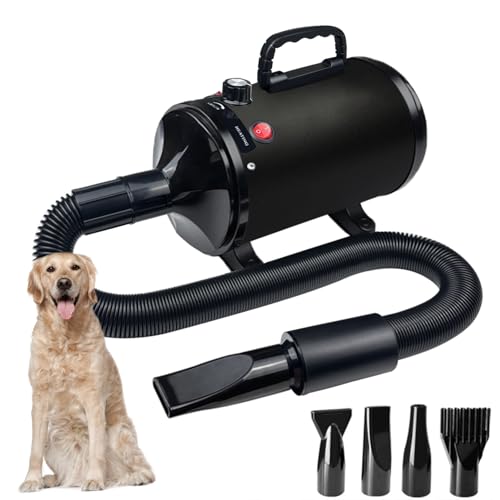
Dog Dryer for Pet Grooming, High-Velocity Force Blow Dryer
One of the home product options compared in this guide.
View on Amazon
CHAOLUN Dog Dryer for Pet Grooming, Pet Hair Dryer with Heater, Blue
One of the home product options compared in this guide.
View on Amazon
Dog Dryer,High Velocity Professional Dog Grooming Dryer
One of the home product options compared in this guide.
View on Amazon
SHELANDY Groomer Partner Pet Hair Force Dryer Dog Grooming Blower with Heater (Pink)
One of the home product options compared in this guide.
View on AmazonAs an Amazon Associate we earn from qualifying purchases.
How to Choose the Best Dog Blow Dryer for a Thick Coat
A human hair dryer works by heating hair until the water evaporates, which is slow, uncomfortable and genuinely risky on a dog. The best dog blow dryer does the opposite job entirely: it pushes a large volume of air through the coat and pushes the water physically out of the hair.
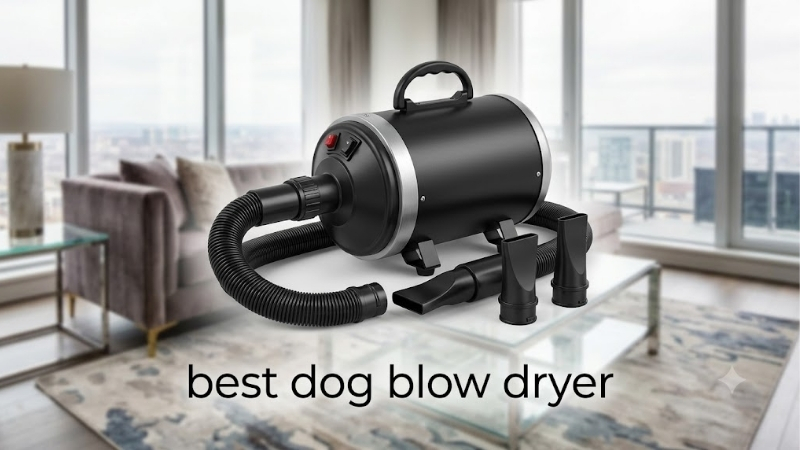
Airflow, Motor Ratings and What the Numbers Mean
The best dog blow dryer specifications are all about volume of air rather than temperature, so the first figure worth finding on any listing is the airflow rating rather than the wattage. Everything else on the box matters a great deal less than how much air actually arrives at the nozzle.
Airflow is usually quoted in cubic feet per minute, and pet force dryers commonly sit anywhere between roughly 100 and 300 CFM at the nozzle. Higher figures dry a dense double coat considerably faster, but they also demand rather more control from whoever is holding the hose.
Motor ratings in horsepower are the other number on the box, typically between two and four for home and salon machines. The figure describes peak draw rather than sustained output, so treat it as a rough class indicator and compare airflow figures and variable speed control instead.
Variable speed matters more than raw maximum power for most households. Being able to drop to a gentle flow for the face, the ears and the belly, then open it up on the body and the britches, is what makes a powerful dryer usable on a dog that would otherwise object very loudly indeed.
Heat Settings and Skin Safety
Many force dryers produce warm air from motor heat alone rather than from a heating element, which is exactly what you want. Air that arrives warm rather than hot dries efficiently without any real risk of burning skin, and it means you can hold the nozzle closer for longer without worry.
Where an adjustable heating element is fitted, keep it low or off and never hold the nozzle still against skin. Puppies, seniors, flat-faced breeds and any dog with thin coat over the belly are the ones at genuine risk, and heat remains the single most common cause of drying injuries at home.
Noise Levels and Introducing the Dryer
Force dryers are loud, commonly in the region of 65 to 85 decibels, and that noise is the reason many dogs refuse the whole process. Quieter models exist, and some machines let you run the hose from another room, which drops the perceived volume dramatically for a genuinely nervous dog.
Introduce the dryer gradually rather than in the middle of a wet, stressful bath. Run it across the room while the dog eats, then work up to short bursts on the body with treats, and keep airflow away from the ears and the face until the dog is completely comfortable with the machine.
Hoses, Nozzles and Storage
Hose length decides how much you have to move the machine around a big dog, and anything under six feet becomes limiting on a large breed standing on the floor. A flexible hose that holds its shape without kinking saves a surprising amount of frustration across a long drying session.
Nozzle choice changes the job. A flat concentrator drives water out of a double coat quickly, a cone works for general drying, and a comb attachment straightens curl on a doodle or a poodle as it dries. Check that the unit stores upright, because these machines are bulky things.
Airflow Targets by Coat Type
Use these airflow targets as a starting point. They are rules of thumb drawn from maker guidance and grooming references, not lab measurements.
- Smooth or short coats (beagle, boxer, lab): 80-120 CFM is enough; a compact dryer such as the Metrovac Quick Draw does the job.
- Medium double coats (border collie, golden retriever, Aussie): aim for 150 CFM or more with variable speed.
- Heavy double coats (husky, malamute, German shepherd): 200 CFM or more shortens the session and removes more loose undercoat.
- Giant coats (Newfoundland, Great Pyrenees, Saint Bernard): 240-320 CFM, often from a dual-motor dryer.
- Curly coats (poodle, doodle): airflow matters less than speed control and a comb or flat nozzle that straightens hair as it dries.
Amperage and Your Circuit
A typical household circuit is 15 amps, and a load running for more than a few minutes should stay under about 12 amps. Single-motor home dryers at 8-12 A fit easily. Dryers rated at 15 A or more, including most dual-motor models, should run on a circuit with nothing else plugged in, and 18-19 A models need a 20-amp circuit. Avoid thin extension cords; if you must use one, choose a short 12-gauge cord.
Best Dog Blow Dryer Comparison: Specs That Matter for a Thick Coat
The horsepower printed on a dog dryer box is a peak figure and often inflated, so this table leads with airflow (CFM), heat source and hose length, the three numbers that decide how fast a double coat dries. Figures come from maker spec sheets; where makers and sellers disagree, the maker figure is used.
| Model | Motor | Max airflow | Heat | Hose | Best for | Price tier |
|---|---|---|---|---|---|---|
| Metrovac Air Force Quick Draw QD-1V | 1.3 HP, single fan | about 101 CFM | Motor warmth only | 6 ft | Small dogs, travel, touch-ups | Under $200 |
| B-Air Fido Max 1 | 2 HP, 2 speeds | 165 CFM | No heater | 6 ft (sellers vary) | Budget, heat-sensitive dogs | Under $150 |
| XPOWER B-24 Thermal Ace | 3 HP, variable | 150 CFM | Motor warmth + 2 heat settings | 8 ft | Most home double coats | $200-$300 |
| Metrovac Air Force Commander AFTD-3V | 4.0 HP, variable | 126 CFM | No heater | 6 ft | Long service life | $300-$400 |
| Flying Pig Flying One | 4.0 HP, multi-speed | 240 CFM | Off / low / high heater | 10 ft | Thick coats in cold rooms | Under $250 |
| Shernbao SHD-2600P Super Cyclone | 5.0 HP peak, variable | 210 CFM | 2 heat settings, 55-131°F | 4-8 ft stretch | Power per dollar | Under $200 |
| XPOWER B-27 Super Tub Pro | Dual 3 HP motors, variable | 180 CFM | Motor warmth only | 8 ft | Multi-dog homes | $300-$400 |
| Shernbao DHD-2400F Typhoon | Dual motors, 6.0 HP peak | 320 CFM | Motor warmth only | 4-8 ft stretch | Giant breeds | $250-$350 |
| Electric Cleaner Co. Mini K-9 | 1 motor, 2 speeds, 9.5 A | 114 CFM | Motor warmth only | 10 ft | Show sites, generators | $300-$400 |
| Electric Cleaner Co. K-9 III | 2 motors, 18 A total | 245 CFM | Motor warmth only | 10 ft | Grooming rooms | Over $500 |
Check the amperage on the spec sheet before you buy. A standard household circuit is 15 amps, and dryers drawing 16-19 amps (the K-9 III and XPOWER B-27, for example) need a dedicated 20-amp circuit or they can trip the breaker halfway through a blowout.
Top Picks: Five Force Dryers for Home Grooming
The best dog blow dryer for a household depends mainly on coat density and how much noise the dog will tolerate. These five range from a straightforward first machine to salon equipment, and each entry carries a genuine drawback rather than a repeat of the copy on the box.
| Dryer | Type | Notable feature | Best for |
|---|---|---|---|
| Shelandy 3.2HP Pet Dryer | Handheld force dryer | Adjustable heat and speed | First serious dryer |
| Flying Pig Grooming Dryer | Force dryer | Strong airflow, two motors on some models | Thick double coats |
| XPOWER B-55 Pro | Force dryer | Variable speed, lighter body | Small to medium dogs |
| B-Air Bear Power Dryer | Force dryer | Durable build, long hose | Multi-dog households |
| K-9 II Dryer | Professional force dryer | High sustained airflow | Grooming rooms, giant breeds |
Shelandy 3.2HP Pet Hair Dryer
For a great many households this ends up being the best dog blow dryer they will ever need, simply because it covers the job without the price or the bulk of professional equipment sitting permanently in a corner of the bathroom. It is the sensible starting point for a first machine.
This is the machine most people buy first, and for a single medium dog it is usually enough. Airflow is strong enough to shift water out of a double coat, the speed dial gives genuine control, and it costs a fraction of what professional equipment does for similar everyday results.
The heat element is the thing to watch. It is adjustable, which is useful in a cold bathroom, but it can run warmer than expected on the highest setting, so keep it low and keep the nozzle moving. Build quality is also several steps below salon machines once it is used heavily every week.
Flying Pig Grooming Force Dryer
Flying Pig sits between the budget units and full professional equipment, and the airflow is where the money goes. On a dense double coat it clears water noticeably faster than a lighter machine, which shortens the whole session and reduces how long the dog is asked to stand still for.
That power is also the trade-off. It is loud, it is heavy to move around, and it is more machine than a smooth-coated small dog will ever need. Anyone drying a whippet or a French bulldog will find the lower-powered options here a great deal easier to live with day to day.
Flying Pig Flying One spec line: 4.0 HP single motor · 240 CFM · heater with off, low and high (about 85-165°F) · 10 ft rubber hose · steel housing · 1-year warranty. The 10 ft hose is the longest in its price tier, which helps when a large dog stands on the floor rather than a table.
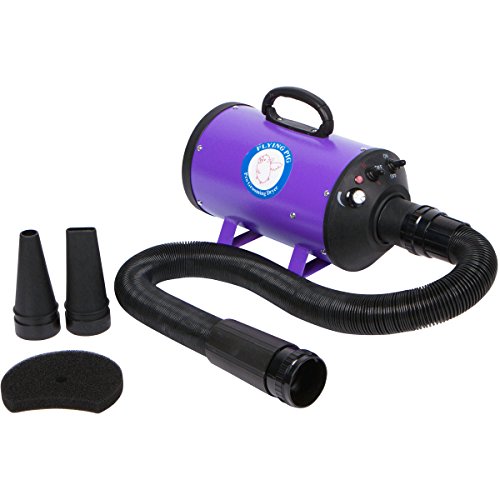
Flying Pig High Velocity Dog Pet Grooming Dryer w/Heater (Model: Flying One, Purple)
One of the home product options compared in this guide.
View on AmazonXPOWER B-55 Pro
The appeal here is a lighter body with useful variable speed, which suits people drying small and medium dogs in a bathroom rather than a dedicated grooming room. It handles a spaniel or a cocker comfortably and stores away far more easily than the bigger units on this list do.
On a giant double coat it runs out of headroom, and drying a full samoyed or a great pyrenees with it takes noticeably longer than with a higher-airflow machine. It is best thought of as the right-sized choice rather than as a compromise, provided your dog fits the category.
B-Air Bear Power Dryer
B-Air builds for durability, which is what matters once a dryer is running several times a week across more than one dog. The long hose reduces how often the unit has to be dragged around the room, and the housing tolerates being knocked about far better than the lighter plastic shells.
It is a straightforward machine rather than a clever one, so there are fewer refinements than on some competitors at the price. Noise sits at the upper end of the range as well, which makes the gradual introduction described earlier considerably more important rather than less.
B-Air Bear Power BPD-1 spec line: sold as a 2 HP high-velocity groomer dryer. B-Air sells several similar-looking models, so confirm hose length and heat options on the product page before ordering.

B-Air BPD-1 Bear Power 2 HP High Velocity Pet Groomer Dryer, Purple Ribbon
One of the home product options compared in this guide.
View on AmazonK-9 II Dryer
This is professional equipment, and it behaves like it. Sustained airflow stays high through a long session rather than tailing off, which is the difference that shows when you are drying a giant breed or several dogs back to back across the same afternoon without a real break.
The drawbacks are price, size and noise, and none of them are small. For one medium dog bathed every six weeks it is far more machine than the situation calls for, and the money is better spent on a mid-range dryer plus a decent slicker and a proper stand for the table.
Frequently Asked Questions
Four questions come up constantly from owners buying their first force dryer, and the answers matter for safety as much as for results. The best dog blow dryer still needs introducing carefully to a dog that has never met one before, so build the association slowly rather than during a bath.
Can I use a human hair dryer on my dog?
It is not a good substitute. Human dryers rely on heat rather than airflow, which risks burning skin, dries far more slowly on a thick coat and leaves the undercoat damp underneath. If you have no alternative, use the coolest setting, keep it moving constantly and stay well back.
How close should the nozzle be to the coat?
Around two to four inches works for body drying with a force dryer, moving continuously rather than holding one spot. Pull back further on thin-coated areas, and never aim directly into the ears, the eyes, the nose or the genitals at any distance or on any speed setting at all.
How do I dry a dog that is scared of the noise?
Build the association away from bath time, with the machine running across the room while good things happen. Some owners run the unit in a hallway with only the hose in the room, and ear protection designed for dogs helps a reasonable proportion of genuinely noise-sensitive animals.
What is the best dog dryer to blow out a winter coat?
A variable-speed, high-velocity force dryer with at least 150 CFM, such as the XPOWER B-24 Thermal Ace or Shernbao SHD-2600P, is the best choice for most double-coated dogs. For giant breeds, a dual-motor dryer such as the Shernbao DHD-2400F Typhoon finishes sooner.
Does a dog dryer need a heater for winter?
No, a heater is optional because airflow, not heat, does most of the drying. Motor-warmed air is enough indoors. A low heat setting helps in a cold garage, but keep the nozzle moving and never use high heat on puppies, seniors or thin-coated areas.
How many CFM do I need for a husky or German shepherd?
Aim for about 200 CFM or more for a heavy double coat. Dryers around 150 CFM still work, but sessions take longer. Below about 100 CFM, a full blowout on these breeds becomes slow and tiring for both of you.
Can a high-velocity dog dryer trip a breaker?
Yes, if it draws 15 amps or more on a circuit shared with other appliances. Check the amperage on the spec label, unplug space heaters and washers on the same circuit, and use a dedicated 20-amp circuit for dual-motor dryers.
Do force dryers help with shedding?
They do, considerably. Blowing out a double coat after a bath removes a large volume of loose undercoat before any of it lands on the floor, which is why groomers dry and then brush rather than the other way around. It also makes the brushing session afterwards considerably faster.
See More:
- Dog grooming shears best
- Best dog clippers for poodles
- Best dog clippers for doodles
- Best dog brush for poodle
- Best dog brush for great pyrenees
Final Thoughts
The best dog blow dryer is a high-velocity machine with variable speed, minimal reliance on a heating element and a hose long enough for your dog’s size. Introduce it slowly, keep the nozzle moving, stay away from the ears and face, and drying a thick coat stops being the worst part of bath day.
Electric Cleaner Company K-9 II: the current listing comes in several colors with a 10 ft hose. Check the amperage on the label against your circuit before ordering, because the professional K-9 models draw more current than home dryers.

Electric Cleaner Company K9 II Dog Blow Dryer - High Power Grooming Dryer, Heavy Duty, 10' Hose, Deshedding, Hunter Green
One of the home product options compared in this guide.
View on AmazonMore High-Velocity Dog Dryers Worth Buying in 2026
The five dryers above leave gaps at both ends: no true travel unit, no all-steel American-made option, and no mid-price dryer with enough airflow for a giant double coat. These five fill those gaps. Specs come from maker spec sheets and owner manuals.
XPOWER B-24 Thermal Ace — Best Overall for Home Winter Coat Blowouts

XPOWER B-24 Professional Pet Grooming Force Dryer with Powerful and Quiet Motor, Variable Speed and Extra Heat, Versatile For All Coats and Breeds
One of the home product options compared in this guide.
View on Amazon- Motor: 3 HP single motor, 12 A on 115V, variable speed
- Airflow: up to 150 CFM
- Heat: motor-warmed air plus a low/high switch for extra heat
- Hose: 8 ft x 1.7 in heat-resistant hose; round, cone and flat nozzles
- Weight: 8.8 lb; ABS housing with dual thermal protection; 1-year limited warranty
The XPOWER B-24 Thermal Ace hits the balance most households need. At 12 amps it runs on an ordinary 15-amp circuit, the variable speed dial lets you start gently around the face, and 150 CFM is enough to push water and loose undercoat out of a golden retriever or a husky in a reasonable session. The extra heat switch is useful in a cold garage, but motor warmth alone is enough most of the year.
Pros:
- Runs on a standard household circuit
- Variable speed plus two heat settings
- 8 ft hose and three nozzles included
- Optional wall and stand mount kits
Cons:
- Plastic housing, not steel
- Less airflow than dual-motor dryers on giant breeds
Skip it if… you dry a Newfoundland or Great Pyrenees every week; a dual-motor dryer will finish noticeably sooner.
Metrovac Air Force Commander AFTD-3V — Best Built to Last

METROVAC AFTD-3V Air Force Commander Variable Speed Pet Dryer Made in USA
One of the home product options compared in this guide.
View on Amazon- Motor: 4.0 peak HP, 10 A / 1,200 W, variable speed
- Airflow: 126 CFM
- Heat: no heating element; air is warmed by the motor only
- Hose: 6 ft flexible hose; blower nozzle, air flare and massager included
- Build: all-steel body, 12 ft cord, about 8 lb, made in USA
The Metrovac Air Force Commander is the dryer many groomers keep for a decade. The steel shell shrugs off knocks, the 10-amp draw is easy on household wiring, and the lack of a heater removes the most common cause of drying burns. Its 126 CFM rating looks modest next to the bigger numbers some imported dryers print on the box, but the steel motor housing and US-made parts are what you pay for here.
Pros:
- All-steel construction, made in USA
- No heater, so no burn risk
- Low 10 A draw
Cons:
- Only a 6 ft hose as standard
- No added heat for cold rooms
- Higher price than imported dryers with similar airflow
Skip it if… you dry in an unheated space in winter and want warm air on demand.
Shernbao SHD-2600P Super Cyclone — Best Power for the Money

Dog Dryer High Velocity Pet Dog Grooming Force Hair Dryer/Blower 5.0HP
One of the home product options compared in this guide.
View on Amazon- Motor: 5.0 HP peak, 15 A on 110V, dial speed control
- Airflow: up to 210 CFM; maximum air speed 64,000 FPM
- Heat: two settings, roughly 55-131°F; heater can be switched off
- Hose: stretch hose about 4-8 ft; three nozzles and air filters
- Noise: listed at 50-72 dB depending on speed
The Shernbao SHD-2600P Super Cyclone delivers more airflow than any other single-motor dryer here at a mid-range price, which makes it a strong match for heavy shedders during spring and fall coat blows. The dial lets you drop the speed for nervous dogs. Its 15-amp draw means it should have a circuit to itself.
Pros:
- 210 CFM from a single motor
- Heater can be turned off
- Speed dial helps with noise-sensitive dogs
Cons:
- 15 A draw needs an unshared circuit
- Stretch hose is short when relaxed
Skip it if… your bathroom outlet shares a circuit with a space heater or washer.
Shernbao DHD-2400F Typhoon — Best for Giant Double Coats

Dual Motor High Velocity Pet Dog Grooming Force Hair Dryer/Blower 6.0HP
One of the home product options compared in this guide.
View on Amazon- Motor: dual motors, 6.0 HP peak, speed dial
- Airflow: up to 320 CFM; air speed 4,921-68,000 FPM
- Heat: no separate heating element; motor warmth only
- Hose: 4-8 ft stretch hose; three nozzles and two air filters
- Weight: about 14.7 lb net
Two motors give the Shernbao DHD-2400F Typhoon the highest listed airflow in this guide, which is what a Newfoundland, Saint Bernard or Alaskan Malamute coat needs in shedding season. Sellers list the amperage differently (15 A to 20 A), so plan on a dedicated 20-amp circuit to be safe.
Pros:
- 320 CFM for the densest coats
- No heating element to burn skin
- Wide speed range for face and body
Cons:
- Heavy and loud at full speed
- Amperage figures vary by seller
Skip it if… your dog is under 40 lb; the extra airflow brings noise without saving much time.
Metrovac Air Force Quick Draw QD-1V — Best Portable Dryer for Travel and Small Dogs
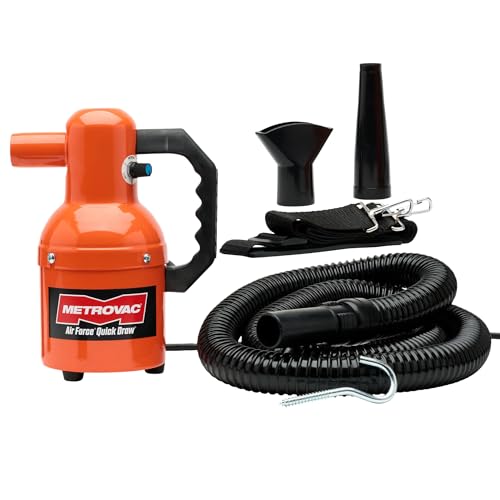
METROVAC QD-1V-6FT Air Force Quick Draw Variable Speed Dryer Made in USA
One of the home product options compared in this guide.
View on Amazon- Motor: 1.3 peak HP, 8 A / 1,000 W, 0-100% variable speed
- Airflow: about 101 CFM (maker figure)
- Heat: no heating element
- Hose: 6 ft hose with airflow control, shoulder strap and table hook
- Size: about 4.5 x 7.5 x 9.75 in and 3 lb; steel body, made in USA
The Metrovac Air Force Quick Draw QD-1V is small enough for a grooming bag and light enough to hang from a shoulder strap at a dog show. On a Shih Tzu, Cavalier or terrier it dries the whole dog; on a husky it is best kept for touch-ups after a bigger dryer has done the heavy lifting.
Pros:
- About 3 lb with shoulder strap
- Full variable speed
- Steel body, made in USA
Cons:
- Too little airflow for a full double-coat blowout
- No heat option
Skip it if… it will be your only dryer for a large double-coated breed.
Also Consider
- XPOWER B-27 Super Tub Pro — best for multi-dog homes · dual 3 HP motors · 180 CFM · 8 ft hose · draws up to 19 A, so it needs a 20-amp circuit.

XPOWER B-27 Powerful, Professional Pet Grooming Force Dryer with Dual Motors, Variable Speed Control
One of the home product options compared in this guide.
View on Amazon- B-Air Fido Max 1 — best budget no-heat dryer · 2 HP · 165 CFM · 2 speeds · 7.4 A · hose length listed differently by sellers (3-6 ft), so check before buying.
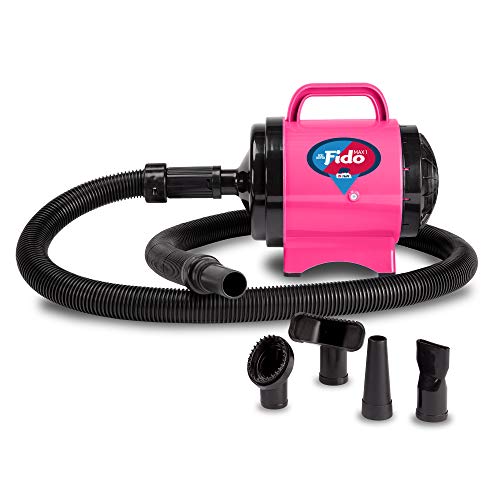
B-Air Fido Max 1 Dog Hair Dryer - Premier Grooming Collection, with 6-Foot Hose and 4 Grooming Nozzles, Hot Pink
One of the home product options compared in this guide.
View on Amazon- Electric Cleaner Company Mini K-9 — best for show sites and generators · 9.5 A · about 114 CFM · 10 ft hose · steel body · two speeds; trade-off is a high price for its airflow.

Electric Cleaner Company ECC Mini K-9 High-Velocity Dog Dryer – Portable Pet Blow Dryer with 2 Speeds, 10' Hose & Tips, Metallic Purple
One of the home product options compared in this guide.
View on Amazon- Electric Cleaner Company K-9 III — best for grooming rooms · two motors · up to 245 CFM · 10 ft hose · 18 A draw, which needs a dedicated 20-amp circuit.

Electric Cleaner Company ECC K-9 III Variable Speed Dog Dryer - High Velocity Blow Dryer for Pets, Metallic Purple
One of the home product options compared in this guide.
View on AmazonBest Dog Dryer to Blow Out a Winter Coat, by Budget
Shedding season is when a dryer earns its keep: a high-velocity dryer pulls out dead undercoat that a brush alone leaves behind. Here is what each price tier realistically delivers.
Best dog blow dryer under $100
- SHELANDY 3.2HP Pet Hair Force Dryer — 3.2 HP listed · stepless speed · heater · four nozzles
- Shernbao SMD-06P — compact force dryer · speed and heat dial · light enough to store in a cabinet
- EGFKI 5.2HP — high listed power · adjustable speed and temperature · four nozzles
- B-Air Fido Max 1 — 2 HP · 165 CFM · no heater · 7.4 A, the rare budget dryer with a published CFM figure
What to expect at this tier:
- Plastic housings and short warranties, usually one year
- Horsepower claims of 3-5 HP that overstate real airflow; few publish a CFM figure
- Heaters that can run hot on the top setting, so keep heat low
- Fine for one medium dog bathed every few weeks
Best dog blow dryer from $100 to $300
- XPOWER B-24 Thermal Ace — 3 HP · 150 CFM · 8 ft hose · 2 heat settings · 12 A
- Shernbao SHD-2600P Super Cyclone — 5.0 HP peak · 210 CFM · 55-131°F · 15 A
- Flying Pig Flying One — 4.0 HP · 240 CFM · 10 ft hose · steel housing
What to expect at this tier:
- Published CFM ratings between about 150 and 240
- 6-10 ft hoses that reach a large dog on the floor
- Washable filters and spare filter sets in the box
- Enough airflow for a full husky or golden retriever blowout in one session
Best dog blow dryer over $300 (pro and multi-dog)
- Metrovac Air Force Commander AFTD-3V — 4.0 HP · 126 CFM · steel · made in USA
- XPOWER B-27 Super Tub Pro — dual motors · 180 CFM · 8 ft hose · 19 A
- Electric Cleaner Company K-9 III — two motors · up to 245 CFM · 10 ft hose · 18 A
What to expect at this tier:
- Steel bodies and replaceable motor brushes built for daily use
- Two-year motor warranties on some models
- Power draw above 15 A on dual-motor units, which means a 20-amp circuit
- Faster drying on giant breeds, but more noise
How We Chose These Dog Dryers
This guide is research-based. We did not put these dryers on dogs ourselves. We compared maker spec sheets and owner manuals for airflow (CFM), amperage, heat source, hose length, weight and warranty, and gave more weight to brands that publish CFM rather than only peak horsepower. We cross-checked figures against independent grooming guides and noted where sellers disagree, using the maker figure in those cases. Dryers that only list horsepower, or that are duplicate color versions of the same machine, were not counted as separate picks.
How to Blow Out a Winter Coat With a Dog Dryer
A blowout works best right after a bath, when the coat is wet and the loose undercoat slides out easily. This order keeps the job quicker and calmer:
- Towel off first. Squeezing out standing water with a microfiber towel can cut drying time noticeably.
- Start low and far away. Turn the dryer on across the room at the lowest speed, then bring the hose closer once the dog settles.
- Work from the back end forward. Begin at the rear legs and britches, then move to the body and chest. Leave the head for last, and use low speed or a towel there.
- Hold the nozzle at an angle. Blow against the direction of hair growth to open the coat and push out water and dead undercoat. A cloud of hair means it is working.
- Keep heat off or low. High-velocity air does the drying; heat only adds risk, especially on puppies, seniors and flat-faced breeds.
- Brush after drying. Finish with an undercoat rake or slicker brush while the coat is still open.
Which dryer for which owner: one medium dog a month — SHELANDY 3.2HP or B-Air Fido Max 1. A husky, shepherd or golden retriever every few weeks — XPOWER B-24 Thermal Ace or Shernbao SHD-2600P. A giant breed or two large dogs — Shernbao DHD-2400F Typhoon or XPOWER B-27. Daily grooming or a home business — Metrovac Air Force Commander or Electric Cleaner Company K-9 III. Travel and dog shows — Metrovac Air Force Quick Draw QD-1V.




Write Your Review
No reviews yet. Be the first to share your experience!