
Our Top Picks
 Andis 65730 Stainless-Steel Comb for Knots7 1/2 Inch2.5 x 10.5 x 0.5 inches0.2 poundsCheck on Amazon
Pros & cons
- Works across short, medium, and long coat lengths
- Patented design grabs hair tips to reduce painful tugging
- Doubles as a tool for removing pet hair from furniture and cars
- 5-inch size may be small for grooming large dogs quickly
- Metal construction requires careful storage away from small children
Pros & cons
- Dual-sided design pairs a 9-tooth and 17-tooth comb in one tool
- Rounded teeth are designed to reduce irritation while deshedding
- Non-slip rubber base helps keep the brush steady during use
- Dense double coats may require repeated passes for full deshedding
- Metal teeth need periodic cleaning to clear trapped hair
Quick answer: Dog hair and dog fur are the same material. Both are keratin growing from follicles in the skin, and science does not treat them as different things. In everyday grooming talk, “hair” describes coats that are fine, grow for a long time, shed little and need regular haircuts, while “fur” describes shorter, denser coats that stop at a set length, shed more and often have an undercoat. Which one your dog has decides how you brush, bathe and trim.
Last updated: October 2026. This guide contains affiliate links, so we may earn a commission on qualifying purchases at no extra cost to you.
Why the hair vs fur question matters
The labels are informal, but the behavior behind them is real. A Poodle and a Siberian Husky do not live with the same coat. One needs scissors and a slicker brush on a schedule; the other needs an undercoat rake and a vacuum. Once you know which type you are dealing with, three things get easier:
- Choosing tools. A fine, tangle-prone coat and a thick shedding coat call for different brushes and combs.
- Planning grooming visits. Hair-type dogs usually need regular trims; fur-type dogs usually need regular brushing and seasonal shedding help.
- Setting expectations. Shedding, matting and “doggy smell” all depend on coat behavior, not just on the label.
If you are shopping for a brush, our guides to the best dog grooming brushes and the best brush for dog hair go deeper once you know your coat type.
What dog hair and dog fur have in common
Every dog coat is built from the same basic parts: a follicle in the skin, a shaft made of keratin, and oil (sebum) that conditions the strand. Coats also do several jobs at once, including protecting skin from sun and minor scrapes, helping with temperature control, and carrying sensory information through whiskers. None of that changes between “hair” and “fur” dogs.
What differs is how long each strand grows, how many strands share a follicle, and how many layers the coat has. Those differences produce the behaviors people usually mean when they say hair or fur.
Dog hair vs fur: side-by-side comparison
| Trait | “Hair” coats | “Fur” coats |
|---|---|---|
| Texture | Usually finer, silky, wavy or curly | Usually denser and coarser, often with a soft undercoat |
| Growth | Long growth phase; keeps growing until cut | Shorter growth phase; stops at a set length |
| Layers | Often a single layer | Often a double coat (guard hairs plus undercoat), though not always |
| Shedding | Lower, but loose strands can stay trapped in the coat | Heavier, with seasonal “blowouts” in many breeds |
| Main grooming need | Brushing to prevent mats, plus regular haircuts | Frequent brushing, baths as needed, and deshedding help |
| Typical breeds | Poodle, Maltese, Shih Tzu, Yorkshire Terrier, Havanese, Portuguese Water Dog | Labrador Retriever, Golden Retriever, German Shepherd, Siberian Husky, Alaskan Malamute |
The science in plain language
Growth cycle: why hair keeps going and fur stops
Each strand moves through phases: an active growth phase, a short transition, and a resting phase before it falls out. In “hair” coats the growth phase is long, which is why a Poodle or Maltese can grow a floor-length coat if left alone. In “fur” coats the growth phase is shorter, so the strand reaches a set length, rests and sheds, and a new one replaces it. That is the root of the shedding difference: shedding is simply strands finishing their cycle.
Single coat vs double coat
Many fur breeds have two layers. The outer guard hairs shed dirt and water, while the soft undercoat insulates. Seasonal shedding is the undercoat letting go, often in spring and fall. Many hair breeds have one layer, so there is no big seasonal undercoat release, but loose strands can stay tangled in the surrounding coat, which is how mats start.
Is there a hard line between hair and fur?
No. Mixed breeds and many popular crosses blend traits, and some breeds sit in between, such as dogs with a wiry outer coat and a light undercoat. Treat “hair” and “fur” as the two ends of a spectrum and groom according to what your dog’s coat actually does: tangles, sheds in clumps, or both.
Which coat type does your dog have? A quick chooser
| What you notice | Likely coat behavior | Start with |
|---|---|---|
| Little shedding, but knots behind ears, in armpits and on the chest | Hair-type, mat-prone | Slicker brush plus metal comb, regular haircuts |
| Tufts of soft fluff coming off in clumps twice a year | Fur-type double coat | Undercoat rake or deshedding tool, bath and blow-dry |
| Short, smooth coat with steady light shedding | Fur-type single or short double coat | Rubber curry or soft bristle brush weekly |
| Curly or wavy coat that grows constantly | Hair-type, high maintenance | Daily or near-daily brushing down to the skin |
| Wiry outer coat that feels rough | Wire coat, in between | Comb and slicker, ask a groomer about hand-stripping |
| Both heavy shedding and tangles | Mixed or crossbreed coat | Comb check first, then rake or slicker as the coat requires |
How to groom a dog with hair
- Brush before every bath. Water tightens knots. Work through the coat in sections and check with a comb that it passes from skin to tip.
- Pay attention to friction zones. Behind the ears, under the collar, in the armpits, and around the hind end mat fastest.
- Bathe with a gentle dog shampoo, rinse thoroughly, and use a conditioner if the coat tangles easily.
- Dry fully. Damp hair coats can mat as they dry. A towel and a low-heat dryer, kept moving, work well.
- Book regular trims. Because the coat keeps growing, a professional or home trim every several weeks keeps length manageable. Your groomer can suggest the right interval for your dog’s coat.
How to groom a dog with fur
- Brush on a weekly rhythm, and more often during shedding season, using a tool that reaches the undercoat.
- Use an undercoat rake or deshedding tool gently. Short, light strokes in the direction of hair growth. Stop if the skin looks red.
- Bathe, then dry thoroughly. Loosened undercoat releases in the tub and during blow-drying, so do this before the final brush-out.
- Do not shave a double coat to stop shedding. The coat helps with insulation and sun protection, and shaving does not stop shedding. It can also change how the coat grows back. Ask a groomer before any major cut.
- Keep the vacuum handy. Deshedding tools reduce loose hair around the house, but they do not make a dog shed-free.
For shedding-specific tools, see our best deshedding dog brush roundup.
Tools by coat type
| Tool | Best for | Notes |
|---|---|---|
| Slicker brush | Hair coats, curly and wavy coats | Fine bent pins lift tangles; use light pressure to avoid brush burn |
| Metal comb | All long or tangle-prone coats | The test tool: if the comb drags, the brush missed something |
| Undercoat rake | Fur coats with thick undercoat | Reaches loose undercoat; avoid raking over mats |
| Deshedding tool | Heavy-shedding fur coats | Use sparingly and gently; overuse can irritate skin |
| Rubber curry or bristle brush | Short smooth coats | Loosens dead hair and spreads natural oils |
| Detangling spray | Long or fine coats | Helps the brush glide and reduces pulling |
Recommended tools to consider
These are examples of tool types that match the two coat styles. Always match size and pin length to your dog.
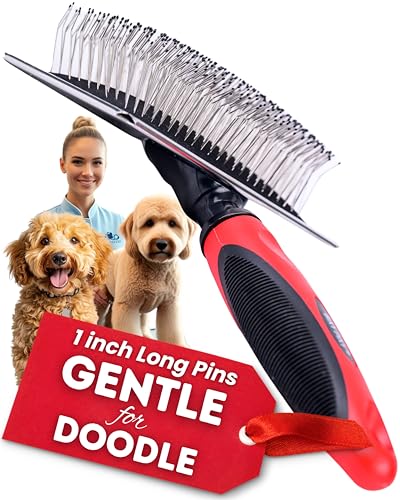
The Chris Christensen Big G slicker brush is a long-pin slicker aimed at doodles, Poodles and other curly or wavy coats. The listing highlights a larger head and a design meant to fluff and detangle like a salon tool. It sits in the premium range, and like any slicker it needs light hands, because pressing hard on bare skin can irritate it.

Chris Christensen Big G Dog Slicker Brush for Dogs (Goldendoodles, Labradoodles, Poodles), Groom Like a Professional, Fluff Detangle Style, Saves Time Energy, Coral, Large
One of the home product options compared in this guide.
View on AmazonThe Andis stainless-steel comb is a basic dematting and finishing comb for removing knots, mats and loose hair. The listing emphasizes a lightweight, comfortable handle. It is useful as the “did I get it all” check on hair coats, but it is not a substitute for a brush on thick coats, and it should not be forced through a tight mat.
Andis 65730 Stainless-Steel Comb for Knots, Mats & Loose Hair Removal - Effective Dematting Tool, Comfortable, Lightweight, Portable & Safe for Dogs, Cats & Pets – Silver, 7-1/2-Inch
One of the home product options compared in this guide.
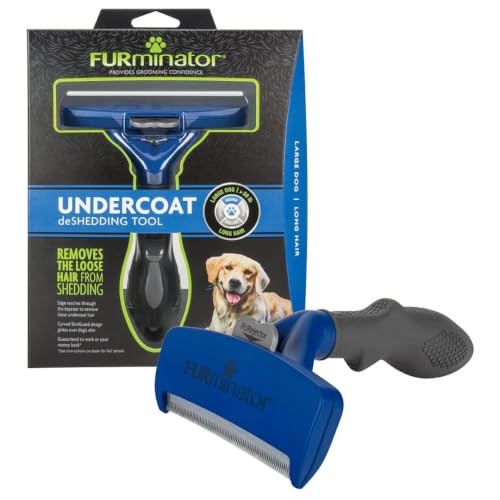
View on AmazonThe SleekEZ is a deshedding tool built for fur coats, with a design meant for short, medium and long coats. The listing says it is made in the USA and sold in several sizes. It is in the mid-range, and like any deshedding tool it should be used gently and sparingly rather than daily on the same patch.

SleekEZ Dog Brush for Shedding | Patented Deshedding Dog Brush | Pet Hair Remover for Short, Medium & Long Coats | Made in USA | 5 Inch
Chosen because it lists an explicit depth/thickness.
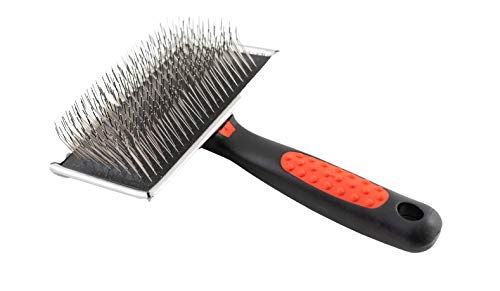
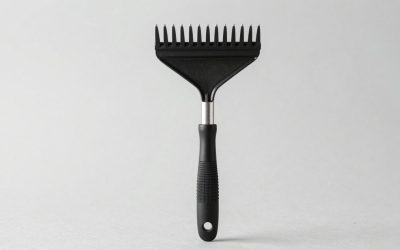
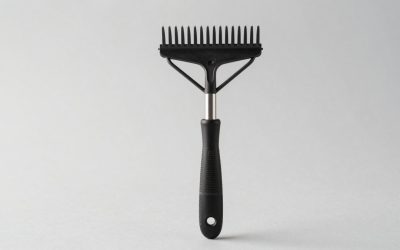
View on AmazonThe Maxpower Planet grooming rake has a wide double-sided head, with one side for deshedding and one for dematting, aimed at thicker or longer coats. It is budget-friendly, but rake teeth can snag on tight mats, so brush or comb out tangles first.

Maxpower Planet Dog Grooming Rake, Deshedding Undercoat Brush, Dogs & Cats | Blue Deshedding & Dematting, Extra-Wide Double-Sided Comb, Long-Haired Coats, Reduces Shedding, Original Design
One of the home product options compared in this guide.
View on AmazonCommon mistakes vs better habits
| Mistake | Why it backfires | Better habit |
|---|---|---|
| Shaving a double-coated dog to “stop shedding” | Shedding continues; coat protection and regrowth can suffer | Regular undercoat brushing and bath-and-blowout help |
| Brushing only the top of a thick coat | Tangles form close to the skin | Line-brush in sections down to the skin |
| Bathing a matted dog | Water tightens mats | Brush and comb first; see a groomer for severe mats |
| Over-using a deshedding tool | Can irritate skin and break coat | Short sessions; stop if skin looks pink |
| Assuming “hair dogs don’t need grooming” | Non-shedding coats mat without upkeep | Schedule brushing and trims |
| Assuming a hair coat means no allergies | Allergens come mainly from dander, saliva and skin, not coat type | Talk with an allergist and spend time with the individual dog |
Hair, fur and allergies
A common belief is that “hair” dogs are safer for people with allergies. The truth is more mixed. Curly hair coats shed less into the home and can hold dander close to the skin, which some allergy sufferers tolerate better. But dander, saliva and skin compounds are the main triggers, and sources disagree on whether coat type predicts reactions. No dog is completely hypoallergenic. If allergies matter in your household, spend time with the specific dog before committing and speak with your doctor.
Seasons, age and coat changes
Coats are not fixed for life. Knowing what is normal saves unnecessary worry.
- Seasonal shedding. Many double-coated fur dogs release undercoat in spring and fall. During those weeks, brush more often and consider a bath and blow-dry to speed up the release. A deshedding tool or rake helps the loose undercoat leave the house on the brush instead of on the sofa.
- Puppy coat change. Many puppies grow in a different adult coat, and some become much more tangle-prone around that transition. If you have a hair-type puppy, start gentle brushing and combing early so the habit is calm before the adult coat arrives.
- Senior dogs. Older dogs may groom themselves less and move less, so mats and nail overgrowth can build faster. Shorten the interval between brush sessions and watch for sore spots.
- Indoor climate. Dogs kept indoors in heating or air conditioning may shed lightly all year instead of in two clear waves.
- Diet and health. A dull, brittle or thinning coat can reflect a health or nutrition issue rather than a grooming problem. Discuss it with your vet before changing food or adding supplements.
A simple weekly routine by coat type
- Hair, curly or long: brush daily or every other day, skin-deep, then do a comb check. Use detangler on trouble spots and keep trims on schedule.
- Fur, double coat: brush two to three times a week, daily in shedding season. Use an undercoat rake and a bath and blow-dry at the season change.
- Fur, short coat: brush weekly with a rubber curry to lift dead hair, and bathe occasionally.
- Wire or in-between: brush two to three times a week and ask a groomer about stripping or tidy trims.
Treat these as starting points. A dog that lives on trails or at the beach may need more, and a dog on a sofa all day may need less. Adjust to what the coat is telling you.
When to see a vet or professional groomer
A coat is a good health indicator, so some changes need more than a brush.
- See a vet for sudden or unusual hair loss, bald patches, red or scabbed skin, constant scratching, a greasy or flaky coat with a strong odor, or a coat that turns dull and brittle without explanation. These can have medical causes that no brush will fix.
- See a vet if you find lumps, open sores, or signs of fleas or ticks, or if your dog flinches when you touch a specific area.
- See a professional groomer for tight mats close to the skin, a coat that has been neglected for months, or a breed that needs hand-stripping or special trimming patterns. Avoid cutting out mats with scissors at home, because skin can be pulled into the mat and cut.
Frequently asked questions
Is dog hair the same as dog fur?
Yes, biologically they are the same keratin material. People use “hair” for fine, long-growing, low-shedding coats and “fur” for shorter, denser coats that shed more, but the labels are informal and the two blend in many dogs.
Which dogs have hair and which have fur?
Poodles, Maltese, Shih Tzus, Yorkshire Terriers and Havanese are usually called hair breeds. Labrador Retrievers, Golden Retrievers, German Shepherds, Siberian Huskies and Alaskan Malamutes are usually called fur breeds. Mixed breeds often show a bit of both.
Do dogs with hair shed?
They shed less than most fur breeds, but they do lose strands. The loose hair often stays tangled in the coat instead of landing on the floor, so brushing is still needed to prevent mats.
Are dogs with hair better for allergies?
Not reliably. Allergens come mainly from dander, saliva and skin, so coat type alone does not predict a reaction. Some allergic people do better with low-shedding coats, but no dog is fully hypoallergenic.
Do hair dogs need haircuts and fur dogs need brushing?
Generally yes. Hair coats keep growing, so they need regular trims along with brushing. Fur coats stop at a set length and mostly need frequent brushing and seasonal deshedding rather than haircuts.
Should I shave a fur dog in summer?
Usually not. A double coat helps insulate against both heat and cold and protects skin from sun. Regular brushing to remove loose undercoat is generally the better way to help a dog stay comfortable. Ask a groomer or vet before shaving.
Can a dog have both hair and fur?
Effectively yes. Many mixed-breed dogs combine a curly or wavy outer coat with some shedding, and some purebreds sit between the two types. Groom to the behavior of the coat rather than the label.
Final thoughts
Hair versus fur is less a scientific divide than a practical guide to how a coat behaves. Figure out whether your dog tangles, sheds or does both, pick tools to match, and keep a regular brushing routine. When the coat or skin looks off, a vet visit is the right next step.


Write Your Review
No reviews yet. Be the first to share your experience!