
Key takeaways
What's inside
Best dog flea bath products kill what is on the dog today and almost nothing beyond that. Roughly 95 percent of a flea population lives in the home rather than on the animal, so a bath is one step in a plan. This guide covers active ingredients, age limits and what to do next.
As an Amazon Associate we earn from qualifying purchases.


As an Amazon Associate we earn from qualifying purchases.
This article is general information, not veterinary advice. Speak to your veterinarian before starting any flea treatment, particularly for puppies, senior dogs, pregnant or nursing dogs, or any dog on medication.
🛒 Best Price Today on Amazon
Prime members get fast, free shipping on everything above, plus member-only deals. New members get a 30-day free trial — cancel anytime.
What the Best Dog Flea Bath Can and Cannot Do
Flea shampoos kill adult fleas on contact during the bath, and that is the whole of what the best dog flea bath achieves on the dog itself. Most offer little or no residual protection once the dog is rinsed and dry, which means a dog can pick up new fleas from carpet and bedding within hours. Understanding that limit is what stops owners bathing repeatedly and getting nowhere.
Contact Kill Versus Residual Protection
A standard flea shampoo is a contact insecticide. It kills the adults present during the wash and then washes down the drain with them. Products containing an insect growth regulator go further by preventing flea eggs developing into biting adults, with some labelled for up to 28 days of that effect.
Neither replaces a prescription preventive. Spot-on treatments and oral products from your veterinarian provide weeks of protection that a bath cannot, and for an established infestation most vets recommend a bath to bring immediate relief alongside a longer-acting product rather than instead of one. The best dog flea bath sits beside a preventive, not in place of it.
Active Ingredients and Age Restrictions
Conventional formulas typically pair a fast-acting pyrethrin with a synergist and an insect growth regulator. One widely sold example lists (S)-Methoprene at 0.10 percent, pyrethrins at 0.15 percent and piperonyl butoxide at 1.88 percent, and its label restricts use to dogs and cats over 12 weeks of age.
Plant-based formulas use essential oils instead. A common veterinary-formulated option lists thyme oil at 0.32 percent, peppermint oil at 0.45 percent, clove oil at 0.72 percent, rosemary oil at 1.00 percent and cedarwood oil at 1.03 percent, also restricted to dogs 12 weeks and older.
Contact Time, Dosage and Rinsing
Contact time is where most flea baths fail. Labels commonly specify three to five minutes of worked lather for conventional formulas and five to ten minutes for oil-based ones, and a rushed two-minute wash simply does not kill what is on the dog.
Dosage matters too. One conventional label specifies roughly one and a third tablespoons per 5 pounds of body weight, worked from the head backwards so fleas cannot retreat to the face. Rinse thoroughly afterwards, since residue on the skin is a common cause of post-bath irritation.
Treating the Home, Not Just the Dog
Since only around 5 percent of a flea population is on the animal, the remaining eggs, larvae and pupae in carpet, bedding and upholstery will reinfest a clean dog quickly. Wash all bedding hot, vacuum thoroughly including under furniture, and empty the vacuum outside immediately afterwards.
Timing is worth planning around. Flea and tick pressure builds sharply from March through May and extends later into autumn in warmer years, so the best dog flea bath results come from starting a household plan at the beginning of that window rather than reacting in July.
Top Picks: 6 Flea Bath Products and Tools
The best dog flea bath depends on your dog’s age and skin as much as on the flea load, so these five shampoos and one comb cover conventional insecticide formulas, plant-based options and the tool that tells you whether any of it worked. Read every label in full before use, and check suitability with your veterinarian.
| Product | Type | Key Feature | Minimum Age |
|---|---|---|---|
| Adams Plus with Precor | Pyrethrin + IGR | 28-day egg control | 12 weeks |
| Vet’s Best Flea & Tick | Essential oils | Plant-based actives | 12 weeks |
| TropiClean Natural Flea & Tick | Essential oils | Plant-based, citrus scent | Check label |
| Hartz UltraGuard Rid | Conventional | Budget option | Check label |
| Sentry Flea & Tick Shampoo | Conventional | Widely stocked | Check label |
| Safari Flea Comb | Fine steel comb | Verification, no chemicals | Any age |
Adams Plus Flea & Tick Shampoo With Precor
The most complete conventional option here, because it does two jobs. Pyrethrins at 0.15 percent with piperonyl butoxide at 1.88 percent kill adult fleas, ticks and lice on contact, while (S)-Methoprene at 0.10 percent acts as an insect growth regulator preventing flea eggs developing for up to 28 days.
The label restricts it to dogs and cats over 12 weeks old and directs owners to consult a veterinarian before using it on aged, debilitated, medicated, pregnant or nursing animals. It is an insecticide, so dogs with sensitive skin can react, and the three to five minute contact time is not optional.
Vet’s Best Flea and Tick Dog Shampoo
The plant-based alternative for owners who want to avoid conventional insecticides. Actives are listed as thyme oil 0.32 percent, peppermint oil 0.45 percent, clove oil 0.72 percent, rosemary oil 1.00 percent and cedarwood oil 1.03 percent, and it is labelled for dogs 12 weeks and older.
Contact time is longer, with the label suggesting five to ten minutes of massaging, and it offers no insect growth regulator effect, so it does nothing about eggs already in the environment. Essential oil formulas also cause reactions in some dogs, and they must never be used on cats.
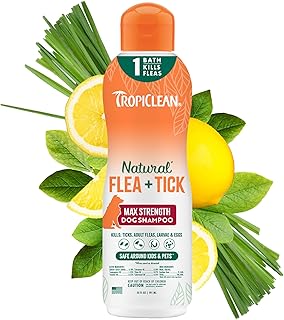
TropiClean Natural Flea & Tick Shampoo
Another plant-based route, generally chosen for scent and skin feel as much as for efficacy. It suits owners doing frequent maintenance washes on a dog with mild exposure rather than tackling an established infestation, and it is gentler on coat condition than repeated insecticide baths.
Like all oil-based formulas it needs thorough rinsing, works on contact only, and requires repeat applications during heavy flea pressure. Read the specific label for the age minimum, since it varies across the range.
Hartz UltraGuard Rid Flea & Tick Shampoo
The budget conventional option, widely available and effective at killing what is on the dog during the wash. For a household treating several dogs, or doing an initial knockdown before a veterinary preventive takes over, the lower cost per bath is a real consideration.
Conventional formulas at this price point tend to be harsher on the coat and more likely to leave skin dry, and reports of sensitivity reactions are more common than with premium formulas. Check the age minimum on the specific bottle and rinse very thoroughly.
Sentry Flea & Tick Shampoo
A mid-priced conventional shampoo that is easy to find in most stores, which matters when you discover fleas on a Sunday evening. It kills adults on contact and cleans the coat at the same time, which is all most owners need from the bath step itself.
It offers no meaningful residual protection, so it is a knockdown tool only. As with any conventional formula, confirm the age minimum on the label and never use a dog-labelled product on a cat, since some ingredients used in dog products are toxic to cats.
Safari Flea Comb
The tool that tells you the truth. Fine stainless teeth spaced tightly enough to catch adult fleas and flea dirt let you check the dog before and after a bath, and it works on puppies too young for any shampoo. Comb over a white towel and dip the comb in soapy water between passes.
It is slow, it clears only what you physically catch, and it does nothing about eggs or larvae. It is not a treatment, but it is the cheapest way to confirm whether the rest of your plan is working.
Frequently Asked Questions
These four cover what owners ask about the best dog flea bath in the first days of an infestation, when the pressure to do something immediately is highest.
How Often Can I Bathe a Dog With Flea Shampoo?
Follow the label, which for most products means no more than once every one to two weeks. Bathing more often strips coat oils and irritates skin without improving results, because the problem is the environment rather than the dog. Speak to your veterinarian if fleas persist despite correct use.
Can I Use Dog Flea Shampoo on My Cat?
Only if the label explicitly lists cats. Several ingredients used in dog flea products are seriously toxic to cats, and this is one of the most common causes of emergency veterinary visits during flea season. If a product is not labelled for cats, do not use it on one.
What About Puppies Under 12 Weeks?
Most flea shampoos set 12 weeks as the minimum age, which leaves younger puppies unprotected by shampoo. A flea comb and a warm bath with plain puppy shampoo removes fleas mechanically, and your veterinarian can advise on what is safe at that age. Do not improvise with adult products.
Why Are the Fleas Back Two Days Later?
Because the bath only treated the 5 percent living on the dog. The eggs, larvae and pupae in carpet, bedding and furniture continue hatching for weeks. Without hot-washing bedding, thorough vacuuming and a longer-acting preventive, the best dog flea bath in the world will look like it failed.
See More:
- Best way to get rid of dog hair in car
- Best vacuum for hard floors and dog hair
- Best dog clippers for golden doodle
- Best small dog nail clipper
- Best dog clippers for yorkies
Final Thoughts
The best dog flea bath is the first step in a plan rather than the plan itself: a shampoo with an insect growth regulator for immediate relief and egg control, a flea comb to verify what is happening, thorough treatment of the home, and a veterinary preventive for lasting protection. Read every label in full, respect the age restrictions, and talk to your vet before you start.


Write Your Review
No reviews yet. Be the first to share your experience!