
Key takeaways
What's inside
Best vacuum for dog hair on wood floors has a problem carpet machines never face: the hair is not held in place. Fur sits loose on timber and gets pushed ahead of the machine by its own airflow, so the head design matters far more than the suction figure printed on the box. Seal beats power on timber.
As an Amazon Associate we earn from qualifying purchases.


As an Amazon Associate we earn from qualifying purchases.
🛒 Best Price Today on Amazon
Prime members get fast, free shipping on everything above, plus member-only deals. New members get a 30-day free trial — cancel anytime.
How to Choose the Best Vacuum for Dog Hair on Wood Floors
Hard floors invert most vacuum advice. The best vacuum for dog hair on wood floors needs a head that seals against a flat surface without scattering what is in front of it, and a brushroll soft enough that it never touches the finish with anything abrasive.
Soft Roller Heads and Why Beater Bars Fail
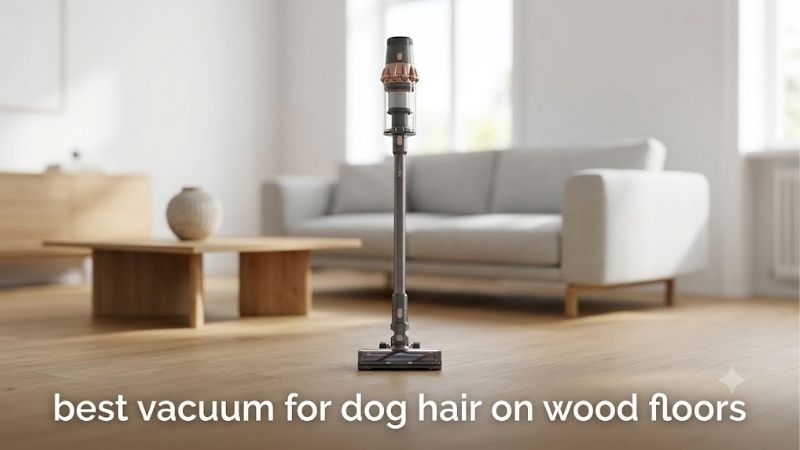
A stiff-bristled carpet brushroll is the wrong tool on timber. It flicks light debris forward instead of drawing it in, and the bristles can mark a softer finish over time. Soft roller heads use a woven or velvet-covered drum that makes full contact and rolls debris into the airflow instead.
Dyson builds this into its Fluffy and Laser Slim Fluffy heads, and the V12 Detect Slim ships with one alongside its de-tangling Motorbar head. The illuminated versions add a low-angle light that shows fine dust and hair against the grain, which on a dark floor genuinely changes what you find.
Canister vacuums handle it differently, using a smooth parquet floorhead with natural bristles and no motor. It is gentler still on a finish and completely silent in operation, though it does nothing to lift hair that has drifted into a gap between boards.
Sealed Suction and Airflow Control
On a hard floor, escaping air is what chases hair around the room. A well-sealed head holds the airflow at the surface where it can lift fur, while a leaky one turns the vacuum into a fan that pushes tumbleweeds into corners just ahead of the nozzle.
Sensible power selection helps too. Machines with automatic adjustment drop the suction on hard floors and raise it when they detect heavier debris, which is more useful here than raw output. Running a powerful cordless in boost mode across timber usually scatters more than it collects.
Wheel design is a small detail with a large consequence. Rubberised wheels roll silently and will not mark a finish, while hard plastic castors pick up grit and drag it across the boards. On an older or softer floor that difference shows up as fine scratching within a year.
Gaps, Edges, and Where Hair Actually Collects
Wood floors concentrate fur in predictable places. It gathers along skirting boards, in the gaps between boards on older floors, under furniture where airflow never reaches, and at the transitions into doorways where it collects against the threshold strip.
That makes edge cleaning and a crevice tool more important than deep-clean performance. A head with a hard front edge that reaches the skirting, plus a narrow tool for board gaps, will collect far more than a machine chosen purely on suction figures.
Head height is the other constraint worth measuring. Hair drifts under sofas, beds and kitchen units and stays there because nothing disturbs it, so a slim head that fits beneath low furniture reaches more of the actual problem than a wide one that cannot get under anything.
Finish Protection, Seasonal Load, and Timing
Grit is the real threat to a wood floor, not the vacuum. Fur trapped against the boards holds sand and dirt tracked in on paws, and that grit is what abrades the finish underfoot. Frequent light vacuuming protects the floor more effectively than periodic deep cleaning does.
Load is seasonal in two directions. Autumn brings the coat change through September and October, and winter brings wet paws, road salt and mud between November and January, which is when a hard floor needs the most frequent attention.
The category discounts hardest at Prime Big Deal Days in early October and Black Friday on 27 November, which lands neatly between those two periods. Older flagship models drift downward in price steadily, so last generation is usually the better value here.
Top Picks: Best Vacuum for Dog Hair on Wood Floors
These six are chosen for hard-floor behaviour rather than carpet scores, and each has a claim to being the best vacuum for dog hair on wood floors in a particular kind of home. Every entry names a real drawback.
| Model | Hard-Floor Head | Best For |
|---|---|---|
| Dyson V15 Detect | Fluffy Optic soft roller | Best overall |
| Dyson V12 Detect Slim | Laser Slim Fluffy | Lightest option |
| Shark PowerDetect Cordless | DuoClean soft roller | Self-emptying dock |
| Miele Classic C1 Cat & Dog | Parquet floorhead | Sealed bagged filtration |
| Tineco Pure One S11 | Soft roller, iLoop sensor | Auto power control |
| Bissell Featherweight Stick | Bare-floor nozzle | Budget quick clean |
Dyson V15 Detect
The Fluffy Optic head is what makes this the reference machine on timber. The soft roller seals against the boards rather than scattering hair, and the low-angle illumination reveals fine dust and fur that is genuinely invisible under normal room light on a dark floor.
The trigger has to be held throughout, which tires the hand, and the illumination is a mixed blessing on an older floor where it highlights every imperfection. It is also expensive, and much of what you pay for is carpet capability you will not use.
Dyson V12 Detect Slim
The lighter, cheaper way to get the same hard-floor technology. It ships with both the Laser Slim Fluffy head for timber and the de-tangling Motorbar for rugs, and the reduced weight makes it far easier to work under furniture and along skirting boards.
The 0.34 litre bin is the smallest here and fills quickly with fur, and the runtime is among the shortest in its class. Independent testing measured close to 51 minutes in eco mode, which drops sharply once you raise the power.
Shark PowerDetect Cordless
The practical choice for a household that wants to think about it less. The DuoClean arrangement pairs a soft roller with a bristle roller so it handles timber and the occasional rug without a head swap, and the self-emptying dock stores weeks of hair.
The dock takes floor space and uses consumable bags, so the convenience carries a running cost. Suction sits below the Dyson flagships, which matters on deep pile but rarely on a hard floor where the head design does most of the work.
Miele Classic C1 Cat & Dog
The canister answer, running a 1200 W motor with an 18-foot cord and a smooth parquet floorhead that is as gentle as anything you can put on a finished floor. Being bagged, dander stays sealed when you change the bag rather than escaping into the room.
It weighs around 21 pounds and needs dragging behind you, which is more effort than a stick vacuum for a quick daily pass. Bags are an ongoing cost, and the floor heads do not swivel as freely as the price would suggest.
Tineco Pure One S11
The iLoop sensor adjusts suction based on detected debris, which suits hard floors where constant maximum power scatters more than it collects. The soft roller head handles timber well, and the LCD ring gives immediate feedback on whether an area is actually clean.
The smart features add setup complexity some owners would rather avoid, and on high-pile rugs testers have found it pushes larger debris down into the fibres. Build quality sits below Dyson at a comparable price point.
Bissell Featherweight Stick Vacuum
The budget entry, and a genuinely sensible one for a small flat with hard floors throughout. It is corded, extremely light, converts to a handheld, and costs a fraction of everything else here while collecting surface fur from timber perfectly adequately.
There is no soft roller and no sealed filtration, so it moves fine dust around rather than capturing it, and it is unsuitable for an allergy household. Bin capacity is tiny, which means frequent emptying with a heavy shedder.
Frequently Asked Questions
These come up most often from owners choosing the best vacuum for dog hair on wood floors rather than a general all-rounder.
Can a vacuum scratch a wood floor?
The vacuum itself rarely does; trapped grit under the head does. Check the wheels and the roller for embedded stones after outdoor cleaning, use a soft roller or parquet head rather than a stiff carpet brushroll, and keep the floor free of grit by vacuuming often.
Why does hair blow away from the nozzle?
Because escaping air is hitting the floor ahead of the head. A poorly sealed nozzle or too much power on a bare floor turns the machine into a blower. Drop to a lower setting and use a head designed to seal against a flat surface.
Is a robot vacuum enough for hard floors?
For daily maintenance in a mostly hard-floor home, often yes. Robots excel at frequency, which is exactly what loose surface hair needs. They still miss edges and under low furniture, so most owners keep a stick vacuum alongside for weekly work.
Should I mop as well?
Vacuum first, always. Mopping a floor that still has hair on it drags fur into wet lines that dry onto the boards. Once the hair is gone, a barely damp mop is fine on a sealed finish, and it removes the paw-print film a vacuum leaves behind.
See More:
- Best nail grinder for big dogs
- Best nail grinder for large dogs
- Best vacuum for dog hair on rugs
- Best Roomba for dog hair
- Best dog hair broom
Final Thoughts
The best vacuum for dog hair on wood floors is decided by its head, not its motor. A soft roller that seals against the boards will outperform a far more powerful machine with a carpet brushroll, and frequent light passes protect the finish better than occasional deep cleans ever will.

Write Your Review
No reviews yet. Be the first to share your experience!