
Key takeaways
Best dog clippers for thick fur start with a question most buying guides skip: should you be clipping this coat at all? On a double-coated breed the answer is often no. This guide covers when clipping is appropriate, what it costs the coat, and six machines that handle it properly.
Our top picks
 oneisall Dog Clippers for Grooming Thick Heavy
- Product Group: Pet Products
- Binding: Health and Beauty
 oneisall Dog Clippers Grooming Kit for Dogs
- Product Group: Pet Products
- Binding: Health and Beauty
| Product | Key specs | Amazon rating | |
|---|---|---|---|
| oneisall Dog Clippers for Grooming Thick Heavy | Product Group: Pet Products Binding: Health and Beauty | 4.1★ | Check price |
 oneisall Professional Dog Grooming Clippers for Thick oneisall Professional Dog Grooming Clippers for Thick | – | Check price | |
| oneisall Dog Clippers Grooming Kit for Dogs | Product Group: Pet Products Binding: Health and Beauty | 4.3★ | Check price |
 oneisall Dog Grooming Kit for Thick/Matted Hair oneisall Dog Grooming Kit for Thick/Matted Hair | Target Audience: Dog Owners Power Source: Battery Powered Are Batteries Required: Yes | 4.4★ | Check price |
 Professional Dog Grooming Clippers for Thick Coat Professional Dog Grooming Clippers for Thick Coat | – | Check price | |
 Professional Dog Clippers for Grooming Thick Curly Professional Dog Clippers for Grooming Thick Curly | Product Group: Pet Products Binding: Health and Beauty | 4.4★ | Check price |
 Dog Clippers Professional Heavy Duty Grooming Clipper Dog Clippers Professional Heavy Duty Grooming Clipper | Charging Time: 3 Hours Battery Description: Lithium-Ion Power Source: Battery Powered | 4.4★ | Check price |
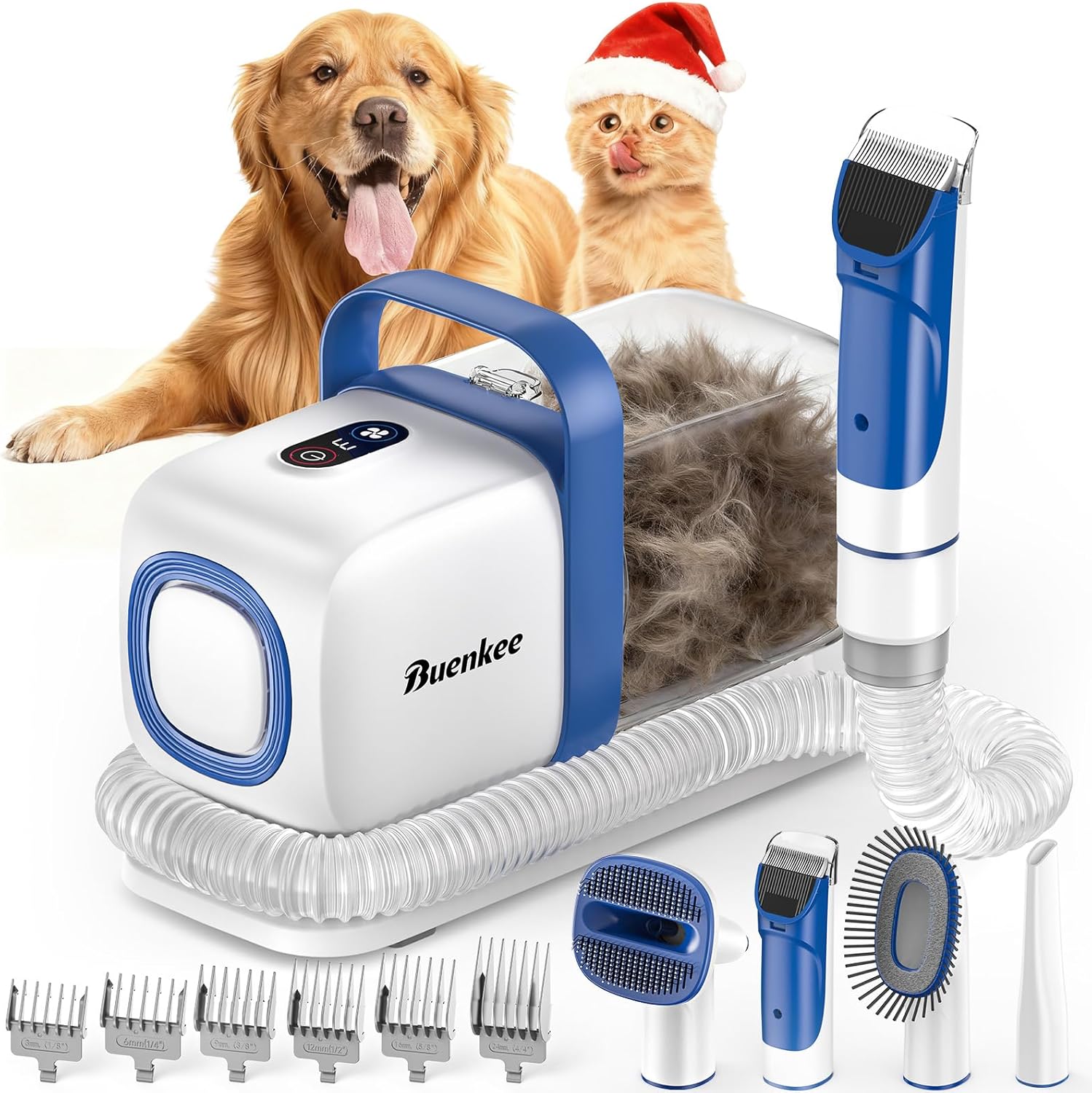 Buenkee Dog Grooming Vacuum Kit Buenkee Dog Grooming Vacuum Kit | 4.6★ | Check price |
As an Amazon Associate we earn from qualifying purchases at no extra cost to you. Ratings are shown as listed on Amazon.
As an Amazon Associate we earn from qualifying purchases.
🛒 Best Price Today on Amazon
Prime members get fast, free shipping on everything above, plus member-only deals. New members get a 30-day free trial — cancel anytime.
Before You Buy the Best Dog Clippers for Thick Fur
The best dog clippers for thick fur are almost always bought for a double coat: a soft dense undercoat beneath a coarser weather-resistant guard coat. That structure insulates against heat as well as cold, and cutting through it changes what regrows. The decision to clip should come before the decision about which machine.
Should a Double Coat Be Clipped at All?
Generally not for cosmetic or cooling reasons. The undercoat regrows faster than the guard coat after a shave, which in many dogs permanently alters coat texture and leaves a patchy, woolly finish that no longer sheds water or blocks sun. Deshedding achieves the comfort benefit without that cost.
There are genuine exceptions. Severe matting, a medical requirement, surgical preparation or a senior dog that can no longer tolerate long grooming sessions all justify clipping, and in those cases the best dog clippers for thick fur are the ones that finish the job quickly and coolly.
Deshedding First, Clipping Second
An enormous proportion of what makes a double coat feel thick is loose undercoat that has not been removed. A thorough deshedding session with a rake and a force dryer often reduces bulk more than a clip would, without touching the guard coat at all.
Clipping an undeshed coat is also harder on the machine. Packed undercoat loads the blade far more than a cleared coat does, which is why owners conclude their clipper is underpowered when the real problem is preparation. Rake, bathe, dry fully, then clip if you still need to. Preparation changes the result more than choosing between any two of the best dog clippers for thick fur on the market.
Blade Choice for Dense Coats
Longer blades are safer here. A #4F leaving roughly 9.5 mm or a #5F at about 6.3 mm preserves enough coat to retain some protection, whereas a #10 at around 1.5 mm on a double coat is effectively a shave and carries the full regrowth risk.
Skip-tooth blades feed dense hair into the cutting edge and move through thick fur noticeably faster, but the wider tooth gaps can catch skin. Use them only on flat taut body areas with the skin pulled tight, never on the face, armpits, sanitary area or on a dog likely to move suddenly. Blade selection alters the outcome more than the machine does, which is why the best dog clippers for thick fur are only half the purchase.
Heat, Volume and Session Planning
A double-coated large dog is a long job, often ninety minutes or more, and blade heat builds fast in dense fur. Two blades of the same size, a coolant spray and oiling every ten minutes are the working minimum, and testing blade temperature on your own wrist between sections is not optional.
Plan the volume too. A Newfoundland or Malamute produces enough hair to clog every vent on a vented machine, which is why vent-free housings are worth seeking out. Sweep between panels rather than working over a growing pile that the clipper keeps pulling back in.
Top Picks: 6 Clippers for Double-Coated Breeds
The best dog clippers for thick fur carry a torque feature rather than a speed record, so all six below have either a reinforced blade drive or constant speed control, since torque under load is what dense fur demands. Four are corded, which is the safer choice when a single dog may take an hour and a half.
| Model | Speed | Torque Feature | Weight |
|---|---|---|---|
| Andis Excel 5-Speed+ | 2,400-4,500 SPM | Reinforced blade drive | 12.5 oz |
| Oster A5 Turbo 2-Speed | 3,000 / 4,000 SPM | Heavy-duty rotary | Approx. 1.9 lb |
| Andis UltraEdge AGC2 Super | 3,400 / 4,400 SPM | Vent-free housing | 17.6 oz |
| Oster A6 Slim 3-Speed | Up to approx. 4,000 SPM | Slimmer grip | Full size |
| Andis Pulse ZR II | 2,500-4,500 SPM | Five-speed cordless | 17.6 oz |
| Wahl KMC+ Cordless | 3,000 / 3,700 SPM | Constant speed control | Approx. 1 lb |
Andis Excel 5-Speed+
The best all-round answer for a double coat. Five settings from roughly 2,400 to 4,500 SPM let you slow right down around the ruff and speed up across the body, and the reinforced blade drive delivering around 25 percent more blade torque is precisely the feature packed undercoat demands.
It is corded and the higher settings build heat quickly in dense fur, so a second blade is a working necessity. The five-position switch adds a component that two-speed machines do not have, and the blade drive remains a scheduled consumable.
Oster A5 Turbo 2-Speed
Descended from livestock equipment and entirely at home in a Malamute coat. Running 3,000 and 4,000 SPM, it simply does not care how dense the fur is, and its blade system is the reference standard so skip-tooth blades in every size are cheap and universally stocked.
At roughly 1.9 pounds it is the heaviest machine here and the loudest, and ninety minutes of that vibration is genuinely tiring. Nervous dogs react to it more than to brushless designs, which lengthens a job that is already long.
Andis UltraEdge AGC2 Super 2-Speed
The fastest way through a large double-coated dog at 3,400 and 4,400 SPM, and the vent-free housing matters more here than on any other coat type because of the sheer volume of undercoat in the air.
Its 17.6 ounces build real fatigue across a long groom, and it generates the most blade heat of anything on this list. On a coat this dense, working without a second blade and coolant spray risks a burn rather than merely a poor finish.
Oster A6 Slim 3-Speed
Built to address hand fatigue on exactly this kind of job. A narrower housing than the classic A5 is easier to grip across a long session, and three speeds topping out near 4,000 SPM give more control than a two-speed machine without five-speed pricing.
It is still a full-size corded professional clipper with meaningful weight and noise, and the slimmer body means slightly less mass absorbing vibration. Blade heat management is identical to any other high-speed detachable machine.
Andis Pulse ZR II
The cordless option with enough range for a genuinely thick coat: five speeds from 2,500 to 4,500 SPM and a removable lithium battery rated up to three hours, which covers a large double-coated dog in one session with margin.
At 17.6 ounces it is heavy for a cordless unit, and dense fur drains the battery faster than the rated figure suggests because the motor is loaded throughout. It is the most expensive machine here, and a spare battery should be treated as part of the purchase.
Wahl KMC+ Cordless
Constant speed control without a cable, running a brushless 3,000 and 3,700 SPM motor at around a pound. On a large dog that panics at a cord dragging across the floor, removing that variable makes a ninety-minute groom meaningfully calmer.
Runtime is the real constraint in dense fur, where the motor works continuously, so a second battery is necessary rather than optional. Its top speed is also lower than the fastest corded machines, which shows on a very large dog.
Frequently Asked Questions
These four cover what owners of double-coated breeds ask before committing to the best dog clippers for thick fur rather than sticking with brushing.
Will Shaving Keep My Dog Cooler in Summer?
Usually not, and it can make things worse. The coat insulates against heat as well as cold and shields skin from sun, so a shaved double-coated dog can be more prone to overheating and sunburn. Deshedding thoroughly removes the trapped undercoat that actually causes the problem.
Will the Coat Grow Back Normally?
Often not fully. The undercoat regrows faster than the guard coat, and in many dogs the texture and colour change permanently, producing a woolly finish that sheds water poorly. This effect varies by individual and cannot be predicted in advance.
What Blade Length Is Safest on a Double Coat?
Longer is safer. A #5F at roughly 6.3 mm or a #4F at about 9.5 mm leaves enough coat to retain some protective function, and guide combs over a short blade leave more still. Reserve a #10 for sanitary areas rather than using it across the body.
My Dog Is Badly Matted. What Now?
A short clip underneath the mat is the humane option, and a groomer or vet should assess first if the matting is severe or the skin underneath looks sore. Cutting mats out with scissors causes serious lacerations because skin tents up into the mat and is invisible from above.
See More:
- Best way to get rid of dog hair in car
- Best vacuum for hard floors and dog hair
- Best dog clippers for golden doodle
- Best small dog nail clipper
- Best dog clippers for yorkies
Final Thoughts
The best dog clippers for thick fur are worth buying only once you have established that the coat genuinely needs clipping rather than thorough deshedding, which for most double-coated breeds it does not. When clipping is warranted, choose a rotary machine with a reinforced drive or constant speed control, run two blades so you can swap as they heat, and leave the coat as long as the situation allows.



Write Your Review
No reviews yet. Be the first to share your experience!