
Best dog clippers for thick coats deserves an unusual opening caveat: for many double-coated breeds, the right answer is not to clip at all. Knowing which thick coats should be clipped and which should be deshedded saves both money and a coat that may never regrow properly. That question comes before any purchase.
Our top picks
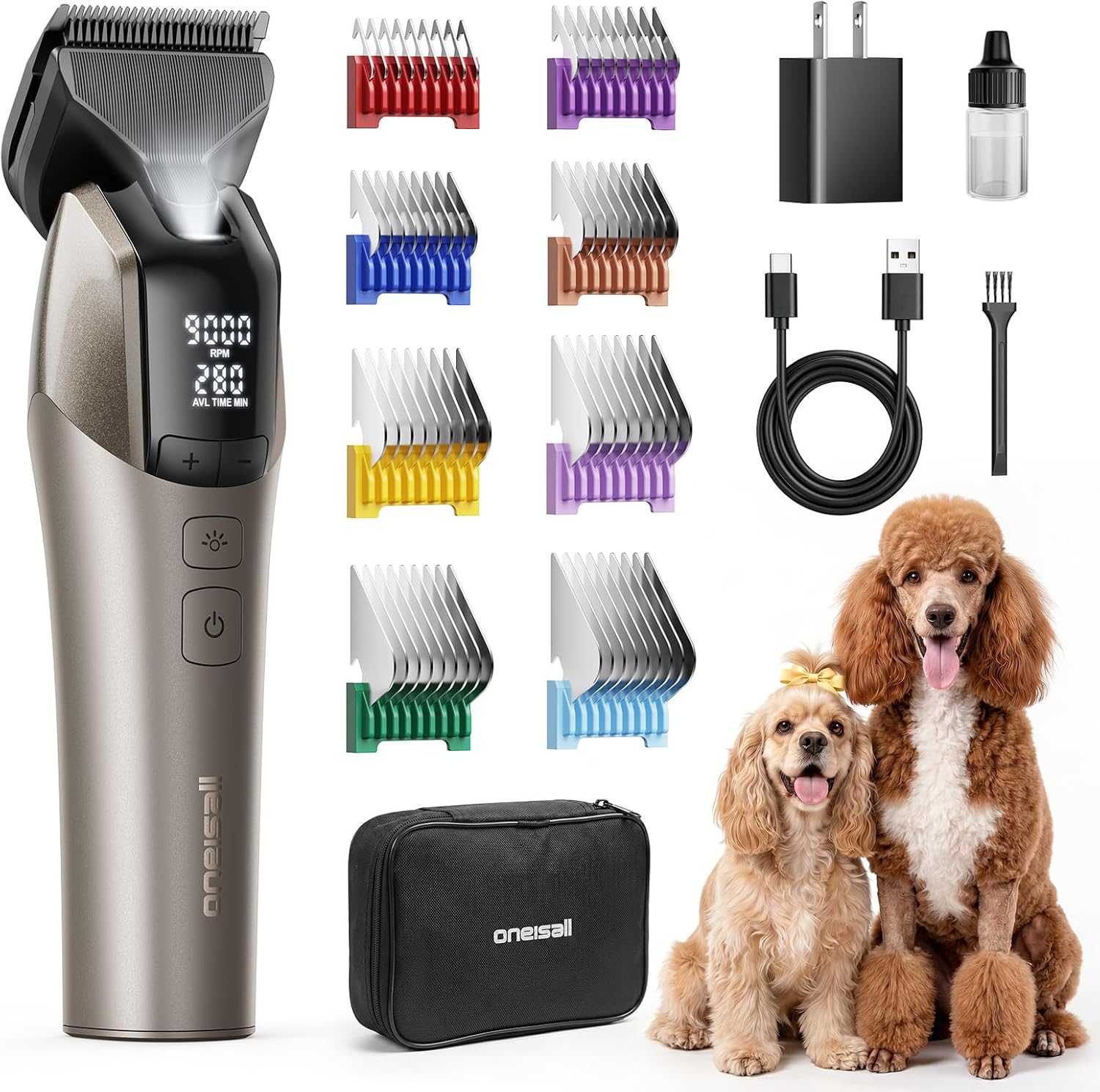
 oneisall Dog Clippers for Grooming Thick Heavy
Stainless steel detachable blade is built for thick, matted coats
2000mAh battery delivers up to 240 minutes of cordless use
IPX7 waterproof build allows direct rinsing of the whole clipper
Below 55dB noise level may still startle very sensitive pets
Ten guide combs add setup time to find the right length
 oneisall Dog Grooming Kit for Thick/Matted Hair
- Target Audience: Dog Owners
- Power Source: Battery Powered
- Are Batteries Required: Yes
Stainless steel blade is designed for thick and matted coats
IPX7 waterproof build allows direct rinsing after use
Cordless design with a locking function suits travel or outdoor use
Below 50dB noise level may still unsettle very anxious pets
Kit includes both clippers and trimmer, adding setup complexity
 oneisall Dog Clippers for Grooming Thick/Matted Hair
- [Trim Thick & Matted Fur Smoothly] oneisall Dog…
- [All in One Dog Grooming Kit-Beginners-Friendly] Oneisall 4-in-1…
- [Ultra-Quiet & Vibration-Free] Oneisall grooming kit for dogs…
 Professional Dog Clippers for Grooming Thick Curly
Brushless motor is designed for quiet operation on thick hair
Battery is rated for over 10,000 hours of lifespan
14-in-1 set includes 8 metal guide combs for varied lengths
14-piece set has many parts to track and store
Two-speed control offers less range than higher-end clippers
 oneisall Dog Clippers Grooming Kit for Dogs
Operates below 50 decibels to avoid startling sensitive pets
Includes 6 guide combs covering a range of trim lengths
One-second blade removal makes cleaning quick between uses
Long, thick coats may need a preliminary trim with scissors first
Charging-while-in-use design still ties the clipper to an outlet at times


As an Amazon Associate we earn from qualifying purchases at no extra cost to you.
As an Amazon Associate we earn from qualifying purchases.
By Laura Simmons
Laura Simmons writes about at-home pet grooming gear and coat care routines for Heads to Tails Grooming.
🛒 Best Price Today on Amazon
Prime members get fast, free shipping on everything above, plus member-only deals. New members get a 30-day free trial — cancel anytime.
Start 30-Day Prime Free Trial →See Today’s Amazon DealsHow to Choose the Best Dog Clippers for Thick Coats
Thick coats fall into two camps that behave completely differently under a clipper. Double coats with a shedding undercoat generally should not be shaved, while dense single or continuously growing coats are clipped routinely and safely by groomers everywhere. Knowing which camp your dog sits in comes first.
Double Coats and Why Shaving Backfires
A double coat insulates against heat as well as cold and shields skin from sun. Shaving removes that protection, and on breeds like Huskies, Shepherds, and Golden Retrievers the undercoat often regrows faster than the guard hairs, leaving a permanently altered texture. Regrowth texture rarely returns to normal afterwards.
Clipping to a guard length is a different matter and is sometimes necessary for matting, surgery, or on veterinary advice. If a double-coated dog seems uncomfortable in heat, thorough deshedding removes far more insulating bulk than clipping ever does. Deshedding removes far more insulating bulk than clipping does.
Coats That Genuinely Need Clipping
Poodles, doodles, Bichons, Old English Sheepdogs, and similar breeds grow hair continuously and must be clipped or trimmed regularly. These coats are dense enough to defeat home kits, which is where genuine motor torque becomes a requirement rather than a luxury. Torque becomes a requirement rather than a luxury.
Spaniels, Newfoundlands, and other heavy-coated breeds sit in between, usually trimmed rather than shaved. A groomer will tell you which category your particular dog falls into, and that conversation is worth having before buying any clipper at all. A groomer will tell you which category your dog falls into.
Torque, Stroke Speed and Heat
Whatever you clip, dense hair loads the motor continuously. Look for two-speed rotary or brushless motors that hold stroke speed under load, since a clipper that slows on the densest areas leaves uneven length and generates heat far faster. A clipper that slows down leaves uneven length behind it every time.
Blade heat is the practical limit on session length. Keep two blades of the same size, swap as one warms, and check against your wrist every couple of minutes, because thick coats reach dangerous blade temperatures faster than any other coat type. Thick coats reach dangerous blade temperatures faster than any other.
Preparation That Makes Clipping Possible
Brush and demat to the skin, then bathe and dry thoroughly with a high-velocity dryer if you have one. A clean, lifted, separated coat feeds into a blade properly, while a compacted one stalls the motor and blunts the blade within a single session. A compacted coat stalls the motor and blunts the blade quickly.
If the coat is genuinely pelted, stop and book a groomer. Clipping under a solid mat requires a very short blade worked flat against skin that has been pulled tight, and it is the situation where most serious home grooming injuries happen. Pelted coats are where most serious home grooming injuries happen.
Top Picks: Best Dog Clippers for Thick Coats
The six below all have the sustained power that dense coats demand. Confirm first that your dog’s coat should be clipped rather than deshedded, since no clipper on this list is the right answer for a healthy double coat. None of the best dog clippers for thick coats are right for a healthy double coat.
| Clipper | Power | Best For | Price Tier |
|---|---|---|---|
| Andis MVP 2-Speed | Corded, two speed | Heavy-duty home use | Mid |
| Oster Clipmaster | Corded, single speed | Very dense coats | Premium |
| Wahl KM10 | Corded, brushless | Constant speed under load | Premium |
| Andis Pulse ZR II | Cordless, two speed | Cordless power | Premium |
| Oster A5 Turbo 2-Speed | Corded, two speed | Proven workhorse | Mid |
| Heiniger Saphir Cordless | Cordless, two speed | Quiet operation | Premium |
Andis MVP 2-Speed
A robust corded clipper aimed at heavy-duty work, with enough torque for dense coats and A5 blade compatibility. It is built to run for long periods without losing speed, which is exactly what a large thick-coated dog demands from a tool. It is built to run for long periods at a time without losing speed.
It is heavier than the standard two-speed clippers and noisier than the cordless competition. The extra bulk also makes detail work around the face and feet less comfortable, so a separate trimmer usually joins it in the kit. A separate trimmer usually joins it in the grooming kit for the detail work.
Oster Clipmaster
Originally developed for livestock, this has more raw cutting power than anything else here and works through coats that stall professional pet clippers entirely. For the densest coats and for owners clipping several dogs, it simply does not slow down. For the densest coats it simply does not slow down at all.
It is large, loud, and heavy, which makes it unsuitable for anything except body work on a tolerant dog. The blade system also differs from standard A5, so blades are less interchangeable with the rest of the category. Blades are less interchangeable with the rest of the category, which matters over time.
Wahl KM10
The brushless motor holds constant speed regardless of load, which is the single most useful property on a dense coat. It runs cooler than comparable corded clippers, and the finish stays even from the first pass to the last. The finish stays even from the very first pass right through to the final one.
It is expensive and heavy, and it is more clipper than someone clipping one dog occasionally will ever need. The cable is also a nuisance around a dog that turns, particularly during the longer sessions dense coats require. The cable is a real nuisance during the longer sessions that dense coats need.
Andis Pulse ZR II
Cordless with genuine salon power, which is the combination that makes clipping a large dense-coated dog manageable without a cable underfoot. Battery life covers a full body clip, and a second battery removes any interruption entirely. It is among the best dog clippers for thick coats in cordless form.
It is expensive, and the kit includes only one blade, so the real cost is higher than the headline. The body is also heavier than lighter cordless models, which becomes noticeable during the undercarriage and leg work. The kit ships with only one blade, so the true cost is higher than it first looks.
Oster A5 Turbo 2-Speed
The salon standard for decades, with power for dense coats and the widest blade availability of any system. Its longevity is the real selling point, since parts and blades will be obtainable for as long as you own the clipper. Blades will remain obtainable for as long as you actually own the clipper.
It is loud and vibrates noticeably, which some dogs object to more than the clipping itself. Blade heat also builds quickly on dense coats, making a second blade to swap in more of a requirement than a convenience. Having a second blade ready to swap in is far more of a requirement than a convenience.
Heiniger Saphir Cordless
Quiet and low on vibration while still delivering real power, which makes it the choice for a thick-coated dog that dislikes noise. It takes A5 blades, runs a long time per charge, and the finish quality on dense hair is excellent. Quietness is really the main justification for the premium over a corded machine.
The price sits at the top of the range and the brand is less widely stocked, so spares take more arranging. For a household clipping one dog, quietness is the main justification for the premium over a corded machine. For a single dog at home, a corded machine will do the very same job for far less money.
Frequently Asked Questions
Owners of thick-coated dogs ask a consistent set of questions, and the most important one is usually whether clipping is appropriate in the first place. The most useful question about the best dog clippers for thick coats is whether the coat should be clipped at all, so these answers start with that point.
Should I shave my double-coated dog in summer?
Generally no. The coat insulates against heat and protects against sunburn, and shaving can permanently alter regrowth. Thorough deshedding removes the insulating undercoat far more effectively, and shade, water, and limited midday exercise do the rest. Shade, water, and limited midday exercise do the rest.
Which thick coats are safe to clip?
Continuously growing coats such as poodles, doodles, and Bichons need regular clipping. The best dog clippers for thick coats suit those breeds, while healthy double coats are better managed with rakes and deshedding tools than with a blade. Rakes and deshedding tools handle a healthy double coat better.
What if a double coat is badly matted?
Clipping may be the only humane option, and that is a legitimate reason to shave. A groomer or veterinarian should handle a pelted coat, and the coat may regrow with a changed texture, which is a fair trade against the pain of matting. Regrowth may change texture, which is a fair trade against pain.
How long does clipping a thick coat take?
Well over an hour for a large dog, plus brushing and drying beforehand. Splitting the session across two days is sensible for both of you, and it usually produces a more even finish than pushing to the end in one go. Splitting the session across two separate days is usually sensible for both of you.
See More:
- Best dog clippers for thick coat
- Best at home dog clippers
- Best dog clippers for poodle hair
- Best dog brush for blue heeler
Final Thoughts
The best dog clippers for thick coats need real sustained torque and careful heat management, but the first question is whether the coat should be clipped at all. Deshed a healthy double coat, clip the continuously growing ones, and ask a groomer if you are unsure. Ask a groomer whenever you are genuinely unsure.

Write Your Review
No reviews yet. Be the first to share your experience!