
Key takeaways
- Choosing by dog weight alone: Two dogs weighing 40 pounds can have very different shoulder heights and neck lengths.
- Ignoring table thickness: A tall arm is useless if its clamp cannot securely fit the table edge.
- Buying the tallest arm automatically: Excess height can create awkward leash angles and allow the restraint to pull upward.
- Forgetting table width: H-shaped arms require more lateral space than single-arm designs.
- Measuring the dog while sitting: Measure shoulder height while the dog is standing naturally.
- Using a grooming arm as a safety tether: Keep one hand on an unfamiliar, anxious, or active dog and never leave a restrained dog unattended.
- Skipping hardware checks: Inspect clamps, welds, adjustment knobs, and loops before each use. Tighten the arm only enough to secure it without damaging the table.
What's inside
The Short Answer
For most home grooming tables, choose a grooming arm that adjusts from about 24 to 48 inches (61 to 122 cm) high and clamps securely to a table that is 1 to 3 inches (2.5 to 7.6 cm) thick. This range works for small dogs, medium breeds, and many large dogs when the table height and dog’s shoulder height are considered together.
A 35-inch (89 cm) adjustable arm is a practical choice for small and medium dogs, especially on a standard table. For large dogs, a 42-inch (107 cm) arm or an H-shaped arm with a 31- to 43-inch (79- to 109 cm) width range gives more headroom and better restraint options. The correct size is not based on the dog’s body length alone. You also need to account for the table’s width, thickness, the dog’s shoulder height, and the amount of movement needed during grooming.
As an Amazon Associate we earn from qualifying purchases at no extra cost to you. Product prices and availability are accurate as of the date shown and are subject to change.

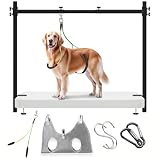

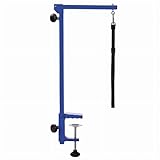
As a general rule, the grooming loop or support should sit above the dog’s head without forcing the neck upward. The arm should be tall enough to prevent the dog from stepping over or backing out of the loop, but not so tall that the restraint pulls vertically on the neck.
Standard Sizes
Grooming arms are usually sold by their maximum height, adjustment range, or overall frame width. The following sizes cover the most common home and professional setups.
| Arm type | Typical dimensions | Metric dimensions | Best for |
|---|---|---|---|
| Compact single arm | 24–35 in. high; 1–3 in. clamp opening | 61–89 cm high; 2.5–7.6 cm clamp opening | Small dogs, puppies, and narrow tables |
| Standard adjustable arm | 24–48 in. high; 1–3 in. clamp opening | 61–122 cm high; 2.5–7.6 cm clamp opening | Most small, medium, and large dogs |
| Fixed or tall arm | 35–42 in. high; 1–3 in. clamp opening | 89–107 cm high; 2.5–7.6 cm clamp opening | Large dogs and taller grooming tables |
| H-shaped arm | 42 in. high; 31–43 in. wide | 107 cm high; 79–109 cm wide | Large dogs or dogs that need extra side support |
| Foldable arm | 24–48 in. high; folds for storage | 61–122 cm high | Home grooming areas and portable tables |
Many basic arms cost approximately $25 to $55. Heavier-duty or foldable models commonly range from $75 to $90, depending on the frame, clamp, adjustment hardware, and included supports. For example, a simple 35-inch adjustable arm may be priced near $30, while an H-shaped 42-inch arm may cost about $50. Foldable Master Equipment-style arms commonly fall in the $75-to-$90 range.
Clamp compatibility matters as much as height. Some foldable arms are designed for tables at least 3 inches thick, while other clamps open less widely. Measure the table edge before ordering. A clamp that is too narrow will not attach safely, and a clamp that barely fits may loosen when the dog moves.
For a small dog under approximately 20 pounds, a 24- to 35-inch arm is normally sufficient if the table is 24 to 30 inches high. Dogs from about 20 to 60 pounds often do well with a 35- to 42-inch arm. Dogs above 60 pounds may benefit from a 42-inch arm, an H-shaped frame, or a pair of compatible grooming supports. These are starting points, not substitutes for checking the dog’s actual shoulder height and behavior.
How to Measure Your Space
- Measure the table thickness. Use a ruler or tape measure at the edge where the clamp will attach. Record the thickest point, including any lip or trim. Common grooming-table edges measure 1 to 3 inches (2.5 to 7.6 cm).
- Measure the table width. Measure from one side of the grooming surface to the other. A narrow 18- to 24-inch (46- to 61 cm) table may work best with a single arm. Wider tables measuring 30 to 36 inches (76 to 91 cm) can accommodate broader H-shaped frames.
- Measure the dog’s shoulder height. Place the dog on a level surface and measure from the floor to the top of the shoulder blades. Do not measure to the top of the head, because head position changes.
- Measure from the tabletop to the dog’s shoulders. If the tabletop is 28 inches (71 cm) above the floor and the dog’s shoulder height is 20 inches (51 cm), the shoulder level is about 8 inches (20 cm) above the table. The arm must provide enough height above this point for a comfortable loop.
- Allow headroom. Add roughly 8 to 14 inches (20 to 36 cm) above the dog’s shoulder level, depending on the dog’s neck length and grooming position. Small dogs generally need less vertical reach than tall, long-necked breeds.
- Check clamp clearance. Make sure drawers, folding legs, a wall, or a raised table edge will not block the clamp. Leave at least 2 inches (5 cm) of unobstructed edge where possible.
- Check the working radius. The dog should be centered on the table, with the arm positioned so the loop is above the shoulders rather than far behind the neck. The arm should not force the dog toward an edge.
- Confirm the rated capacity. Follow the manufacturer’s stated dog-weight and table-thickness limits. Never treat a grooming arm as a lifting device or rely on it to hold a dog that is jumping or falling.
By Room or Use Case
Small home grooming area
A compact 24- to 35-inch arm is usually easiest to use in a laundry room, bathroom, or utility area. It takes up less vertical space and fits tables with narrow edges. Choose a foldable model if the table must be stored in a closet. A 35-inch arm is a versatile choice for toy breeds, puppies, and calm dogs under about 20 pounds.
Standard home grooming table
For a dedicated table in a garage, mudroom, or spare room, a 24- to 48-inch adjustable arm provides the most flexibility. This size range can accommodate different dogs and table heights. It is also useful if a child or another adult may groom the dog from a different working position. Confirm that the clamp opens wide enough for the tabletop, particularly if the table is thicker than 2 inches (5 cm).
Large or strong dogs
Large dogs generally need more vertical reach and a sturdier frame rather than simply a longer loop. A 42-inch arm or H-shaped frame gives additional support around the dog’s body. An H-shaped design may help keep a broad dog centered, but it requires enough table width—often about 31 to 43 inches (79 to 109 cm) of adjustable span. Use a second support only when it is approved for the arm and does not restrict breathing or movement.
Portable grooming setup
For a folding table or mobile grooming station, select a foldable arm with a locking hinge and a clamp that matches the table thickness. A 24- to 48-inch adjustable range is convenient, but the folded size and storage weight also matter. Remove the arm before folding the table unless the manufacturer specifically says it can remain attached.
Professional or frequent grooming
Frequent use justifies a heavier clamp, reinforced adjustment points, and a frame that can be tightened without tools. A foldable arm in the approximately $75-to-$90 range may be preferable to a basic arm near $30 if it will be installed and removed often. Even for professional use, the arm is a positioning aid, not a substitute for supervision.
Common Sizing Mistakes
- Choosing by dog weight alone: Two dogs weighing 40 pounds can have very different shoulder heights and neck lengths.
- Ignoring table thickness: A tall arm is useless if its clamp cannot securely fit the table edge.
- Buying the tallest arm automatically: Excess height can create awkward leash angles and allow the restraint to pull upward.
- Forgetting table width: H-shaped arms require more lateral space than single-arm designs.
- Measuring the dog while sitting: Measure shoulder height while the dog is standing naturally.
- Using a grooming arm as a safety tether: Keep one hand on an unfamiliar, anxious, or active dog and never leave a restrained dog unattended.
- Skipping hardware checks: Inspect clamps, welds, adjustment knobs, and loops before each use. Tighten the arm only enough to secure it without damaging the table.
FAQ
What size grooming arm is best for a small dog?
A 24- to 35-inch (61- to 89 cm) adjustable arm is generally suitable for small dogs. Choose the lower range for a low table and a short dog, or a 35-inch arm if you want room to adjust as a puppy grows. The loop should sit comfortably above the shoulders without pressing against the throat.
Is a 42-inch grooming arm too tall?
Not necessarily. A 42-inch (107 cm) arm can be appropriate for large dogs, tall tables, or a broad H-shaped frame. It may be excessive for a tiny dog on a low table. Measure from the tabletop to the dog’s shoulders and select an arm with enough adjustment to position the loop correctly.
Can any grooming arm fit any table?
No. Check the clamp opening, table thickness, edge shape, and available clearance. Some arms require a table at least 3 inches thick, while others fit thinner edges. The clamp should sit flat and tighten fully without contacting a folding mechanism or unstable trim.
Do I need one arm or an H-shaped grooming arm?
One arm is adequate for many calm small and medium dogs. An H-shaped arm may be useful for a large, wide, or restless dog because it offers support across more of the table. It also needs a wider table and more setup space. Regardless of design, supervise the dog continuously and use only the included or approved restraint accessories.





Write Your Review
No reviews yet. Be the first to share your experience!