
Key takeaways
- Table of Contents 7 sections 10 min read 1 Quick Verdict 2 Side by Side 3 Where Single Speed Wins 4 Where Variable Speed Dog Dryer Wins 5 Cost Over 5 Years 6 Which One for Your Home 6.1 Small…
What's inside
Choosing between a single speed vs variable speed dog dryer is less about finding the most powerful motor and more about matching the dryer to your home, your dog, and your grooming routine. A single-speed model keeps operation simple: turn it on, choose the nozzle, and work at one airflow setting. A variable-speed dryer gives you more control, allowing a gentle stream for a nervous puppy or face and a stronger blast for a thick double coat.
For occasional baths, a compact single-speed dryer can be the practical choice. For multi-dog households, long-coated breeds, or owners who want one dryer that can adapt over time, variable speed is usually worth the higher price. The best decision also depends on storage space, noise tolerance, maintenance, and whether you expect to groom at home for several years.
As an Amazon Associate we earn from qualifying purchases at no extra cost to you. Product prices and availability are accurate as of the date shown and are subject to change.



Quick Verdict
Choose a single-speed dog dryer if you want a straightforward, generally lower-cost tool for occasional use and your dog tolerates a consistent airflow. It is especially suitable for small dogs, short coats, and owners who do not need fine control around sensitive areas.
Choose a variable-speed dog dryer if you groom frequently, own a large or thick-coated dog, or want to adjust airflow for different parts of the body. Variable speed is also the safer-feeling option for dogs that are anxious around grooming equipment because you can begin gently and increase power gradually.
For most homes planning to groom at least once or twice a month, variable speed offers the better long-term balance. A single-speed model remains appealing when simplicity, storage, and upfront cost matter most.
Side by Side
| Feature | Single-Speed Dryer | Variable-Speed Dryer |
|---|---|---|
| Comfort | Consistent airflow; can feel intense on small or nervous dogs | Gentle starting speed and stronger settings when needed |
| Durability | Fewer controls may mean fewer parts to wear out | Usually durable, but the speed controller adds another component |
| Price range | About $50-$150 for home models | About $80-$250 for home and heavier-duty models |
| Maintenance | Clean the filter, hose, and nozzles regularly | Same basic maintenance, with extra care around the speed control |
| Space needed | Often about 12-18 inches tall or long; compact options are common | Typically about 14-22 inches, with some heavier floor models |
| Look | Simple, utilitarian, and often easier to store discreetly | More controls and a professional grooming-tool appearance |
| Resale | Easy to sell if clean and working, though demand is limited | Can attract more buyers because it suits more coat types |
| Noise control | Limited ability to reduce the initial sound or airflow | Lower settings can make introductions less overwhelming |
| Best for | Short coats, small dogs, occasional baths, and simple routines | Thick coats, multiple pets, frequent grooming, and growing puppies |
Where Single Speed Wins
The main advantage of a single-speed dryer is simplicity. There is no need to decide which setting to use or adjust the control while holding a wet, moving dog. That straightforward operation can be useful in a laundry room, mudroom, or bathroom where grooming is an occasional chore rather than a regular salon-style routine.
Single-speed units are often lighter and less complicated than variable-speed machines. A typical home model may weigh roughly 4-10 pounds, while larger variable-speed dryers can weigh 8-18 pounds or more. The difference matters if you carry the dryer between floors or store it in a closet after every use.
They can also be less expensive. Basic single-speed force dryers commonly fall between $50 and $150, although wattage, included nozzles, heating features, and build quality affect the price. A simple model may draw approximately 1,200-2,400 watts, so check the product label and use an appropriate household outlet.
Single speed is a reasonable match for a smooth-coated dog that dries quickly. It may also work well for owners who towel-dry thoroughly first and use the dryer mainly to finish the coat. If your dog is calm and the fixed airflow is comfortable, paying for additional control may not improve the result enough to justify the expense.
There is a useful distinction between a single-speed dog dryer and unrelated single-speed products. For example, a $13.99 Bike Chain Kit and a $19.99 Bibike Single Speed Conversion Kit use “single speed” in the bicycle sense, not the pet-grooming sense. They have no bearing on how a dog dryer operates, but the terminology can be confusing when shopping online.
Where Variable Speed Dog Dryer Wins
Variable speed is most valuable when one airflow level cannot suit every dog or every part of the coat. You can start around the legs, belly, and shoulders at a lower setting, then increase the airflow over the back and rear legs. This flexibility is helpful around the ears and face, where direct, forceful air may be unpleasant.
It is also useful for acclimating a puppy or anxious adult dog. Begin with the dryer several feet away, use a lower setting, and reward calm behavior. Variable speed does not make a dryer silent, and it should not be treated as a guarantee that a fearful dog will accept grooming. It simply gives you more ways to make the introduction gradual.
Thick, curly, and double coats are another strong reason to choose variable speed. Stronger airflow can separate and lift wet hair, while a lower setting provides better control for sensitive areas and finishing work. If you have two dogs with different coat types, one adjustable dryer can replace the need for separate grooming tools.
Many variable-speed models also include temperature control. This is different from airflow control: speed changes how forcefully air moves, while temperature changes how warm it feels. For home use, airflow is often the more important feature because excessive heat can irritate skin or create hot spots. Never leave a warm dryer aimed at one area, and keep checking your dog’s comfort.
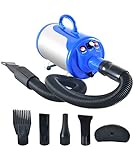
Current home options show the typical price spread. The SHELANDY Groomer Partner Pet Hair Force Dryer with Heater is listed at $75.99, while a 5.2HP/3800W pet dryer with adjustable speed and temperature control is listed at $89.99. Product labels can use different motor and wattage claims, so compare actual controls, hose length, included nozzles, dimensions, and warranty rather than relying on one headline number.
Cost Over 5 Years
Upfront price is only part of the calculation. Assume a single-speed dryer costs $90 and a variable-speed dryer costs $150. Over five years, the equipment cost works out to about $18 per year for the single-speed model and $30 per year for the variable-speed model, before electricity and replacement parts.
Electricity use depends on wattage and drying time. A 1,800-watt dryer running for 20 minutes uses about 0.6 kilowatt-hours per session. At an example electricity rate of $0.18 per kilowatt-hour, that is roughly 11 cents per session. A 3,800-watt dryer used for the same time would use about 1.27 kilowatt-hours, or approximately 23 cents at that rate. Actual costs vary by local utility pricing and how long the coat takes to dry.
A variable-speed model may reduce energy use if a lower setting shortens preparation time or lets you finish efficiently, but that is not guaranteed. Conversely, a powerful dryer can consume more electricity even if it dries a large coat faster. Plan on another $10-$30 over five years for replacement filters, depending on the model and availability. The larger financial risk is replacing a dryer early because it is uncomfortable to use, difficult to store, or poorly matched to your dog.
Which One for Your Home
Small apartment
Choose a compact variable-speed model if your dog is nervous or has a dense coat; choose single speed if your dog is small, calm, and short-haired. Prioritize a manageable sound level, a hose that reaches without moving the unit, and storage dimensions of roughly 12-18 inches. Avoid buying the highest-wattage dryer simply because it is powerful when your main limitation is noise and closet space.
Family with kids and pets
Variable speed is usually the more flexible choice. Different dogs may need different airflow, and children may be present while you are setting up or grooming. Select a dryer with stable feet, insulated controls, a flexible hose, and clear temperature settings. Store it unplugged and out of reach, and keep children away from nozzles and moving air while the dryer is running.
Rental
A single-speed dryer can make sense for a renter who wants lower upfront cost and minimal storage demands. However, variable speed is worth considering if your dog is easily startled and you need to manage noise in a shared-wall building. Groom in a washable area, use a mat to reduce slipping, and check that the dryer’s power requirements suit the outlet without using an unsuitable extension cord.
Long-term home
For a permanent grooming station, choose variable speed unless your needs are very limited. You are more likely to add another pet, adopt a different coat type, or groom more often once the equipment is easy to access. Look for a replaceable filter, sturdy hose connections, a long cord, and a warranty. A model in the $120-$250 range can be sensible when it prevents the need to upgrade later.
FAQ
Is a single-speed dog dryer powerful enough for a double coat?
It can be, provided the motor and airflow are adequate and you towel-dry first. However, a fixed setting may take longer or feel too forceful in sensitive areas. Variable speed gives you more control, but power, nozzle design, and technique matter just as much.
Does variable speed mean the dryer will be quiet?
No. A lower setting may make the airflow less overwhelming, but motor noise remains. Look for manufacturer sound information when available, introduce the dryer gradually, and never assume that an adjustable dryer is automatically apartment-quiet.
Do I need a heated dog dryer?
Usually not. Force-drying with room-temperature air is often sufficient and can reduce the risk of overheating the coat or skin. If you choose a model with heat, use the lowest comfortable setting, keep air moving, and stop if your dog pants heavily or seems uncomfortable.
What is the best choice for most owners in 2026?
A variable-speed dryer is the safer all-purpose recommendation for frequent grooming, multiple pets, and dogs with thick or sensitive coats. A single-speed dryer remains the better value for occasional use, short coats, limited storage, and owners who want the simplest possible setup.




Write Your Review
No reviews yet. Be the first to share your experience!