
Key takeaways
What's inside
Best dog clippers for goldendoodle grooming at home are only half the purchase. Blades, guide combs, shears and a way to dry the coat all matter, and a clipper bought alone usually sits unused. This guide covers the full kit, what it costs against salon visits, and six machines worth building around.
As an Amazon Associate we earn from qualifying purchases.


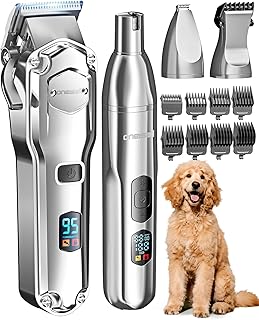


As an Amazon Associate we earn from qualifying purchases.
🛒 Best Price Today on Amazon
Prime members get fast, free shipping on everything above, plus member-only deals. New members get a 30-day free trial — cancel anytime.
How to Build Around the Best Dog Clippers for Goldendoodle Home Grooming
The best dog clippers for goldendoodle owners are part of a system, not a single tool. Owners who quit usually do so because they bought a clipper, discovered they could not reach the length they wanted, and gave up. Working out the whole kit before you buy avoids that, and it changes which clipper makes sense.
What the Full Kit Actually Costs Against Salon Visits
A doodle needs professional grooming every six to eight weeks, which is roughly seven or eight appointments a year. Against that recurring cost, a complete home kit generally pays for itself within the first year even at the professional end of the clipper range, provided you actually use it. That arithmetic is what justifies buying the best dog clippers for goldendoodle coats rather than the cheapest option.
The kit is more than the clipper. Budget for at least one spare blade, a stainless guide comb set, a slicker brush, a metal greyhound comb, curved shears for feet and face, blade oil and coolant spray. Many owners also add a force dryer, which is the single biggest quality jump after the clipper itself.
Which Blades and Combs You Genuinely Need
A #10 blade handles sanitary areas and under the belly and comes with most clippers. Add a #30 or keep the #10 as your base for guide combs, then buy a stainless comb set spanning roughly 3 mm to 25 mm. That combination, paired with the best dog clippers for goldendoodle coats you can afford, covers every haircut a doodle realistically needs.
Skip the temptation to buy a wide range of bare blades. A #7F at about 3.2 mm and a #5F at about 6.3 mm are useful for a genuine summer clip or a matted rescue, but for a maintained coat the comb set does the work and costs less than the equivalent blades.
Blade Sharpening, Drives and Running Costs
Blades dull, and a dull blade pulls hair rather than cutting it, which is the most common cause of a dog refusing to be groomed. Professional sharpening is inexpensive and restores an edge several times before the blade is finished; ceramic-edged blades stretch that interval noticeably.
Detachable-blade clippers also use a blade drive that wears. Manufacturers commonly recommend monthly replacement under professional load, which for a single dog at home usually translates to once a year or less. It is a small cost, but it is the part owners forget until the clipper starts skipping.
Learning Curve and Realistic Session Length
A first full clip typically takes 90 minutes to two hours and produces an uneven result. By the fourth or fifth attempt most owners are down to an hour with a finish they are happy with. Splitting the job across two evenings works better than pushing through one long session.
Coat prep dominates the timeline. Brushing and line-combing to the skin, bathing and fully drying can take longer than the clipping itself, and skipping any of it produces a poor cut and a blunt blade. With pet-category budgets tightening for many households, the value of home grooming only shows up if the technique is right.
Top Picks: 6 Clippers to Build a Home Kit Around
The best dog clippers for goldendoodle kits are the ones you can build around long term, meaning each of these machines meaning it takes standard detachable blades and combs, or covers detail work that a full-size clipper cannot. Two are cordless and four run on a cord.
| Model | Blade System | Power | Kit Role |
|---|---|---|---|
| Andis UltraEdge AGC2 Super | Detachable A5 | Corded, 14 ft | Primary body clipper |
| Wahl KM10 2-Speed | Detachable A5 | Corded, 14 ft | Lightweight primary |
| Andis Pulse ZR II | Detachable A5 | Cordless, 3 hr | Cord-free primary |
| Andis Excel 5-Speed | Detachable A5 | Corded, 14 ft | Variable-speed primary |
| Andis EasyClip Versa Kit | Detachable A5 | Corded | Budget starter |
| Wahl Bravura Lithium | 5-in-1 adjustable | Cordless, 90 min | Face, feet, sanitary |
Andis UltraEdge AGC2 Super 2-Speed
The fastest corded pick among the best dog clippers for goldendoodle work, at 3,400 and 4,400 SPM, which is what you want for a large body clip. The housing has no cooling vents to clog with hair, a locking switch prevents accidental shutoff mid-stroke, and the 14-foot cord gives real freedom around a table or a dog standing on the floor.
At 17.6 ounces it is heavy over a two-hour first attempt, and the high blade speed generates heat that makes a second blade close to mandatory. The recommended monthly blade drive replacement applies to professional loads rather than home use, but it is still a part that wears.
Wahl KM10 2-Speed
The lightweight primary. A brushless motor at 3,000 and 3,700 SPM with constant speed control, in a 12.3-ounce body measuring 7.5 by 2 by 1.75 inches, which is meaningfully easier on the wrist than heavier corded machines during a long session on a standard-sized dog.
Lower top speed means it moves through a heavy coat more slowly than the AGC2, and it is a US-voltage machine needing an adapter elsewhere. Constant speed control compensates on dense sections, but it will not turn a matted coat into an easy job.
Andis Pulse ZR II
The cord-free primary, with five speeds from 2,500 to 4,500 SPM, a removable lithium battery rated up to three hours and a #10 CeramicEdge blade included. For a dog that reacts badly to a cable, removing it eliminates the most common cause of a groom going wrong halfway through.
It is the heaviest cordless option at 17.6 ounces and the most expensive machine here. Long-term reliability reports are mixed enough that budgeting for a spare battery early is sensible rather than pessimistic.
Andis Excel 5-Speed
The best middle ground on this list. Five speeds from 2,500 to 4,500 SPM give you a genuinely slow setting for a nervous dog’s face and a fast one for the body, the 4×4 blade drive adds around 25 percent more blade torque, and 12.5 ounces with a 14-foot cord suits long sessions.
It is corded, and the top speeds build heat in dense coat quickly. Anti-slip housing helps grip but does not reduce the vibration a dog feels through the blade, so noise-sensitive doodles still need gradual introduction.
Andis EasyClip Versa Kit
The budget starter that still uses standard A5 blades, which means the combs and blades you buy now carry over if you upgrade later. That compatibility is what separates it from cheap proprietary-blade clippers that leave you starting from scratch.
Motor torque is well below professional grade and it slows on dense or tangled sections, which on a curly wool coat is a real limitation rather than a theoretical one. It is also louder than any brushless option here.
Wahl Bravura Lithium
Every kit needs a detail tool, and this is the one. At 7.9 ounces with a 5-in-1 adjustable blade, roughly 90 minutes of runtime and a 60-minute charge, it handles muzzle, eye corners, paw pads and sanitary areas with control a full-size clipper cannot match.
It cannot do the body. The 5-in-1 blade tops out around 2 mm and the motor is not built for dense coat, so treating it as a primary clipper is the most common mistake buyers make with it.
Frequently Asked Questions
These four come from owners partway through assembling a kit around the best dog clippers for goldendoodle grooming, usually after the clipper has arrived and the gaps in the kit have become obvious.
Do I Need a Force Dryer as Well?
Not to start, but it is the biggest single upgrade after the clipper. A high-velocity dryer blows water out of a dense coat rather than evaporating it, which cuts drying time dramatically and straightens curl enough that the clipper cuts evenly. Clipping a partially damp doodle coat produces a poor finish and dulls blades fast.
What Shears Should I Buy?
One pair of curved shears around 7 to 7.5 inches covers feet, face and the topline blend, and blunt-tipped safety shears are worth having for around the eyes. Thinning shears help blend clipper lines but are not essential in a first kit.
How Do I Avoid Clipper Lines?
Work in overlapping passes in the direction of hair growth, keep the comb flat against the coat rather than tilting it, and brush the section out between passes so the coat stands up evenly. Lines usually come from an inconsistent angle rather than from the clipper itself.
Is Home Grooming Realistic for a Full Beginner?
Yes for a maintained coat, no for a matted one. If the coat is already felted to the skin, a professional shave-down is the humane option, and home grooming starts from the regrown coat. Beginning with sanitary trims and feet before attempting a full body clip builds both skill and the dog’s tolerance.
See More:
- Best way to get rid of dog hair in car
- Best vacuum for hard floors and dog hair
- Best dog clippers for golden doodle
- Best small dog nail clipper
- Best dog clippers for yorkies
Final Thoughts
The best dog clippers for goldendoodle owners grooming at home are the ones that anchor a complete kit: a detachable A5 machine with real torque, a stainless comb set spanning 3 mm to 25 mm, a spare blade, and a light trimmer for the face. Bought that way, the setup replaces most salon visits inside a year and gives you control over length that a booked appointment never does.


Write Your Review
No reviews yet. Be the first to share your experience!