
Key takeaways
What's inside
Best vacuum for hard floors and dog hair shoppers face a specific problem: hair scatters ahead of a spinning brushroll on sealed surfaces instead of being picked up. This guide breaks down what actually solves that, then compares six machines on suction, brushroll design, bin size and runtime, including where each one disappoints.
As an Amazon Associate we earn from qualifying purchases.


As an Amazon Associate we earn from qualifying purchases.
🛒 Best Price Today on Amazon
Prime members get fast, free shipping on everything above, plus member-only deals. New members get a 30-day free trial — cancel anytime.
How to Choose the Best Vacuum for Hard Floors and Dog Hair
Hard floors punish design flaws that carpet hides, which is why the best vacuum for hard floors and dog hair is rarely the one with the biggest motor. A brushroll tuned for deep pile flings hair across tile, a poor seal lets fine dander escape, and a small bin clogs with fluff long before it looks full. These four criteria separate machines that genuinely handle both problems from ones that only market themselves that way.
Brushroll Design and Hair Tangling
Two features matter here. Soft roller heads, sometimes sold as fluffy or hard-floor heads, use a plush nylon sleeve that traps fine dust and pushes larger debris forward rather than scattering it. Combination heads with soft and stiff fin rows aim to do both jobs at once, with a small compromise on each. This component alone separates the best vacuum for hard floors and dog hair from machines that simply redistribute it.
Anti-tangle geometry is the second half. Conical or tapered brushbars spiral long hair off the end of the bar and into the airflow instead of letting it wrap, which is the single biggest maintenance difference between machines. Without it, expect to cut hair off the roller with scissors every few weeks in a double-coated household.
Suction Rating and Airflow on Sealed Surfaces
Air watts describe the combination of suction and airflow at the cleaner head, which is the number worth comparing. Premium cordless machines now sit around 240 air watts at peak, while mid-range units land considerably lower and rely on better head design to compensate. On hard floors, head sealing often matters more than the headline figure.
Automatic power adjustment is worth paying for in a shedding home. Systems that read brushbar resistance or particle counts hundreds of times a second raise power over a hair mat and drop it again on clean tile, which preserves runtime without you managing a trigger. Manual boost modes work too, they just drain the battery faster.
Bin Capacity, Filtration and Emptying
Dog hair is bulky and light, so it fills volume rather than weight. Cordless bins commonly land near 0.7 to 0.8 liters, which is a genuine constraint in a multi-dog home and usually means emptying mid-clean. Corded canisters and uprights offer several times that capacity at the cost of portability.
Filtration matters for dander rather than hair. A fully sealed system with a HEPA-grade filter keeps fine allergens inside the machine instead of venting them back into the room. Check whether the filter is washable and how long it takes to dry, since running a damp filter damages motors.
Weight, Maneuverability and Storage
A premium cordless stick weighs around 6.8 pounds assembled and roughly 4.5 pounds in handheld mode, which is manageable for stairs and furniture but tiring during a full-house clean at arm height. Canister vacuums shift weight to the floor and are far less fatiguing for large tiled areas.
Storage decides whether the machine gets used. A wall dock near the room your dog sheds in most gets picked up daily; a canister in a closet gets used weekly. In apartments, the docked cordless almost always wins on frequency even when the canister cleans better per pass.
Top Picks: 6 Vacuums for Hard Floors and Dog Hair
The best vacuum for hard floors and dog hair looks different in an apartment than in a large house, so the six below span cordless sticks, a canister, wet/dry multi-surface machines and a budget corded upright. Choosing between them mostly depends on floor area, whether you also have rugs, and how much you value not managing a cord.
| Model | Type | Key Spec | Best For |
|---|---|---|---|
| Dyson V15 Detect | Cordless stick | 240 AW, up to 60 min | Mixed floors, fine dander |
| Shark Stratos Cordless | Cordless stick | Self-cleaning brushroll | Long-hair tangling |
| Tineco Floor One S5 | Wet/dry floor washer | Sensor-based auto power | Sealed hard floors only |
| Miele Complete C3 Cat & Dog | Canister | Sealed HEPA system | Large tile and wood areas |
| Bissell CrossWave Pet Pro | Wet/dry multi-surface | Vacuums and washes | Muddy paws, spills |
| Shark Navigator Lift-Away NV352 | Corded upright | Detachable pod | Budget, large bin |
Dyson V15 Detect Cordless Vacuum
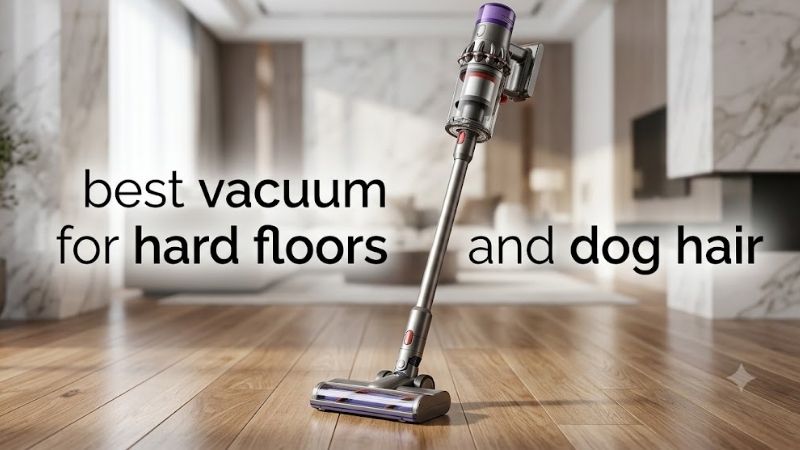
This is the strongest all-round answer, and for most readers the best vacuum for hard floors and dog hair in a mixed-surface home. Dyson rates it at 240 air watts with up to 60 minutes of runtime, an assembled weight near 6.8 pounds, and a bin around 0.77 liters. The soft roller head carries an angled green laser that makes fine dust visible on dark wood and tile.
Automatic power adjustment reads brushbar resistance hundreds of times per second and raises output over hair, which preserves battery on clean stretches. The honest drawbacks are price and bin size: 0.77 liters fills quickly with fluffy undercoat, and full-power mode cuts that 60-minute figure to a fraction of it.
Shark Stratos Cordless
Shark’s answer to hair tangling is a self-cleaning brushroll with a comb that strips wrapped strands off as the bar spins, plus a fin-and-soft-roller combination head that works on both hard floors and rugs. An odor-neutralizing cartridge in the bin addresses the smell that builds up in a dog household.
Trade-offs are real. The combination head is a compromise rather than a dedicated hard-floor roller, so it does not match a true soft roller for fine dust on tile, and the odor cartridge is a consumable you replace. In exchange, it typically costs meaningfully less than the premium tier.
Tineco Floor One S5 Wet/Dry Floor Washer
This is a different category: it vacuums and washes sealed hard floors in one pass, which suits homes where muddy paws and water bowl splashes are the daily reality. A sensor reads how dirty the water coming off the floor is and raises suction and water flow automatically when it detects a mess.
It is not a general-purpose vacuum. It cannot be used on carpet or rugs, it should not touch unsealed wood, and the dirty water tank has to be emptied and rinsed after every use or it develops an odor within a day. Treat it as a mop replacement rather than a vacuum replacement.
Miele Complete C3 Cat & Dog Canister
For large tiled or hardwood areas, a canister removes the arm fatigue that stick vacuums cause. This model pairs a sealed filtration system with a HEPA-grade filter and a bagged design, which means hair and dander go into a sealed bag rather than being shaken loose during emptying. That matters in allergy households.
The compromises are bags and bulk. Bags are a recurring cost, the canister has to be dragged room to room, and stairs are awkward. Runtime is unlimited on a cord, which is precisely why it still beats cordless machines on very large floor areas.
Bissell CrossWave Pet Pro
The CrossWave vacuums and washes simultaneously, with a tangle-free brushroll designed for pet hair and a separate dirty-water tank with a hair strainer. For homes where the mess is as much muddy paw prints and water bowl overflow as it is hair, it removes a whole second cleaning step.
It struggles as a dry-only vacuum, the brushroll needs rinsing after nearly every use, and the tanks add weight during operation. As with any wet machine, it belongs on sealed floors only, and it does not replace a proper vacuum for rugs and stairs.
Shark Navigator Lift-Away NV352
The budget entry here, and a sensible one. It is a corded upright whose canister pod detaches to become a portable unit for stairs and upholstery, with a bin several times the capacity of any cordless stick and a brushroll shutoff for bare floors, which stops the scattering problem outright.
It is heavier and noisier than the cordless options, the cord limits room-to-room speed, and hair still wraps around the brushroll because there is no anti-tangle geometry. For a large-bin machine at a fraction of premium pricing, most owners accept that maintenance.
Frequently Asked Questions
Four questions come up repeatedly from owners choosing the best vacuum for hard floors and dog hair while running a shedding breed across tile, laminate or hardwood. The answers below focus on technique and maintenance, which change day-to-day results as much as the machine choice does.
Why Does My Vacuum Scatter Hair Across Tile?
A stiff-bristle brushroll spinning at high speed on a hard surface pushes light debris forward faster than the airflow can capture it. The fix is either a soft roller head designed for sealed floors, or switching the brushroll off entirely so the machine relies on suction alone. Most scattering complaints trace back to the wrong head.
How Often Should I Clean the Brushroll?
In a shedding household, inspect it weekly and clean it monthly at minimum. Wrapped hair increases motor load, reduces suction and eventually burns out belts on corded uprights. Anti-tangle conical brushbars stretch that interval significantly but do not eliminate it, especially with long-coated breeds.
Is Cordless Powerful Enough for a Heavy Shedder?
On hard floors, yes. Sealed surfaces need far less deep-cleaning force than carpet, so head design and airflow matter more than raw motor power. The real constraint is bin volume and runtime rather than suction, which is why multi-dog homes with large floor areas often keep a canister as well.
When Is the Best Time to Buy?
Vacuums are one of the most discounted categories during Prime Big Deal Days in early October and again through Black Friday and Cyber Monday in late November. That window happens to line up with the autumn coat change in double-coated breeds, when shedding volume peaks. Buying the best vacuum for hard floors and dog hair just ahead of that season means the machine is working when the load is heaviest, and it typically costs less than it will in spring.
See More:
- Best way to get rid of dog hair in car
- Best dog clippers for golden doodle
- Best small dog nail clipper
- Best dog clippers for yorkies
Final Thoughts
The best vacuum for hard floors and dog hair is the one whose cleaner head suits your specific surfaces, with anti-tangle brushroll geometry and a bin large enough that you are not emptying it three times per clean. A premium cordless covers mixed floors most conveniently, a canister wins on large tiled areas, and a wet/dry machine only makes sense as a second machine alongside a proper vacuum.

Write Your Review
No reviews yet. Be the first to share your experience!