

Best dog nail grinder choices come down to three things that no packaging mentions: how loud the motor actually is, how much torque survives contact with a thick claw, and whether the guard traps enough dust to be bearable indoors. Five grinders are compared below on exactly those terms, drawbacks included.
As an Amazon Associate we earn from qualifying purchases.
By Laura Simmons, professional dog groomer and pet care writer
Grinding Versus Clipping
A grinder removes nail in fine dust rather than in one decisive cut, which changes almost everything about the job. It is slower, noisier and messier than a plier, and in exchange it is much harder to take too much at once. The best dog nail grinder suits some dogs enormously well and others not at all.
Why Owners Switch
The main reason is fear of the quick. Grinding removes a fraction of a millimetre at a time, so you can stop the instant the cut face starts to change colour, which makes it far more forgiving than a plier on black claws, where the quick stays invisible until the moment you have already gone too far.
The finish is the second reason. A ground nail is rounded and smooth rather than left with the sharp forward corner a clipper produces, so it snags less on carpet and scratches less on legs. For households with small children or elderly relatives, that difference is easily worth the extra few minutes it takes.
Noise and Vibration
This is where most grinders fail in practice. A dog that tolerates clippers may refuse a tool that hums and buzzes against the toe, and no amount of technique overcomes a genuinely frightened animal. Quoted decibel figures are close to meaningless in practice, so treat owner reports as much the better guide here.
Vibration matters as much as sound, because the dog feels it travelling up the leg. Lower-speed models with a well-balanced barrel are noticeably calmer in the hand. Whatever you buy, run it near your dog for several days without touching a claw at all before you ever attempt an actual trim with it.
Heat, Dust and Safety
Friction generates heat, and holding the barrel against one spot for more than a couple of seconds is genuinely uncomfortable for the dog. Work in short passes, moving constantly, and touch the nail with your own fingers every so often to check just how warm it has actually become during the session.
Long coat is the other hazard, because feathering wraps around a spinning barrel almost instantly. Pull the fur back through a thin sock or an old pair of tights with holes for the claws. Dust is entirely unavoidable, so grind somewhere that you do not mind fine keratin powder settling over everything.
Best Dog Nail Grinder Picks
The five below cover quiet models for anxious dogs, high-torque tools for thick large-breed claws, and cheap cordless options for occasional touch-ups. Each of the best dog nail grinder options here has its honest drawback set out alongside what the tool genuinely does well after several months of regular use.
| Grinder | Suits | Drawback |
|---|---|---|
| Dremel 7350 | Thick claws | Louder |
| Casfuy | Nervous dogs | Low torque |
| Oster | Small dogs | Slow on big claws |
| Wahl | Everyday use | Short battery |
| Hertzko | Occasional use | Build quality |
Dremel 7350
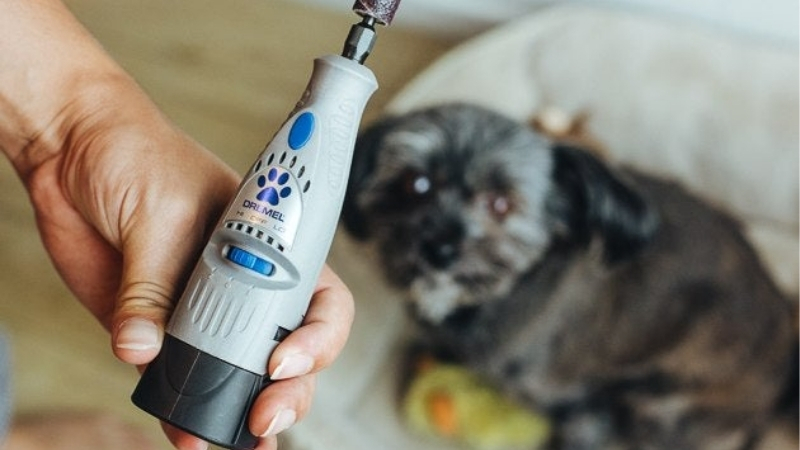
Dremel builds rotary tools for workshops and it shows here. The 7350-PET holds its speed when pressed against a thick claw instead of bogging down, the barrel is well balanced, and the battery lasts through several dogs. For a large breed with genuinely heavy claws, nothing else on this list is really comparable to it.
It is also the loudest option, and that matters more than the specification suggests with a nervous dog. The single speed is fast enough to generate heat quickly if you rest in one place, so keep the passes short. Owners of anxious small dogs should probably look a little further down this list instead.
Casfuy
Casfuy has become the default recommendation for anxious dogs, and deservedly so. The motor is genuinely quiet, the vibration through the body is mild, and the three-port guard lets you match the opening to the claw size, which stops the barrel from wandering onto bare skin at exactly the wrong moment.
Torque is the obvious compromise. Press it into a thick labrador claw and the speed drops away sharply, so the job takes noticeably longer than it would with a Dremel. For a small or medium dog it is close to ideal, and for a large one it quickly becomes an exercise in patience rather than in any real efficiency.
Oster
Oster’s Gentle Paws is a compact two-speed grinder aimed squarely at small dogs, with a light body that is easy to control at the awkward angles a toy breed offers. The guard is simple, the noise level is moderate, and it is cheap enough to make a genuinely low-risk first grinder for a hesitant owner to try.
It runs on replaceable batteries rather than a rechargeable pack, which is both an ongoing cost and a real annoyance when the power fades halfway through a session. On anything thicker than a spaniel claw it is slow to the point of real frustration, so match it honestly against the dog that you actually own.
Wahl
Wahl’s pet grinder sits in the middle of the range in every respect: reasonable torque, moderate noise, a rechargeable battery and a guard that works without being clever. For a medium dog trimmed every three weeks, it does the job perfectly well without any of the extremes at either end of this list.
Battery life is the weak point, and it fades noticeably as the tool ages rather than holding steady. Charge it fully before a session with more than one dog. The sanding bands also wear noticeably faster than the Dremel equivalents do, so factor those replacements into your overall running cost too.
Hertzko
Hertzko sells an inexpensive cordless grinder with a three-opening guard and a simple two-speed switch, which makes it a sensible way to find out whether your dog will tolerate grinding at all before spending more. For occasional tidying up between full clipper sessions it is perfectly adequate for the money involved.
Build quality is where the low price shows itself. The guard fits loosely, the barrel can develop a slight wobble over months, and the motor lacks the torque for a genuinely thick claw. Treat it as a trial tool rather than as the best dog nail grinder that you will still be using three years from now.
Grinding Questions
Grinders raise a rather different set of worries from clippers, mostly about noise, heat and how long the whole business ought to take. They come up constantly once someone has actually bought one, whichever of the best dog nail grinder options they happen to have chosen for the dog sitting in front of them.
How do I introduce it?
Slowly, and over days rather than minutes. Run the grinder across the room while your dog eats, then closer, then let it touch a paw without turning it on. Only then grind a single claw and stop there for the day. Rushing this stage is precisely why so many grinders end up sitting unused at the back of a kitchen drawer.
How long does it take?
Around ten to fifteen minutes for a full set once your dog is comfortable, which is considerably longer than clipping. Many owners split it across two evenings, doing two paws each time. That is a perfectly sensible approach and usually far less stressful for everyone involved than one long session.
Can I use a hardware rotary tool?
Technically yes, and plenty of groomers do, but the speeds on a workshop tool are far higher and heat builds much faster. If you do go down that route, use the lowest setting available and a fine band. A pet-specific guard is genuinely useful for keeping the spinning barrel well away from skin and fur.
See more:
- Best rated cat nail clippers
- Best cat nail trimmer
- Best scent dog shampoo
- Best cat nail scissors
- Best cat nail clipper
Final Thoughts
The best dog nail grinder is quiet enough that your dog tolerates it and strong enough to finish the job in reasonable time, and those two demands pull against each other. Match the best dog nail grinder to your dog’s size and nerve, introduce it slowly over days, and keep every pass short to avoid heat.
