

Best dog nail cutter shortlists usually argue about brands when the real question is mechanical: does the tool part the nail or compress it first. A crushed nail splits, flakes and hurts, and that comes down to edge sharpness and jaw alignment. Five cutters are compared below on exactly that mechanical question.
As an Amazon Associate we earn from qualifying purchases.
By Laura Simmons, professional dog groomer and pet care writer
A Clean Cut
A nail is layered keratin, closer to a laminated material than to a solid rod. Cut it with a sharp edge and the layers part together; squeeze it with a dull one and they separate, which is what produces flaking. The best dog nail cutter is defined by that one difference far more than by anything else.
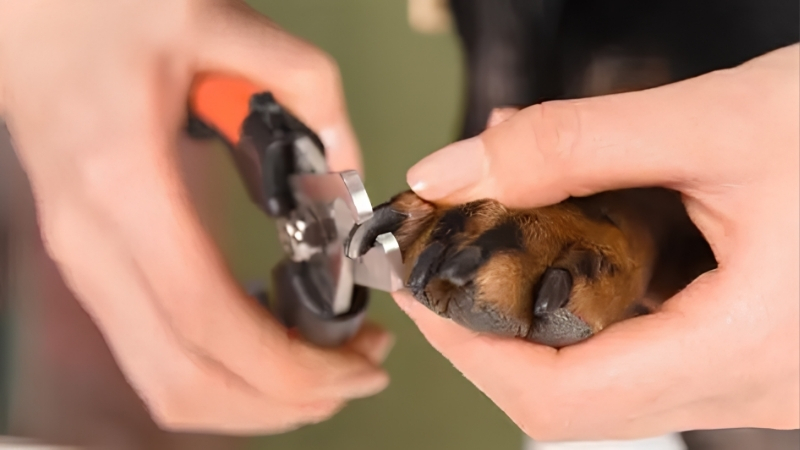
Blade Sharpness
Factory sharpness is easy to get and easy to lose. What separates a good cutter from a cheap one is how long the edge lasts under repeated loads, which depends on the hardness of the steel rather than on how keen the edge happened to feel during the first week or two of ownership, when everything cuts well.
You can hear the difference before you see it. A sharp tool makes a single clean click; a tired one produces a duller compression sound and the cut face looks rough. Once you are squeezing harder each session, whatever you paid for it, the best dog nail cutter you own has quietly stopped being one of them.
Jaw Alignment
Two blades that no longer meet squarely will crush no matter how sharp they are. Alignment goes when the pivot rivet loosens, which happens faster on tools with softer metal and thinner construction than on professional pliers built for daily salon use. Alignment is what the best dog nail cutter really sells you.
Testing it takes a second. Close the handles fully and try to move the jaws sideways against each other; any perceptible play means the blades are passing rather than meeting. That is the point at which a cutter should be replaced rather than sharpened, and certainly rather than persevered with for another year.
Cutting Angle
Nails should be cut roughly perpendicular to their length, following the natural downward angle of the claw rather than straight across the paw. Cutting flat leaves a sharp forward edge that catches on carpet and can split, which is why the finished shape of the nail matters just as much as the length you removed.
Jaw shape helps here. A concave blade cradles a rounded nail and stops it rolling out as the tool closes, which keeps the angle honest. A flat or worn blade lets the nail slide, and a slipped cut is how the great majority of accidental quick injuries actually happen at home rather than in a salon setting.
Best Dog Nail Cutter Picks
The five tools below are judged on edge retention, jaw alignment and how cleanly they leave the cut face, rather than on features. They cover thin claws through to thick large-breed nails in both plier and guillotine designs, and each entry names its honest weakness alongside the more obvious strength.
| Model | Design | Main drawback |
|---|---|---|
| Millers | Plier | No safety guard |
| Epica | Plier | Guard blocks |
| Resco | Guillotine | Blade cost |
| Hertzko | Plier | Edge softens |
| Republique | Plier | Light construction |
Millers Forge
Millers Forge remains the benchmark for exactly the reasons this article is about. The Japanese stainless blades meet squarely and keep meeting squarely, the pivot resists developing play, and thick nails part with a single clean click rather than the dull compression sound made by a tired, failing tool.
There is no guard and no safety stop, so depth of cut rests entirely on your own judgement. The plastic handles are smooth and can twist in a damp grip. Neither is a defect so much as a design choice, but together they mean the tool rewards a steady hand rather more than it ever does a hesitant one.
Epica
Epica builds a heavier stainless plier with a semicircular blade and generously sized handles. It has real heft, no flex through the jaws under load, and the alignment holds up well over time, which is precisely what you are actually paying for once you step up into the mid-price bracket for a plier.
The sliding guard is the usual complaint and a fair one: in place it obscures exactly the part of the nail you need to judge, and most owners retract it permanently. The tool is also plainly oversized for a toy breed, where the jaws hide the nail completely and the best dog nail cutter is simply a smaller one.
Resco Deluxe
Resco is the guillotine that has kept its name because the blade is replaceable rather than disposable. The ring holds the nail steady while a single blade crosses it, which suits shaky hands and gives a very tidy cut face on thin and medium nails without any real squeezing action at all on the claw.
Replaceable blades mean a running cost, and guillotine edges wear faster than plier blades because one edge does all the work. Thick large-breed nails ask more of it than it can comfortably give, and fitting the head backwards crushes rather than cuts, which catches a great many first-time owners out.
Hertzko
Hertzko sells a straightforward stainless plier with a quick guard and non-slip handles, cheap enough to keep a spare one in the car. Out of the box the alignment is good and the cut face is clean, which is a good deal more than can be said for a good many of the other tools sold at this sort of price.
The steel does not hold an edge the way the premium tools do, so after a year of regular use the cut starts to feel like a push rather than a slice. That is the honest cost of the price, and it remains a fair one provided that you replace the tool in good time rather than carry on with a blunt edge.
Pet Republique
Pet Republique offers a light stainless plier aimed at small and medium dogs, with a guard and a comfortable moulded handle. For thin nails it cuts cleanly and the reduced weight is genuinely easier to control at an awkward angle underneath a dog that simply will not hold still for very long at all.
Light construction is also the main limitation. The jaws flex on thick claws and the pivot loosens sooner than on a heavier tool, so alignment goes before the edge does. A reasonable choice for a small dog, and it is plainly the wrong choice for anything at all that has substantial weight-bearing nails.
Aftercare
Cutting is only part of the job. What you do in the minute afterwards decides whether the nail catches on carpet, splits along a layer or bleeds. None of this is at all complicated, and all of it applies whichever best dog nail cutter you happened to choose for your own particular household and dog.
Filing
Run a coarse file or an emery board across the cut face in one direction, taking off the sharp forward corner. Ten seconds a nail is plenty. It stops the nail snagging on fabric, reduces scratching on your legs and removes the small flakes that even a clean cut inevitably leaves behind on the tip itself.
Split nails
A nail that splits during cutting almost always means a dull blade compressed it first. If splitting keeps happening with a sharp tool, or the nail is flaking near the base, that becomes a veterinary question rather than an equipment one, and it is well worth having the whole paw properly looked at.
Bleeding
Press styptic powder firmly onto the tip for a couple of minutes, or else use cornflour if that is all you have to hand. It looks far worse than it is and usually stops quickly. End the session there and come back to it again tomorrow rather than pushing on through all of the remaining claws regardless.
See more:
- Best rated cat nail clippers
- Best cat nail trimmer
- Best scent dog shampoo
- Best cat nail scissors
- Best cat nail clipper
Final Thoughts
The best dog nail cutter for your household is the one that still parts nails cleanly a year from now. Judge it on edge retention and jaw alignment rather than on bundled extras, test the pivot for play every few months, and replace it without any sentiment at all the moment the cut starts going ragged.
