
Key takeaways
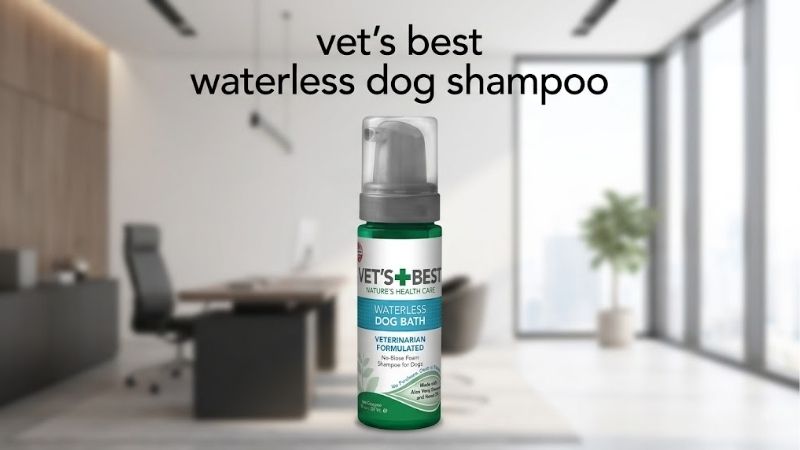
Vet’s best waterless dog shampoo turns up constantly in searches for between-bath cleaning, and it is a reasonable place to start. No-rinse products all work on the same principle, though, so it helps to understand what the category can and cannot do before choosing one. Format matters more than brand here.
Our top picks


As an Amazon Associate we earn from qualifying purchases at no extra cost to you.
As an Amazon Associate we earn from qualifying purchases.
By Laura Simmons
Laura Simmons writes about at-home pet grooming gear and coat care routines for Heads to Tails Grooming.
🛒 Best Price Today on Amazon
Prime members get fast, free shipping on everything above, plus member-only deals. New members get a 30-day free trial — cancel anytime.
Start 30-Day Prime Free Trial →See Today’s Amazon DealsHow to Choose a Waterless Shampoo Like Vet’s Best Waterless Dog Shampoo
Waterless products clean by lifting surface dirt and oils into a foam or liquid that you towel away, without ever rinsing. That makes them excellent for touch-ups and poor substitutes for a real bath, and the format you pick determines which jobs they handle well. Expectations are the main thing to set correctly.
Foam, Spray or Wipe Formats
Foams sit on the coat rather than running off, which suits thick or long hair and gives you control over how much product lands where. Sprays cover a large area quickly and suit short coats, while wipes are best for paws, faces, and small localised messes. Match the format to the coat rather than to the price.
Coat length usually decides the answer. On a dense double coat a spray struggles to reach skin level, and on a smooth short coat a foam can feel like more product than the job needs for a quick clean between proper baths. Working the product in by hand solves most of the coverage problem in either case.
Ingredients and Skin Comfort
Because nothing gets rinsed away, whatever you apply stays on the skin until the next bath. Aloe, vitamin E, and oatmeal are common and sensible additions, while heavy fragrance and alcohol are the two things worth avoiding on dogs with reactive skin. Read the ingredient list as carefully as you would for a leave-on lotion.
Check that the product is labelled for dogs and free of alcohol. Alcohol-based formulas dry quickly, which sounds convenient, but on a dog that already flakes in winter they leave the skin worse than the dirt you were removing. Alcohol-free is the single most useful thing to check on any label in this category.
What Waterless Cleaning Cannot Replace
No-rinse products remove surface dirt and reduce light odour, and that is the honest extent of it. They will not clean a genuinely muddy coat, resolve a smell coming from the skin, or substitute for a medicated bath a veterinarian has recommended. Anything beyond surface dirt still needs water and a rinse-out shampoo.
They are best thought of as maintenance between baths, particularly useful for senior dogs, dogs recovering from surgery, puppies not yet ready for a full bath, and winter months when drying a large coat properly is difficult. Winter is when most households discover how useful the category actually is.
Application Technique and Frequency
Work the product in with your hands or a rubber curry so it reaches below the surface, wait the minute or so the label specifies, then towel briskly in the direction of the coat. Rushing the towelling leaves residue that attracts dirt faster than before. A rubber curry helps more than fingers on a thick coat.
Frequency depends on skin tolerance rather than the label. Once or twice a week is fine for most dogs, but if the coat starts feeling sticky or the skin looks irritated, build-up is happening and a proper bath is overdue. Build-up is the signal to run a proper bath rather than reaching for another application.
Top Picks: Vet’s Best Waterless Dog Shampoo and Five Alternatives
The table compares the well-known option with five no-rinse products covering different formats and price points. Most owners end up with a foam or spray for the body plus a pack of wipes for paws and faces. Vet’s best waterless dog shampoo sits in the middle of a category where the differences are small.
| Product | Format | Best For | Price Tier |
|---|---|---|---|
| Vet’s Best Waterless Dog Shampoo | Foam | All-round between-bath use | Budget |
| Burt’s Bees Waterless Shampoo Spray | Spray | Short coats | Budget |
| Wahl No Rinse Waterless Shampoo | Foam | Thick coats | Budget |
| Bodhi Dog Waterless Shampoo | Spray | Sensitive skin | Mid |
| TropiClean Waterless Deep Cleaning | Foam | Odour touch-ups | Budget |
| Pet Head Dry Clean Spray | Spray | Quick freshening | Budget |
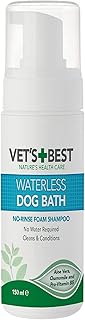
Vet’s Best Waterless Dog Shampoo
The foam format with aloe vera and vitamin E is easy to control, which is what makes this the default recommendation for most coat types. It works into a thick coat without soaking it, and the light scent fades rather than lingering for days afterwards. Control over placement is what makes a foam easier to live with.
Cleaning power is modest, as it is across the whole category, so a properly dirty dog still needs a bath. The foam also disappears from the can faster than the price suggests on a large breed, which makes it costly for regular full-body use. On a large breed the running cost adds up faster than owners expect.
Burt’s Bees Waterless Shampoo Spray
Apple and honey in a pH balanced spray make this a straightforward pick for smooth short coats where a spray can reach skin easily. It is widely stocked, gentle enough for frequent use, and among the cheapest options in the category. On a smooth short coat it is the quickest option in the whole category.
On dense or long coats the spray sits on the surface and never gets where it needs to be. Coverage is also uneven unless you work it in thoroughly by hand, which removes some of the speed advantage a spray is meant to offer. Coat length rather than price is really the deciding factor with a spray like this.
Wahl No Rinse Waterless Shampoo
The lavender and chamomile foam is alcohol free and paraben free, and it holds together well enough to work into a heavy coat before it dissipates. For thick-coated breeds this is usually the better foam of the widely available budget options. Foam holding together long enough to work in is a genuine advantage.
The fragrance is stronger than most and stays noticeable for a couple of days, which not every household enjoys. Cleaning is light, so it freshens rather than cleans, and heavy dirt still needs water and a proper shampoo. Keep it for freshening between proper baths rather than for anything genuinely muddy.
Bodhi Dog Waterless Shampoo
A short ingredient list without alcohol or harsh detergents makes this the option for dogs that react to almost everything else. It leaves very little residue, which matters most in this category since nothing is being rinsed off afterwards. Reactive skin is exactly the case this particular product is built for.
It costs more per ounce than the supermarket alternatives and cleans conservatively, so heavy grime is beyond it. Owners looking for a strong fresh scent afterwards will also find it noticeably plainer than the mainstream options. Owners who want a strong scent afterwards should look at the mainstream options.
TropiClean Waterless Deep Cleaning Shampoo
This foam leans harder on cleaning and odour control than most, which makes it the pick for a dog that smells rather than one that simply looks dusty. The scent lasts longer than the category average, for better or worse. On a dog that smells rather than one that looks dusty, it is the better choice.
That extra cleaning strength can dry skin already prone to flaking, so it suits occasional use rather than a twice-weekly routine. The sweet fragrance is also divisive among owners who prefer their dog to smell of nothing much. Occasional use suits it far better than a twice-weekly routine on dry skin.
Pet Head Dry Clean Spray
Cheap, widely available, and pleasant to use, this is the freshening spray to keep by the door for muddy paws and post-walk touch-ups. It works quickly on short and medium coats and needs no particular technique to get a reasonable result. Keeping the bottle by the door is what makes it actually get used at all.
It is the lightest cleaner here and works mainly by masking, with a strong fragrance doing much of the perceived work. On dogs with sensitive skin the scent load is worth considering before making it a regular part of the routine. Dogs with sensitive skin are better served by one of the plainer options.
Frequently Asked Questions
Owners considering no-rinse products ask a consistent set of questions, mostly about how far these can be pushed before a proper bath becomes unavoidable. People searching for vet’s best waterless dog shampoo usually want to know how far a no-rinse product can be pushed, so these answers set the limits.
How often can I use a waterless shampoo?
Once or twice a week suits most dogs. Because nothing is rinsed away, product accumulates on the coat, so if the hair starts feeling sticky or the skin looks irritated it is time for a bath rather than another application. A sticky-feeling coat is the clearest signal that the build-up has gone too far.
Does waterless shampoo actually clean?
It lifts surface dirt and oil and reduces light odour, which is genuinely useful between baths. Vet’s best waterless dog shampoo and every alternative here work the same way, and none of them substitute for water and a rinse-out shampoo on a dirty dog. Treat it as maintenance rather than as a replacement for bath day.
Is it safe for puppies and senior dogs?
Generally yes, provided the product is labelled for dogs and free of alcohol. It is particularly useful for puppies too young for a full bath and for senior or post-surgical dogs where standing in a tub is difficult or inadvisable. Check with your veterinarian before using anything near a fresh surgical site.
Can I use it on the face?
Use wipes rather than a foam or spray around the eyes, ears, and mouth, and keep any product away from the eyes themselves. A damp cloth handles most facial cleaning and avoids the residue that no-rinse formulas inevitably leave behind. Wipes give you far more control around the eyes and ears than any spray.
See More:
- Best dog brush for havanese
- Best dog brush for boxers
- Best brush for matted dog hair
- Best dog shampoo and conditioner for yorkie
- Best dog shampoo for human allergies
Final Thoughts
Vet’s best waterless dog shampoo is a sensible default in a category where the products are more alike than different, with format and skin tolerance mattering more than brand. Use it for touch-ups between baths, and give the coat a proper wash when it needs one. Format and skin tolerance decide the rest.
Write Your Review
No reviews yet. Be the first to share your experience!