
Our Top Picks
 SENTRY PET CARE Sentry Hairball Relief for Cats4.4 Ounce (Pack of 1)1.5 x 1.88 x 7 inches0.3 poundsCheck on Amazon
 Greenies Feline Smartbites Healthy Indoor Cat Treats2.1 Ounce (Pack of 1)1.25 x 4.5 x 7 inches0.1 poundsCheck on Amazon
 Vet's Best Cat Hairball Relief Chewable Tablets60 count2.25 x 2.25 x 4.5 inches0.3 poundsCheck on Amazon

Every groomer knows the sound: a cat hunched over, hacking, until a soggy tube of fur lands on the rug. Hairballs form because cats swallow loose hair while grooming themselves, and that hair can gather in the stomach instead of passing through the digestive tract. Long-haired breeds and heavy shedders produce them most often, but any cat that grooms can bring one up now and then. Regular brushing removes loose fur before it gets swallowed, and the remedies in this guide handle the hair that still gets through.
The five picks below cover the main remedy forms sold for cats: a classic malt paste, fiber-focused treats, chewable tablets, a paw gel built on oils and psyllium, and a liquid drop formula. Each listing takes a slightly different route, from lubricating the digestive tract to adding fiber or supporting skin and coat health so less hair is shed in the first place. One plain note before the picks: a remedy is for routine hairball care only. If a cat keeps vomiting, stops eating, seems lethargic, strains without producing anything, or cannot keep food down, that cat needs a veterinarian, not another dose of paste.
As an Amazon Associate, we earn from qualifying purchases.
Quick answer
For most cats, the Sentry Petromalt paste is the pick to try first: a malt-flavored tube remedy with mineral oil and petrolatum, given once a day on a paw or into the mouth. Cats that refuse pastes are better served by the Greenies SmartBites treats or the Vet’s Best chewable tablets, while the Nutri-Vet paw gel and HomeoPet drops suit owners who prefer a gel or a liquid.
Sentry Petromalt Hairball Relief for Cats
The Sentry listing, sold as Sentry HC Petromalt, is the traditional malt paste format: a 4.4-ounce squeeze tube of malt-flavored remedy (model SEN11102) that you shake well, then squeeze a small amount onto your cat’s paw or directly into the mouth. The listing’s directions say that, for best results, it is given once a day, which makes it the simplest routine in this roundup to keep up.
Its ingredient list, as printed on the listing, reads like the classic petrolatum-style recipe: corn syrup, barley malt extract, mineral oil, petrolatum, glycerin, water, hydroxylated lecithin, fish oil, guar gum, citric acid, xanthan gum, and tocopheryl acetate. The mineral oil and petrolatum are the lubricating core of this style of remedy, the barley malt extract supplies the malt flavor in the product name, and the fish oil sits alongside them in the formula. Because the listing publishes the full ingredient panel, owners who avoid particular ingredients can check it before ordering.
Choose the Sentry tube if you want the straightforward, once-daily paste that this category was built on, in a malt flavor many cats accept from a paw. Skip it if your cat will not lick anything off a paw and cannot be dosed by mouth, or if you would rather avoid mineral oil and petrolatum entirely; the chew, treat, and drop picks below take different approaches.
Greenies Feline SmartBites Healthy Indoor Cat Treats
The Greenies pick is the food-format option: a 2.1-ounce pack of chicken-flavor treats (model 10153213) made for indoor cats. The Amazon listing files this exact pack under the Hairball Control style, and its product information names hairball control as the specific use, so this is the hairball-specific version of the SmartBites line rather than the skin and fur or kitten variants sold under the same brand.
Because the remedy arrives as a treat, there is no tube to squeeze and no paw to smear. That matters for cats that bolt at the sight of a paste tube and for owners who want hairball care folded into the normal treat routine. The small 2.1-ounce pouch is a sensible first bag if you are checking whether your cat will eat them at all; larger tubs and multipacks of the same line appear on Amazon for households that go through them quickly.
Choose the Greenies treats if your cat is treat-motivated and you want the lowest-effort daily format here. Follow the feeding directions on the pack, since treats still add up in a cat’s day. Skip them if your cat needs a stricter calorie plan, is on a limited-ingredient diet that a chicken treat does not fit, or ignores crunchy treats in favor of lickable foods.
Vet’s Best Cat Hairball Relief Digestive Aid
Vet’s Best takes the supplement route with a bottle of 60 chewable tablets in a classic chicken flavor. The listing describes the formula as vet formulated and built on a blend of plant-based ingredients, positioned as a digestive aid that supports healthy digestion while helping with hairballs. That framing sets it apart from the lubricant-style picks: instead of coating the digestive tract with oils or petrolatum, this one is presented as daily digestive support in tablet form.
The chewable tablet format suits cats that will take a small tablet as a treat or crumbled into food, and a 60-count bottle keeps the routine going for a while without frequent reorders. The brand also sells a 180-count version of the same formula on Amazon, which the listing shows as the larger size of the same product.
Choose Vet’s Best if you prefer a plant-based, tablet-style supplement and want to avoid pastes and gels altogether. Skip it if your cat refuses anything tablet-shaped even when it is flavored, or if you want the lubricating action of a petrolatum or oil remedy instead; the Sentry paste and Nutri-Vet gel cover that ground.
Nutri-Vet Hairball Paw Gel for Cats
Nutri-Vet’s entry is a 3-ounce tube of salmon-flavor paw gel (model 50403-1), and the listing marks it as not discontinued by the manufacturer. The directions are simple and printed on the listing: for cats six weeks of age or older, apply a quarter teaspoon of the gel to the cat’s paw once or twice daily, and continue as needed. The cat then licks the gel off during normal grooming, which is the delivery trick behind every paw gel.
The ingredient panel mixes oils with a fiber source: hydrogenated vegetable oil, soybean oil, corn oil, ascorbic acid (vitamin C), catnip extract, cetyl alcohol, salmon flavor, lecithin, malt syrup, polysorbate 60, psyllium, sodium stearoyl lactylate, stearic acid, water, and xanthan gum, with preservatives including methylparaben, potassium sorbate, and sodium benzoate. The product title also names coconut oil among its oils. That oil-and-psyllium mix gives this gel a different profile from the petrolatum pastes: part lubricant, part fiber supplement, with catnip extract in the mix as well.
Choose the Nutri-Vet gel if the paw-lick method works in your house and you want a salmon flavor rather than malt. Skip it if your cat wipes gel off onto furniture instead of licking, or if you need a remedy with no oils at all; the Vet’s Best tablets and HomeoPet drops are the oil-free formats in this guide.
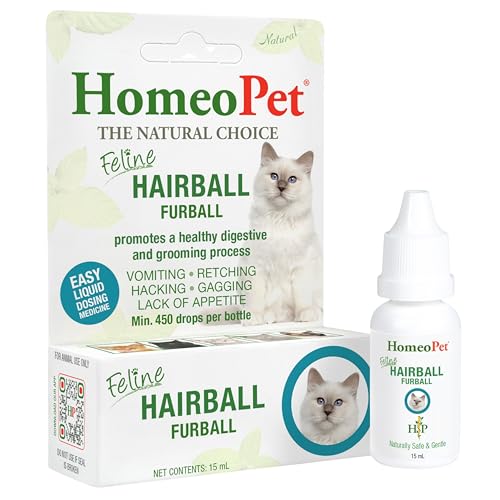
HomeoPet Feline Furball
HomeoPet Feline Furball is the liquid option, a 15-milliliter bottle of drops that the listing presents as a homeopathic supplement for cats. There is no tube and no treat: the listing’s directions say to dose it directly into the cat’s mouth, in water, or at meal or snack time, three times a day. For cats that reject every solid format, a few drops in water or on food is the least confrontational routine here.
The listing prints its full formula. Each bottle contains equal parts of Alfalfa 3X, Althaea 3X, Carbo vegetabilis 6X, Cucurbita pepo (semen) 3X, Linum usitatissimum 3X, Nux vomica 8X, Olea europaea (flos) 3X, Ornithogalum 3X, Sulphur 9X, Triticum 3X, and Ulmus fulva 3X, in a base of 10 percent USP alcohol, vegetable glycerin, and purified water. The listing notes that the formula includes olive oil and flaxseed among its sources. Read that panel closely if the alcohol base or any botanical ingredient matters to you, and treat the product as what its listing says it is: a homeopathic preparation, dosed by drops rather than by the spoonful.
Choose HomeoPet if you want a liquid you can add to water or food and your cat defeats every paste, treat, and tablet. Skip it if you prefer a conventional lubricant or fiber remedy with a familiar ingredient style, or if three-times-a-day dosing does not fit your schedule.
How to choose
Match the form to the cat first. Paste and gel picks only work if the cat will lick a paw or accept a dose by mouth, treats and chewable tablets only work if the cat will eat them, and drops only work if you can dose three times a day. A remedy that fits the cat’s habits beats a stronger formula that never gets given.
Next, decide which approach you want. The Sentry paste and, in part, the Nutri-Vet gel follow the lubricant route, built on mineral oil, petrolatum, or vegetable oils. The Greenies treats and Vet’s Best tablets lean on fiber and digestive support. The HomeoPet drops are a homeopathic liquid, a different category entirely, so weigh them on that basis rather than comparing ingredient amounts across forms.
Then read the full ingredient panel on the listing before ordering, especially for cats with food sensitivities, and follow each listing’s directions for amount and frequency rather than borrowing a schedule from another product. Pair any remedy with grooming: brushing a long-haired cat several times a week removes loose fur at the source and is the one habit that reduces how much hair gets swallowed at all. Finally, keep the vet rule in view. Hairballs that come with repeated vomiting, appetite loss, lethargy, or unproductive retching are a medical problem, and no product in this guide is a substitute for an examination.
Who should skip
Skip this whole category and book a vet visit if the hairballs are frequent and new, if vomiting continues between episodes, or if your cat has lost weight or appetite. Those signs can point to skin disease, food intolerance, or a blockage, and a remedy would only delay the diagnosis.
Skip pastes and gels if your cat cannot be handled around the mouth or paws and reacts badly to restraint; the stress of dosing can be worse than the hairball, and the treat, chew, or drop formats exist for exactly that cat. Skip the treats if your cat is on a measured diet where extra snacks are already accounted for elsewhere. Skip the HomeoPet drops if you are not comfortable with a homeopathic product or with its listed alcohol base. And skip any single product whose listing ingredient panel includes something your veterinarian has told you to avoid.
Frequently Asked Questions
How often should a cat get a hairball remedy?
Follow the directions printed on the listing for the product you buy, because the schedules differ by form. The Sentry paste listing says once a day for best results, the Nutri-Vet gel says a quarter teaspoon once or twice daily, and the HomeoPet drops say three times a day. Treats and tablets carry their own feeding directions on the pack or bottle.
Can a remedy replace regular brushing?
No. Every form here deals with hair after it has been swallowed. Brushing removes loose fur before the cat grooms it off, which is why groomers treat brushing as the foundation and a remedy as the backup. For long-haired cats, several short brushing sessions a week make the biggest difference to how many hairballs form.
When is a hairball a reason to see a veterinarian?
When it stops being an occasional event. Repeated vomiting, retching that produces nothing, loss of appetite, lethargy, constipation, or a swollen or painful belly all call for a veterinarian rather than a remedy. A cat that cannot keep food down needs an examination, since those signs can indicate a blockage or another illness.
Are pastes, gels, treats, chews, and drops interchangeable?
They are different formats with different ingredient styles, so treat them as alternatives, not equivalents. Pastes and paw gels are usually lubricant based, treats and chewable tablets lean on fiber and digestive support, and the HomeoPet liquid is a homeopathic preparation. Pick one form, follow its own listing directions, and give it time before judging it.
Final verdict
The Sentry Petromalt paste is the default recommendation: a full ingredient panel on the listing, a once-a-day routine, and the classic malt-and-petrolatum formula in a 4.4-ounce tube. Treat-driven households should go with the Greenies SmartBites, supplement-minded owners with the Vet’s Best tablets, paw-gel fans with the Nutri-Vet salmon gel, and anyone whose cat defeats every solid format with the HomeoPet drops. Whichever form you choose, keep brushing, follow the listing’s directions, and let a veterinarian handle any cat whose symptoms go beyond the odd hairball.
Product and ASIN Reference
| Product | ASIN |
|---|---|
| Sentry Petromalt Hairball Relief for Cats, Malt Flavor, 4.4 oz | B000255UYY |
| Greenies Feline SmartBites Healthy Indoor Cat Treats, Chicken Flavor, 2.1 oz | B008FXKOKK |
| Vet’s Best Cat Hairball Relief Digestive Aid, 60 Chewable Tablets | B0002I9O84 |
| Nutri-Vet Hairball Paw Gel for Cats, Salmon Flavor, 3 oz | B0051HQOPC |
| HomeoPet Feline Furball, 15 mL | B07G4LG93B |
FAQ
How often should a cat get a hairball remedy?
Can a remedy replace regular brushing?
When is a hairball a reason to see a veterinarian?
Are pastes, gels, treats, chews, and drops interchangeable?
More from Amazon
Programs that pair well with the guide above. Offers and eligibility are set by Amazon and may change.
Set up recurring deliveries of everyday items on eligible products. Terms and savings are set by Amazon.
Explore Subscribe & SaveFree shipping on eligible items, Prime Video and more. Eligible new members can start with a free trial.
Start a Prime free trialA Prime membership for ages 18-24 with a trial period. Eligibility is set by Amazon.
See Prime for Young AdultsAudiobooks and podcasts to listen to on the go. Eligible new members can start with a free trial.
Try Audible freeAs an Amazon Associate we earn from qualifying purchases.





Write Your Review
No reviews yet. Be the first to share your experience!