
Key takeaways
- Blade interface: The hinge, latch, and drive socket should align with your clipper without forcing or wobbling.
- Tooth configuration: Full-tooth or finishing blades are generally easier to use for an even body finish. Skip-tooth blades can help start a coat or move through thick hair, but they demand more care around loose skin and folds.
- Tooth spacing: Closely spaced teeth can clog in a dense or dirty coat. Wider spacing may move more hair but can leave a less uniform finish.
- Edge alignment: The moving cutter should sit evenly across the stationary blade. Uneven gaps, bent teeth, or rough edges are return-worthy defects.
What's inside
- Decide These 3 Things First
- Blade Size: Start With the Finished Length
- Material: Steel or Ceramic?
- Construction: Compatibility and Tooth Design
- Comfort and Performance: Heat, Noise, and Handling
- Price Tiers: What Should You Spend?
- Warranty and Replacement Support
- Delivery and Assembly: What to Verify Before Ordering
- Spec Checklist
- Red Flags
- FAQ
Choosing a dog clipper blade by number alone is an easy way to get the wrong finish. A lower number does not always mean a better blade, and a blade labeled “10” may be unsuitable for a fluffy coat, a nervous dog, or a close sanitary trim if you do not understand the measurement. Buyers also commonly confuse a detachable blade with a snap-on comb, overlook clipper compatibility, or assume ceramic automatically means sharper.
- Decide These 3 Things First
- Blade Size: Start With the Finished Length
- Material: Steel or Ceramic?
- Construction: Compatibility and Tooth Design
- Comfort and Performance: Heat, Noise, and Handling
- Price Tiers: What Should You Spend?
- Warranty and Replacement Support
- Delivery and Assembly: What to Verify Before Ordering
- Spec Checklist
- Red Flags
- FAQ
The right choice depends on the coat length you want, the clipper you own, and how much heat, maintenance, and replacement cost you can accept. This guide explains how to choose dog clipper blade size for home grooming in 2026, with practical numbers and buying criteria that matter more than marketing language.
As an Amazon Associate we earn from qualifying purchases at no extra cost to you. Product prices and availability are accurate as of the date shown and are subject to change.


Decide These 3 Things First
- Choose the finished coat length. A #10 blade leaves approximately 1.8 mm of hair, while a #7F or #7FC leaves about 3.2 mm. A #5F generally leaves about 6.3 mm. These are close-cut grooming lengths, not fluffy pet-hair lengths.
- Check your clipper system. Detachable blades for Andis, Oster A5-style, and Wahl professional clippers are often interchangeable, but you still need to confirm the exact model and blade format. Adjustable clippers use a different blade system.
- Match the blade to your skill and the dog’s tolerance. A close blade exposes the skin more readily and leaves less room for uneven technique. For many owners, a medium blade plus snap-on combs is more versatile than buying several short blades.
Blade Size: Start With the Finished Length
Blade numbers generally work in reverse: the smaller the number, the longer the cut. Common detachable-blade measurements are approximate because manufacturers can vary slightly:
| Blade | Approximate cut length | Typical use |
|---|---|---|
| #10 | 1.8 mm | Sanitary areas, paw pads, and close trims |
| #7F or #7FC | 3.2 mm | Short body trims and dense coats |
| #5F | 6.3 mm | Shorter all-over trims with more coverage |
| #4F | 9.5 mm | Longer body finish where available |
The “F” usually indicates a full-tooth finish blade, which leaves a more even, finished surface than a skip-tooth design. “FC” is commonly used for a similar finishing configuration. A #10 is not a good default for an entire dog unless you specifically want a very short trim and understand how to avoid skin irritation, clipper marks, and accidental nicks.
For a first purchase, consider a #7F or #5F for the body and a #10 for limited detail work. Never use a close blade over mats without first removing or carefully loosening them; pulling tightly against the skin can make a short blade more hazardous.
Material: Steel or Ceramic?
Most detachable blades use a steel cutting edge, while ceramic versions replace part of the moving cutter with a ceramic component. Ceramic cutters are often marketed as running cooler, and they can reduce heat transfer during extended grooming. However, no blade remains cool indefinitely. Friction, coat density, clipper speed, and lubrication still matter.
Steel is usually the economical choice and is easy to sharpen or replace. A standard steel #10 blade commonly costs about $10 to $25, depending on brand and finish. Ceramic blades generally cost about $20 to $40. A ceramic cutter may be worthwhile if you groom several dogs, work through dense coats, or want a second cutter for rotation.
Look for stainless or corrosion-resistant steel, a clearly stated blade size, and a replacement cutter that can actually be purchased separately. Ceramic is brittle compared with steel: dropping the blade can chip the cutter or damage the alignment. Neither material eliminates the need to stop, check temperature, brush out hair, and apply clipper oil as directed.
Construction: Compatibility and Tooth Design
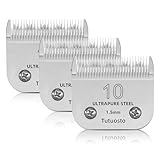
Compatibility is more important than a low price. Confirm that the blade is a detachable A5-style blade if your clipper accepts that format. The product listings for the 3 Pack 10 Clipper Blade Compatible with Andis, Wahl, and Oster Dog Clippers, the Tutuosto 10 blade, and the 7FC and 10 ceramic blades all emphasize compatibility with major professional systems, but a buyer should still compare the listing with the clipper manual.
Inspect these construction details:
- Blade interface: The hinge, latch, and drive socket should align with your clipper without forcing or wobbling.
- Tooth configuration: Full-tooth or finishing blades are generally easier to use for an even body finish. Skip-tooth blades can help start a coat or move through thick hair, but they demand more care around loose skin and folds.
- Tooth spacing: Closely spaced teeth can clog in a dense or dirty coat. Wider spacing may move more hair but can leave a less uniform finish.
- Edge alignment: The moving cutter should sit evenly across the stationary blade. Uneven gaps, bent teeth, or rough edges are return-worthy defects.
A blade should slide onto the clipper with firm, smooth resistance and lock securely. Do not modify the hinge or use a blade that rattles. Compatibility claims are not a substitute for checking the clipper model.
Comfort and Performance: Heat, Noise, and Handling
For home grooming, comfort often matters more than theoretical cutting speed. Professional clippers commonly use motors in the approximate 35- to 45-watt range, while lighter cordless models may list lower electrical ratings or battery voltage instead. A powerful clipper can move through a coat efficiently, but it can also transfer more vibration and heat if the blade is dirty or poorly lubricated.
Blade weight is usually modest—roughly 3 to 5 ounces for many detachable blades—but the complete clipper may weigh 1 to 2 pounds. That difference becomes noticeable during a 30- to 60-minute grooming session. A ceramic blade can reduce the frequency of heat-related pauses, but plan to check the blade against the inside of your wrist every 5 to 10 minutes during continuous use. If it feels hot to you, stop and change blades or allow it to cool.
For a nervous dog, a quieter clipper and shorter sessions may be more useful than a premium blade. Brush and dry the coat first, work in small sections, and stop if the dog is struggling. Blades do not replace safe restraint, calm handling, or professional help for severe matting.
Price Tiers: What Should You Spend?
Blade pricing usually falls into three practical levels:
- Budget, about $10 to $18 per blade: Suitable for occasional grooming and basic detail work. Expect fewer extras and potentially more variation in finish or durability.
- Midrange, about $18 to $35 per blade or $30 to $50 for a multipack: A sensible category for regular home grooming. Multipacks can lower the per-blade cost and let you rotate blades as they warm.
- Premium, about $35 to $60 per blade: Often includes ceramic components, tighter manufacturing tolerances, or professional-grade finishing. The price is easier to justify if you groom frequently or need consistent results.
For comparison, the listed examples include a $32.99 three-pack of #10 blades, a $13.99 Tutuosto #10 blade, and $32.38 ceramic options in #7FC and #10 sizes. The key question is not simply which one costs less. Compare the number of blades, material, tooth style, return policy, and whether the product is the correct size for your intended trim.
Warranty and Replacement Support
A blade is a wear item, so warranty coverage is usually more limited than it is for the clipper itself. Look for a clearly stated return window of at least 30 days and a manufacturer or seller willing to address chipped ceramic, bent teeth, missing parts, or a blade that does not fit the advertised system.
Also check whether replacement cutters are available. A detachable blade may last months or years with occasional use, but frequency, coat type, dirt, and maintenance can shorten its useful life. Sharpening commonly costs about $8 to $20 per blade, while a replacement budget blade may cost less than sharpening. Ceramic components may not be practical to sharpen through every service, so confirm the replacement process before buying a premium model.
Delivery and Assembly: What to Verify Before Ordering
Dog clipper blades do not require assembly, but they do require correct delivery and inspection. Confirm the package includes the stated number of blades, the correct #10 or #7FC size, and any blade oil or case promised in the description. A multipack is only a value if all blades are usable and match the listing.
When the package arrives, inspect the teeth under good light before attaching the blade. Check for chips, bent teeth, excess oil, loose screws, or a warped base. Test the fit with the clipper turned off. If shipping protection is minimal, photograph damage before requesting a replacement. Avoid using a damaged blade even for a quick trim.
Spec Checklist
| Spec | Budget | Mid | Premium |
|---|---|---|---|
| Typical price | $10–$18 | $18–$35 | $35–$60 |
| Common material | Chrome-plated or stainless steel | Hardened steel | Steel with ceramic cutter |
| Useful sizes | #10, about 1.8 mm | #7F/#7FC, about 3.2 mm | #5F to #10, depending on coat plan |
| Best for | Occasional detail trimming | Routine home grooming | Frequent or multi-dog grooming |
| Weight target | About 3–5 oz | About 3–5 oz | About 3–5 oz |
| Must-have support | 30-day returns | Returns and replacement cutter availability | Warranty, replacement parts, and sharpening guidance |
Red Flags
- The listing gives a blade number but no cut length in millimeters.
- It claims universal compatibility without naming the detachable-blade system.
- There are no close-up photos of the teeth, hinge, or underside.
- The seller promises a “cool” blade with no guidance about lubrication or cooling breaks.
- The product has an unusually low price but no clear return policy.
- The blade arrives with chipped teeth, a loose hinge, rust, or uneven alignment.
- The description recommends one close blade for every coat, body area, and dog.
FAQ
What blade size is best for a beginner?
A #7F or #7FC, approximately 3.2 mm, is often a more forgiving body-trim choice than a #10. Keep a #10 for paw pads and sanitary areas, and use snap-on combs when you want more length.
Is a #10 blade too short for a dog’s whole body?
Not necessarily, but it leaves only about 1.8 mm and requires careful technique. It may be unsuitable for dogs with delicate, irritated, thin, or very loose skin. Ask a professional groomer or veterinarian for guidance when skin problems or severe mats are involved.
Are ceramic dog clipper blades better?
They can be useful because the cutter may manage heat well during longer sessions, but ceramic is not automatically sharper or safer. Proper fit, cleaning, lubrication, and regular temperature checks still determine performance.
How often should I replace a dog clipper blade?
There is no universal schedule. Replace or sharpen it when it pulls hair, leaves uneven tracks, develops visible damage, or heats unusually fast despite cleaning and oiling. Occasional home users may go many months between services, while frequent groomers may need attention much sooner.


Write Your Review
No reviews yet. Be the first to share your experience!