
Key takeaways
What's inside
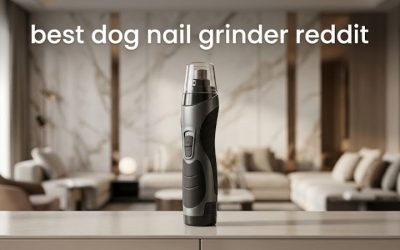
Best dog nail grinder picks share two things nervous dogs actually notice: low noise and low vibration. This guide compares RPM ranges, battery life, and safety guards across five real options, so you can pick a grinder your dog will tolerate instead of fear.
As an Amazon Associate we earn from qualifying purchases.




As an Amazon Associate we earn from qualifying purchases.
How to Choose the Best Dog Nail Grinder for Your Dog
A nail grinder wears the nail down gradually instead of cutting it in one motion, which lowers the risk of hitting the quick, but only if you pick one of the best dog nail grinder options your dog can actually tolerate.
Noise and Vibration Level
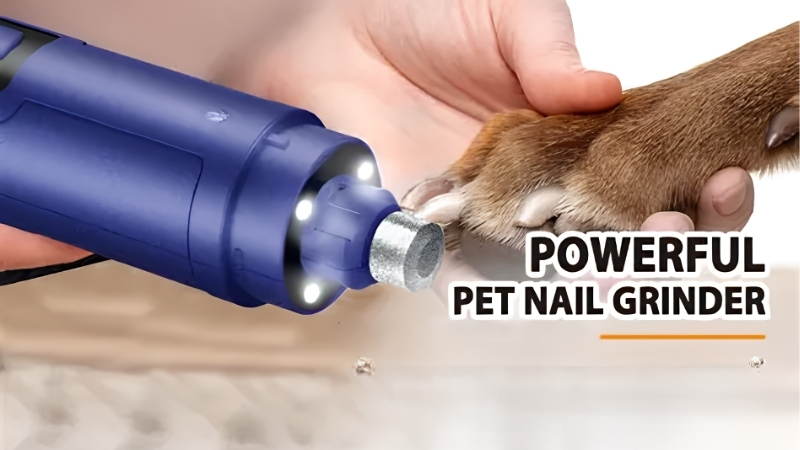
Noise is the number-one reason dogs resist a grinder, more than the sensation itself. Look for products specifically marketed as low-noise or whisper-quiet, and check owner reviews for mentions of the actual sound level rather than trusting marketing copy alone.
Vibration matters almost as much as noise for anxious dogs. Brushless motors tend to run smoother with less vibration than older brushed-motor designs, which is worth checking in the product description. A dog who tolerates the sound fine but pulls away from the vibration needs a different fix than one who’s purely sound-sensitive.
Speed Range and Adjustability
Multiple speed settings let you start slow while your dog acclimates and increase power only once they’re comfortable. A grinder with six speed levels offers more gradual acclimation than a basic two-speed model, especially for a fearful dog.
Higher RPM ranges cut down grinding time on thick nails but tend to run louder, so there’s a real trade-off between speed and the low-noise quality anxious dogs need most. Matching the speed to your dog’s specific comfort level, rather than defaulting to the highest setting, is what actually makes a session go smoothly.
Battery Life and Charging
Cordless, rechargeable models are far easier to maneuver around paws than corded tools, but battery life varies significantly between models, so check the stated run time per charge against how many dogs or sessions you’ll realistically need.
A dust cap or debris catcher is a small feature that makes a real difference for at-home use, since it keeps ground nail dust from scattering across your grooming area. It’s a small detail, but it’s one of the practical things that separates the best dog nail grinder picks from a bare-bones tool.
Top Picks: Best Dog Nail Grinder for Every Situation
These five grinders cover the range from budget-friendly beginner tools to a professional-grade option for large breeds with thick nails.
| Product | Speed Range | Best For | Power Source |
|---|---|---|---|
| Dremel PawControl 7760-PGK | ~8,000-25,000 RPM (4 speeds) | Large breeds, thick nails | Cordless rechargeable |
| Casfuy 6-Speed Dog Nail Grinder | ~7,000-12,000 RPM (6 speeds) | Gradual acclimation | Cordless rechargeable |
| LuckyTail Pet Nail Grinder | 2 speeds | Nervous, noise-sensitive dogs | USB rechargeable |
| Dremel 7350-PET | Multiple (compact) | General at-home use | Corded/cordless per model |
| 2-in-1 Grinder & Clipper with Catcher | Low-noise grind + clip combo | Simplicity, debris control | USB rechargeable |
Dremel PawControl 7760-PGK
Dremel’s PawControl offers four speed settings ranging from roughly 8,000 to 25,000 RPM, cordless operation, and a safety guard with multiple port sizes to help position nails correctly. It’s the most powerful option here, built for medium to large dogs and thick nails, and consistently ranked among the best dog nail grinder picks for that specific use case.
That power comes with more noise than the quieter, gentler-focused models on this list, so it may not be the best starting point for an especially fearful or noise-sensitive dog.
Casfuy 6-Speed Dog Nail Grinder
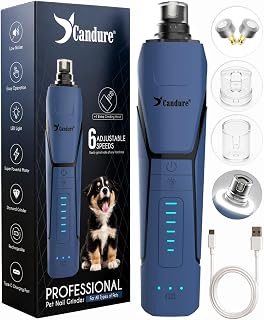
Casfuy’s six speed settings run roughly 7,000 to 12,000 RPM, giving you room to start low for acclimation and increase gradually. Dual LED lights illuminate the nail as you work, which helps avoid grinding too far, and it’s widely reported as one of the quieter options in its price range.
Battery life varies by version and reported use, so treat any specific runtime claim as approximate rather than guaranteed, and keep the charger accessible for a longer session with multiple dogs. Its six-speed range makes it one of the more flexible entries among the best dog nail grinder options for households with more than one dog.
LuckyTail Pet Nail Grinder
Built specifically around low vibration and quiet operation, this cordless, USB-rechargeable grinder includes two LED lights and two speed settings, making it a straightforward option for owners just starting to introduce grinding to a nervous dog.
Two speeds is less range than the six-speed models here, so it offers less fine-tuning for dogs with a wide range of nail thicknesses across their paws. It’s a sensible starting point specifically for a dog who has never tolerated any nail tool well before.
Dremel 7350-PET
This is Dremel’s quieter, more compact option compared to the PawControl, with versatile speed settings aimed at general at-home use rather than heavy-duty professional grooming.
It has less raw grinding power than the PawControl 7760 series, so very thick nails on large breeds may take noticeably longer to grind down. For small to medium dogs with average nail thickness, though, that’s rarely a practical downside in day-to-day use.
2-in-1 Dog Nail Grinder & Clippers with Catcher
This hybrid tool combines a grinder with a built-in clipper and a debris catcher, letting you clip the bulk of the nail first and grind the edges smooth afterward. Dual LED quick-sensor lighting and low-noise operation round out the feature set.
Combining two tools in one keeps things simple, but it also means neither function is quite as specialized as a dedicated clipper or a dedicated high-power grinder would be on its own.
Frequently Asked Questions
Here’s what owners ask most before buying one of the best dog nail grinder options for the first time.
Will my dog tolerate a grinder better than clippers?
It depends on the individual dog. Some dogs find the vibration and sound more stressful than a quick clip, while others tolerate gradual grinding better than the sudden pressure of a clipper. If your dog has never experienced either, introduce the grinder slowly and reward calm behavior before running it near their paws.
How do I introduce a nail grinder to a nervous dog?
Let your dog sniff and investigate the tool while it’s off first, then turn it on nearby without touching their paws so they get used to the sound. Only progress to touching a nail once they’re relaxed around the noise, and keep sessions short at first. Ending each session on a calm note, even if you’ve only done one nail, builds trust faster than pushing through all four paws.
Can I use a dog nail grinder on a cat?
Some grinders are marketed for both, but cats generally tolerate the vibration and noise less than dogs do, and their nails are thinner and more delicate. If you’re grinding a cat’s nails, start on the lowest speed setting and go especially slowly.
How long does grinding take compared to clipping?
Grinding each nail down to length typically takes longer per nail than a single clip, since it’s a gradual process. Most full sessions take longer overall than clipping, but many owners find the trade-off worthwhile for a calmer, more controlled trim.
See More:
- Dog shampoo best
- Best dog toenail clippers
- Best dog toe nail clippers
- Best rated dog nail clippers
- Dog claw clippers best
Final Thoughts
The best dog nail grinder for your dog is the one they’ll actually sit still for — which usually means prioritizing low noise and adjustable speed over raw power. Start slow, use the lowest comfortable speed setting while your dog adjusts, and keep styptic powder nearby just in case, even though grinding lowers the risk of hitting the quick compared to clipping.

Write Your Review
No reviews yet. Be the first to share your experience!