

Best dog grooming clipper searches almost always end in the same trap: a cheap kit that stalls halfway through a double coat and leaves tram lines behind. Motor type, blade system, and how hot the head runs matter far more than the accessory count, so this guide compares five machines on exactly those points.
As an Amazon Associate we earn from qualifying purchases.
Best Dog Grooming Clipper: What Actually Matters
Choosing the best dog grooming clipper comes down to three practical questions rather than a spec sheet. How much motor you genuinely need for your dog’s coat, which blade system you are willing to buy into long term, and how much heat and noise the dog in front of you will tolerate before the session falls apart.
Motor Power and Coat Density
Rotary motors deliver steady torque and cope with the dense, wiry, or matted coats that stall smaller machines. They are the standard choice for anyone clipping a doodle, a spaniel, or a heavily coated terrier, and the extra power means the blade keeps cutting instead of dragging hair through the teeth.
Lighter magnetic and pivot motors are quieter and easier on the wrist, which suits smooth-coated dogs and tidy-up work around the face, feet, and sanitary areas. Ask one to clear a thick winter coat, though, and it will bog down, overheat, and leave the uneven finish that puts owners off clipping at home.
Detachable Versus Adjustable Blades
Detachable blade systems, the type used on most professional machines, let you swap between numbered blades in seconds and replace only the blade that has gone blunt. The catch is cost, because each blade is bought separately and a working set adds up surprisingly quickly over the first year of grooming at home.
Adjustable five-in-one blades cover a range of lengths from a single unit, which keeps the initial outlay down and suits owners who only clip one dog. They are less flexible than a full blade set, and when the single blade finally dulls you are replacing the one component the whole machine actually relies on.
Heat, Noise and Nervous Dogs
Blades heat up faster than most first-time users expect, and a hot blade is the quickest way to teach a dog that clippers are unpleasant. Ceramic cutting edges run cooler than all-steel ones, and stopping to test the blade against your forearm every few minutes is a habit worth building in from the first session.
Noise and vibration matter just as much for anxious dogs. Powerful corded machines are the loudest on this list, so if your dog already dislikes the hairdryer it is worth trading some raw power for a quieter cordless model and accepting that dense coats will simply take a good deal longer to work through.
Five Options for the Best Dog Grooming Clipper
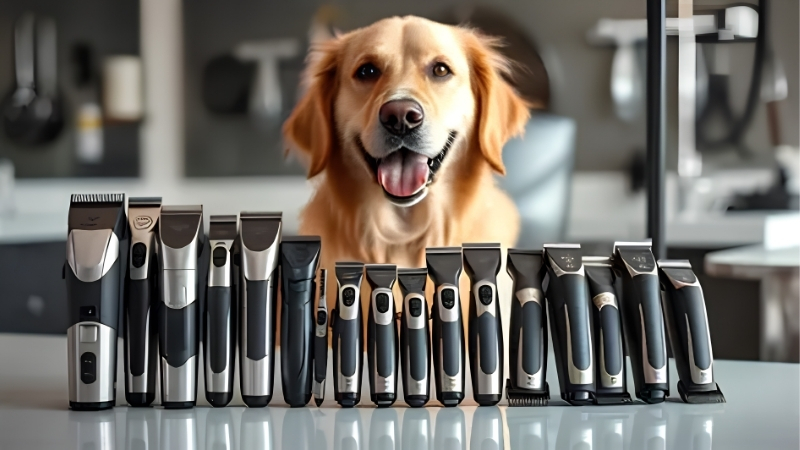
The five machines below span home kits to professional workhorses, because the best dog grooming clipper for a smooth-coated whippet is nothing like the right answer for a matted doodle. Each entry covers what it handles comfortably, who it suits, and the one drawback that is worth knowing before you buy.
| Clipper | Power | Best for | Drawback |
|---|---|---|---|
| Wahl Lithium Pro | Cordless | Home use | Stalls on matts |
| Andis AGC2 | Corded | Dense coats | Blades cost extra |
| Wahl Bravura | Cordless | Finishing work | Struggles with density |
| Oster A5 Turbo | Corded | Heavy-duty work | Loud and heavy |
| Oneisall | Cordless | Nervous dogs | Limited power |
Wahl Lithium Ion Pro Series
For most owners clipping one dog at home, this cordless kit is the sensible starting point. It arrives with a set of guide combs, runs quietly enough that a moderately confident dog will settle, and holds a charge long enough to get through a full groom on a small or medium coat without stopping for a recharge.
Its limits show the moment density increases. On a thick double coat or anything approaching a matt it slows noticeably, and the plastic guide combs flex under pressure, which makes a consistent length harder to hold. Treat it as a maintenance clipper rather than a machine for serious full de-coating work.
Andis ProClip AGC2
This is the corded machine most grooming courses recommend, and the reason is consistency. The two-speed rotary motor does not bog down in dense coats, the detachable blade system takes the full range of numbered blades, and it keeps cutting at the same rate whether you are ten minutes or two hours in.
Buying into it costs more than the sticker suggests, because blades are sold separately and a usable set is a genuine investment. It is also corded, which means managing a lead around a moving dog, and the head warms up over long sessions, so regular blade breaks quickly become part of the working routine.
Wahl Bravura Lithium
The Bravura pairs cordless freedom with an adjustable five-in-one blade, so you can move between several lengths without stopping to swap hardware. It is light in the hand, comfortable for detailed work around faces and feet, and quiet enough that most nervous dogs will generally tolerate it well enough.
Density is where it runs out of ideas. Thick, wiry, or slightly matted coats slow it down, and because everything depends on that single adjustable blade, wear shows up as a noticeably worse cut across every length. Owners of heavily coated breeds usually end up buying a stronger machine to sit alongside it.
Oster A5 Turbo
The A5 has been on grooming tables for decades because it simply keeps going. Torque is its whole personality: thick coats, dense undercoat, and long sessions barely register, and the detachable blade system means you can drop straight into whichever numbered blade the job in front of you happens to call for.
It is also the loudest and heaviest option here, with vibration that anxious dogs tend to notice immediately and that tires the wrist on a long groom. If your dog is sound-sensitive, or you are clipping a small breed on your lap, this machine is considerably more power than the situation actually needs.
Oneisall Low Noise
Sold specifically at nervous dogs and first-time owners, this budget cordless option runs quietly and vibrates very little, which makes it far easier to introduce to a puppy. For small dogs, tidy-up work, and paw pads between full grooms, it does a perfectly reasonable job for the money you are spending.
Cutting power is the obvious compromise here. Anything thicker than a light coat causes it to slow down and pull, the supplied blade dulls noticeably faster than professional equivalents, and it is simply not a machine to buy if a full-body clip on a dense double coat is the actual job in front of you.
Best Dog Grooming Clipper: Before You Buy
Most buying regret in this category comes down to three questions people only think to ask after the first groom goes badly. The answers below cover blade numbering, whether corded is still worth considering, and how often blades genuinely need sharpening or replacing on a typical home grooming setup.
What do blade numbers mean?
Higher numbers cut shorter, so a number ten blade leaves considerably less coat behind than a number four. Guide combs clip over the blade itself to leave more length, which is how most owners get a longer, softer finish without having to buy a separate blade for every possible length they might want.
Is corded still worth buying?
For dense coats, yes. Corded machines deliver genuinely constant power and never fade partway through a groom, which is exactly why professionals still keep one on the table. Cordless suits smaller dogs, finishing work, and anyone whose dog will not tolerate a lead trailing around the room during a groom.
How often to sharpen blades?
It depends on hours of use rather than the calendar, but a blade that pulls, leaves lines, or heats up unusually fast is telling you it needs attention. Oiling before and during every session extends the interval considerably, and even the best dog grooming clipper cuts poorly on a badly neglected blade.
See More:
- Best dog shampoo smell
- Best scented dog shampoo
- Best smelling dog shampoo
- Best dog shampoo that smells good
Final Thoughts on Clippers That Last
The best dog grooming clipper is the one matched to your dog’s coat density rather than the one with the longest accessory list on the box. Be honest about how thick the coat really is, budget for blades as well as the machine, and keep them oiled, because maintenance decides how long any clipper lasts.
